

A 1:100 leverage prop firm lets you control a $100,000 position with roughly $1,000 in margin, which suits scalpers and intraday traders who use tight stops and need capital efficiency, not swing traders holding wide stops through overnight risk. It works well when your position sizing already respects the firm's drawdown limits. It becomes dangerous fast when a trader treats the ratio as free money instead of a tool that needs matching risk controls, stop discipline, and a plan for how a firm's rules interact with it.
TL;DR:
- Most prop firms limit maximum position sizes through notional caps and asset-specific leverage constraints, reducing effective buying power below advertised ratios.
- Margin requirements depend on position size, with a standard lot at 1:100 leverage needing about 1% of the notional in margin, regardless of account balance.
- High leverage increases risk when drawdown rules are fixed or trailing, as rapid adverse moves can quickly exhaust your risk cushion.
- Effective use of 1:100 leverage requires tight stops and a risk management plan aligned with your trading style, especially for scalping or intraday strategies.
- Most traders lose accounts by risking too much relative to their stop-loss and ignoring drawdown limits, not because of the leverage ratio itself.
Table of Contents
- What 1:100 Leverage Actually Means for Your Prop Account
- The Position-Size Math Every Trader Should Memorize
- Why Drawdown Rules Make High Leverage Riskier Than It Looks
- Matching Your Leverage to Your Stop-Loss, Not the Other Way Around
- Safe Trading Rules to Run Under 1:100 Leverage
- The Fine Print That Changes Your Effective Leverage
- How FundedAxe Applies 1:100 Leverage in Practice
- An Editorial Take on Leverage Discipline
- Get Funded With FundedAxe's Pay After Pass Model
- Sources
- FAQ
What 1:100 Leverage Actually Means for Your Prop Account
The math is simple: 1:100 leverage requires 1% margin to open a position. Put up $1,000 and you control $100,000 of notional exposure. Investopedia's margin table lays out the pattern clearly: 2% margin gets you 50:1, 1% margin gets you 100:1, and 0.5% margin stretches to 200:1. Lower margin requirement, higher leverage, bigger swings in both directions.
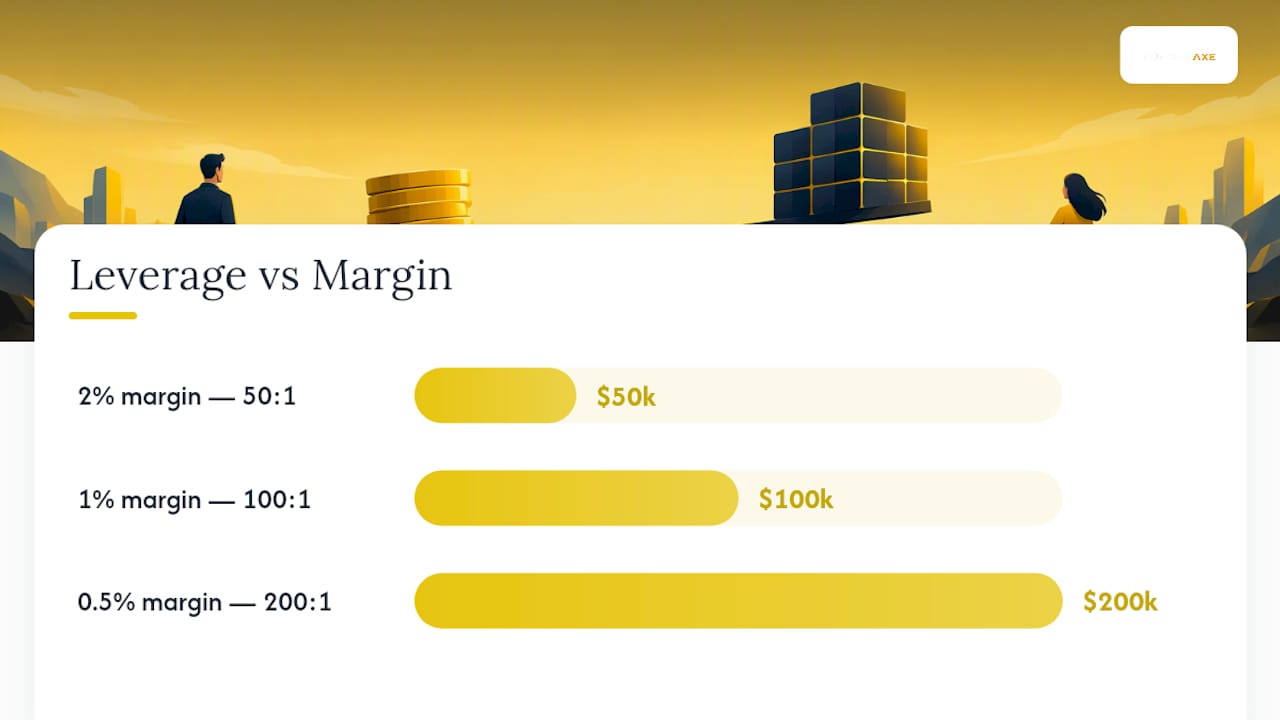
Here's where prop traders get tripped up. The headline account size, say a $100,000 evaluation, is not the same thing as your buying power, and it's definitely not the same as the capital you can actually lose before the firm shuts the account down. Buying power comes from the leverage ratio applied to your balance. Your true expendable risk comes from the drawdown limit, which is almost always a much smaller number than your notional exposure.
Prop firms rarely hand you the full 1:100 without strings attached. Common constraints include:
- Per-asset sub-leverage, where indices, metals, or crypto get a fraction of the forex ratio
- Notional caps that limit how large a single position can grow regardless of your account size
- Maximum lot limits per trade or per symbol, often tightened around high-impact news
- Reduced leverage on illiquid pairs where spreads widen and slippage risk climbs
None of this is unusual. PropFirmCircle's breakdown of leverage tiers points out that the advertised ratio is a ceiling, not a guarantee, and the real constraint on most accounts is the drawdown rule sitting underneath it.
The Position-Size Math Every Trader Should Memorize
Margin required per lot follows one formula: (Lot size × contract size × price) ÷ leverage = margin required. For a standard forex lot (100,000 units) at 1:100, you need 1% of the notional value in margin, regardless of the pair's price, because the leverage ratio does the scaling.
Pip value follows a separate, simpler rule for most USD-quoted pairs: one standard lot moves roughly $10 per pip, one mini lot (10,000 units) moves about $1 per pip, and one micro lot (1,000 units) moves about $0.10 per pip.
Here's how that plays out across three common headline account sizes at 1:100:
- $10,000 account: One standard lot needs about $1,000 margin, which is 10% of your balance tied up in a single position. A 20-pip stop costs you $200, or 2% of the account.
- $50,000 account: One standard lot needs the same $1,000 margin, now just 2% of balance. You could reasonably run three to four standard lots before margin use gets uncomfortable.
- $100,000 account: One standard lot at $1,000 margin is 1% of balance. This is the size range where 1:100 starts feeling generous, because your margin usage stays low even with several concurrent positions.
The pattern to remember: margin required scales with the position, not the account size. What changes as your headline balance grows is how much of your capital that margin consumes, and therefore how much room you have before a drawdown rule gets triggered.
To recalculate for any account size: divide your target position's notional value by 100, compare that margin figure to your account balance as a percentage, then check that figure against the firm's maximum drawdown before you click buy.
Why Drawdown Rules Make High Leverage Riskier Than It Looks
Leverage decides how big your position can be. Drawdown rules decide how much room you have to be wrong. The two interact in ways that catch new prop traders off guard.
Static drawdown measures your loss against the initial balance and never moves. Trailing drawdown ratchets up as your equity climbs, cutting your cushion the moment you're in profit. Daily drawdown caps how much you can lose in a single session, independent of the overall limit.
Open three standard lots at 1:100 (roughly $3,000 in margin) on a pair moving 15 pips against you. At $10 per pip per lot, that's $450 in losses. Stack a fast 50 pip move, the kind that happens in seconds during a news spike, and three lots lose $1,500, more than half your daily allowance, in the time it takes to read this sentence.
- Static drawdown: fixed against starting balance, easiest to plan around
- Trailing drawdown: shrinks your buffer as profits grow, punishes overconfidence
- Daily drawdown: resets each session but ends your day (or your account) fast if ignored
- Revenge trading after a loss, combined with 1:100 sizing, is how disciplined traders blow accounts they were otherwise passing
Pro Tip: Check whether your firm uses static or trailing drawdown before you size a single trade. The same stop-loss can be perfectly safe under one rule and account-ending under the other.
Matching Your Leverage to Your Stop-Loss, Not the Other Way Around
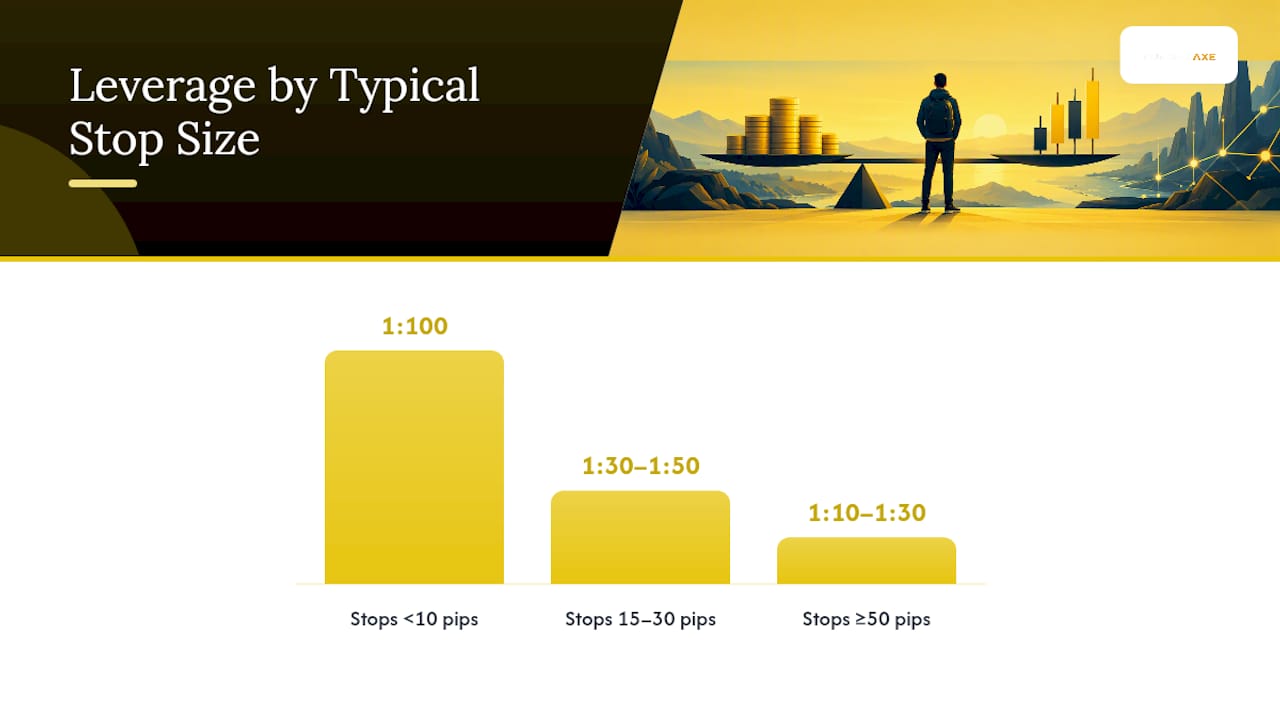
Leverage should follow your strategy, not define it. The size of your typical stop-loss is the single best predictor of how much leverage you actually need, and most traders have this backwards.
A useful rule of thumb, drawn from how pip risk scales against position size:
- Stops under 10 pips (scalping, tight intraday setups) pair naturally with 1:100, because tight stops keep dollar risk low even on large notional positions
- Stops in the 15 to 30 pip range fit better with 1:30 to 1:50, since wider stops on 1:100 sizing can eat drawdown fast
- Stops of 50 pips or more (swing trades, position trades) call for 1:10 to 1:30, where the leverage ratio stops amplifying every adverse tick into a meaningful account hit
Scalpers and high-frequency intraday traders are the clearest fit for 1:100. Their edge depends on capturing small moves with tight stops across many trades, and low margin requirements let them stay diversified across setups instead of concentrating risk in one oversized position. SpiceProp's argument for treating 1:100 as a diversification tool rather than a size multiplier lines up with this: the ratio works best when it spreads exposure thin across several small, independent bets, not when it's used to load up on one trade.
Swing traders holding positions overnight or across days generally do not need 1:100. Wider stops already carry more pip risk, and stacking high leverage on top just accelerates how fast a normal adverse swing eats into drawdown.
Ask yourself these questions before opting into the highest leverage tier a firm offers:
- Does my average stop-loss sit under 15 pips on the pairs I actually trade?
- Do I hold positions for minutes or hours, not days?
- Can I point to a backtested win rate that justifies frequent small-margin trades?
- Have I ever blown a demo account by oversizing after a loss?
Pro Tip: If you answered "no" to the first two questions, 1:100 probably isn't buying you anything useful. It's just adding risk you don't need given the style you actually trade.
Safe Trading Rules to Run Under 1:100 Leverage
Cap risk per trade at 0.25% to 1% of your headline balance, then work backward to figure out your maximum lot size. On a $100,000 account with a 0.5% per-trade cap, that's $500 of risk, which at $10 per pip per standard lot means roughly a 5 pip cushion per lot, or scale down lot size if your stop is wider.
- Set your stop-loss before you enter, sized to the cap above, never after watching the trade move against you.
- Calculate your maximum position size from your drawdown limit divided by your typical stop distance, not from how much margin the leverage ratio technically allows.
- Reduce position size or step away entirely around high-impact news releases and thin overnight liquidity, where spreads widen and stops slip.
- Run your sizing plan on a demo or free trial account before committing challenge fees, so the math gets tested with zero financial downside.
Pro Tip: Build a small grid before you trade: lot size across the top, pip move down the side, dollar loss and percent-of-drawdown in each cell. Glancing at that grid for ten seconds beats guessing under pressure.
The Fine Print That Changes Your Effective Leverage
The advertised 1:100 rarely applies uniformly across every instrument. Notional caps often limit how large a position can get even when your account technically qualifies for more, which means your effective buying power on a big trade can be lower than the ratio suggests.
Gold, major indices, and crypto pairs typically carry different sub-leverage than standard forex majors. Kraken's own leverage announcement for its prop product shows how quickly these numbers move, with leverage on Bitcoin, the Nasdaq 100, and the S&P 500 raised in 2026, proof that instrument-specific caps change independent of a firm's headline forex ratio.
Before trusting an advertised number, check:
- Whether gold, indices, or crypto carry a lower leverage tier than currency pairs
- Whether there's a notional cap that kicks in above a certain position size, regardless of your account balance
- Whether swap fees apply to overnight positions, or whether a swap-free option is available for traders who need it
- Maximum lot limits per order or per symbol, which can force you to split a position across multiple tickets
None of this is unique to any single firm. It's a structural feature of how leverage products get priced and risk-managed across the industry, and it's worth five minutes of reading before you fund an evaluation.
How FundedAxe Applies 1:100 Leverage in Practice
The firm runs simulated funded accounts on MetaTrader 5, with leverage up to 1:100 built into the evaluation and funded phases. The flagship product, Pay After Pass, lets a trader start an evaluation for $9.99 and only pay the remaining challenge fee after actually passing, instead of risking the full fee upfront on an unproven sizing plan.
Account structure is flexible: 1-step, 2-step, or 3-step evaluations, with no time limit on any phase and no minimum trading days.
Beyond Pay After Pass, the firm offers upfront challenges with fee refunds on the second reward, instant funding accounts without evaluation, a free simulated trial account, a loyalty program, and an affiliate program. All evaluations and funded accounts are simulated: traders never risk real client capital, though rewards are paid in real money based on simulated performance under the trader agreement.
An Editorial Take on Leverage Discipline
Most traders don't lose accounts because 1:100 is too much leverage. They lose because they size positions off the leverage ratio instead of off the drawdown limit, then double down after a bad session. Use 1:100 when your stops are tight and your edge is tested. Avoid it if you're still finding your strategy on wide stops.
Three habits matter more than any indicator: cap risk per trade before you enter, honor your stop without exception, and never add size to chase back a loss. Test your sizing plan on a demo or FundedAxe's Free1K trial before a challenge fee is on the line.
— Jean
Get Funded With FundedAxe's Pay After Pass Model
Fundedaxe removes the biggest financial risk in prop trading: paying full price for an evaluation before you know if your sizing plan actually holds up. Pay After Pass starts at $9.99 upfront, with the remaining challenge fee due only once you pass, so a trader testing 1:100 sizing isn't gambling a full fee on an untested plan.

Account sizes run up to $400,000 across 1-step, 2-step, and 3-step evaluations, and every account carries static drawdown rules rather than a trailing structure that punishes early profit. News trading, weekend holding, and EA use are all permitted, which matters if your strategy at 1:100 depends on automation or holding through volatility windows.
Want to test your position-sizing math before spending a cent? Start with the free Free1K simulated trial account, then compare account sizes on the package comparison page when you're ready to fund a real evaluation.
Sources
- How Leverage Works in the Forex Market — Investopedia
- Prop Firm Leverage Explained: The 2026 Ultimate Guide (1:10 vs 1:100) | PropFirmCircle
This article is general information, not a substitute for advice from a qualified financial advisor. Consult a qualified financial professional about your own circumstances before acting on anything here.
FAQ
Is 1:100 Leverage a Lot?
It's moderate by industry standards. Many retail brokers and prop firms offer ranges between 1:30 and 1:100, and 1:100 sits at the higher end without reaching the extreme ratios some offshore brokers advertise. Whether it's "a lot" for you depends entirely on your stop-loss size and position sizing discipline, not the ratio itself.
Which Broker Has 1:1000 Leverage?
Some offshore retail brokers advertise very high leverage ratios, but those figures are rarely usable in practice because drawdown and margin call rules limit real exposure long before the ratio itself becomes relevant. Prop firms, including Fundedaxe, generally cap leverage at 1:100, specifically because tighter ratios pair better with fixed drawdown limits.
Which Prop Firm Gives the Highest Leverage?
Advertised leverage varies across the industry, with some firms marketing figures above 1:100 for certain account types. The advertised number matters less than how it interacts with a firm's drawdown rules and per-asset caps, since a high ratio paired with a tight trailing drawdown can be riskier than a lower ratio under static rules. Fundedaxe offers leverage up to 1:100 across its evaluation and funded accounts, combined with static drawdown for predictable risk boundaries.
Is 1:2000 Leverage Good for a Beginner?
No. A ratio that high magnifies both gains and losses to a degree that leaves almost no room for error, and most prop firm drawdown rules would end an evaluation within a handful of pips at that exposure.
What Does It Cost to Start a Prop Challenge With Fundedaxe?
Fundedaxe's Pay After Pass model starts at $9.99 upfront, with the remaining base fee of $515.01 due only after passing the evaluation. Traditional upfront packages and Instant Funding accounts are priced separately on the package comparison page.