
1:100 leverage means your broker lets you control 100 times your margin, so you only need to put up 1% of a trade's full value. Put $1,000 into your account, and that $1,000 can open a $100,000 position. The catch: your profits and losses are still calculated on the full $100,000, not the $1,000 you actually deposited, so every pip move swings your account by the same dollar amount it would on a fully funded trade.
TL;DR:
- Using 1:100 leverage requires careful position sizing, preferably limiting exposure to around 1:10 or 1:20 to prevent quick account wipeouts.
- A standard lot at 1:100 leverage needs $1,000 margin, while a micro lot only requires $10, making smaller trades safer for small accounts.
- A 30 pip loss on a full standard lot can wipe out a $1,000 account, highlighting the importance of effective stop-loss placement and risk management.
- Raising leverage to 1:500 reduces margin requirements but increases temptation to take oversized positions beyond safe limits.
- Practicing with simulated accounts helps traders understand margin mechanics and risk management rules without risking real capital.
Table of Contents
- What Is 1:100 Leverage in Forex, and How Does the Math Work?
- Worked Examples: Lot Sizes and Pip Value at 1:100
- How 1:100 Leverage Actually Changes Your Risk
- Position Sizing Rules That Keep 1:100 Leverage Safe
- 1:100 vs. Higher Leverage: What Actually Changes
- Why I Think Simulated Accounts Are the Right Place to Learn This
- Practice 1:100 Leverage on a Simulated Funded Account
- Sources
What Is 1:100 Leverage in Forex, and How Does the Math Work?
Every leveraged trade starts with one formula: required margin equals position size divided by leverage. Open a standard lot ($100,000 notional) at 1:100, and your broker locks up $1,000 as collateral, since 1% of $100,000 is $1,000. That locked amount is your used margin. Whatever is left in your account after that is your free margin, the cash available to open new positions or absorb losses.
The number that actually keeps you in the game is margin level, calculated as equity divided by used margin, times 100%. Equity is your account balance adjusted for open profit or loss in real time.
- 100% used margin utilization means you have exactly enough to hold your current trades and nothing more.
- Most brokers issue a margin call somewhere around 100% margin level, warning you that losses are eating into your buffer.
- A stop-out, where the broker force-closes positions automatically, typically kicks in between 20% and 50% margin level depending on the broker.
Once you're near that stop-out zone, the platform starts closing trades on its own, starting with the biggest losers, until your margin level climbs back to safety. That's not a penalty. It's the mechanism that keeps your account from going negative.
Worked Examples: Lot Sizes and Pip Value at 1:100
Numbers make this concrete faster than any explanation does. Here's how a $1,000 account actually behaves at 1:100 leverage.
- A standard lot is out of reach. At 1:100, a full $100,000 position needs $1,000 in margin, meaning your entire account balance would be tied up with zero buffer for drawdown. That's not a trade; that's a coin flip.
- A mini lot (0.10) is more realistic. A $10,000 position needs just $100 in margin, leaving $900 free. Each pip on a mini lot in a major USD pair is worth roughly $1, so a 20 pip stop costs you about $20, or 2% of your account.
- A micro lot (0.01) is where most beginners should start. A $1,000 position needs only $10 in margin. Pip value drops to about $0.10, so even a rough 50 pip stop only costs $5.
Compare that same $100,000 position at 1:500 instead of 1:100, and the margin required drops to just $200 instead of $1,000. That's the entire effect of higher leverage: it frees up capital by shrinking the margin requirement. Your pip value on a standard lot is still $10 either way, because leverage never touches how much a pip is worth. It only touches how much cash the broker locks up to let you hold the trade.
How 1:100 Leverage Actually Changes Your Risk
Leverage doesn't create risk out of nothing. It gives you access to position sizes your account balance couldn't otherwise support, and that access is where the risk lives.
- A 0.10 lot losing 30 pips costs about $30, regardless of whether you're trading at 1:50, 1:100, or 1:500.
- A 1.00 lot losing that same 30 pips costs about $300, which is 30% of a $1,000 account.
- Leverage decides whether your account balance is even large enough to legally open that 1.00 lot in the first place.
Statistic Callout: The Math Behind a Wipeout With 1:100 leverage on a $1,000 account holding a full standard lot ($10 per pip), it takes only around 100 pips against you to erase the entire account. On a major pair, such loss can occur quickly during periods of high volatility. This is exactly the scenario margin level monitoring is designed to catch before the balance hits zero.
That single number should reframe how you think about lot size. The leverage ratio determines what you're allowed to open. Your stop-loss distance and lot size determine what you actually stand to lose.
Position Sizing Rules That Keep 1:100 Leverage Safe
Having access to 1:100 doesn't mean you should use anywhere near all of it. Here's a simple sequence to run before every trade.
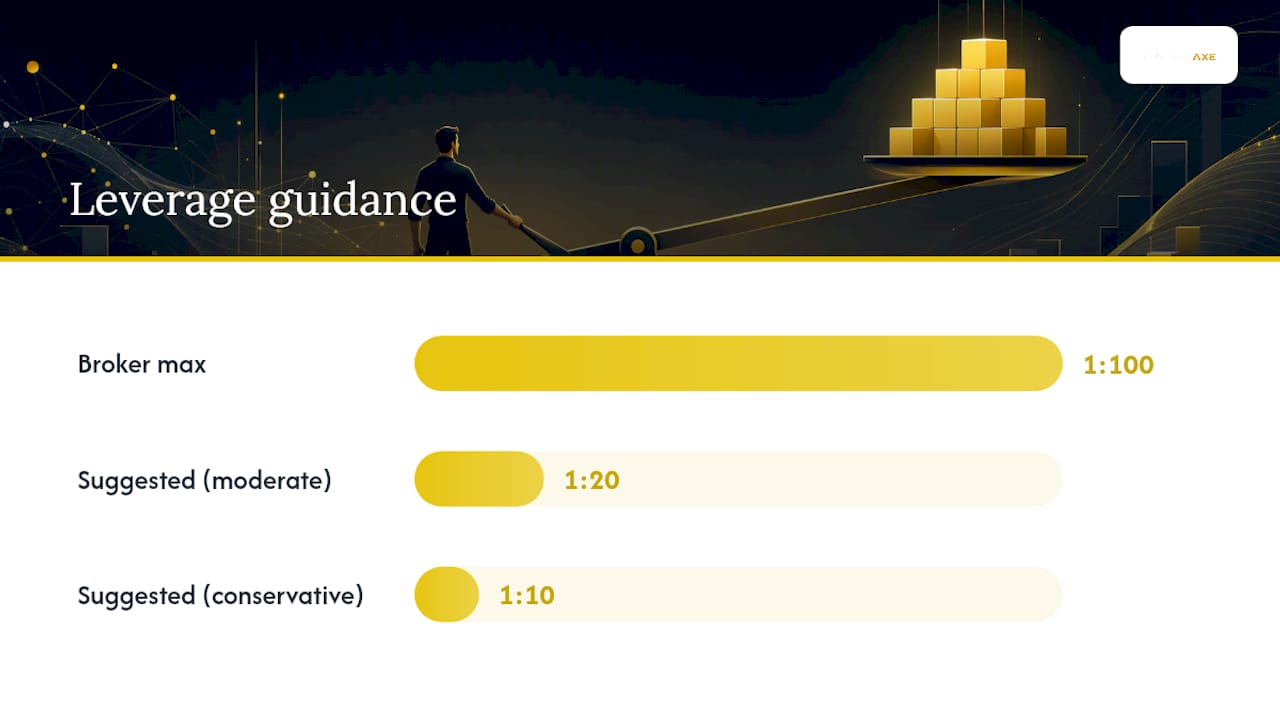
- Set your effective leverage target first. Even with 1:100 available, aim to keep your actual exposure closer to 1:10 or 1:20. The broker's maximum is a ceiling, not a goal.
- Apply the 1% risk rule. Risk no more than 1% of account equity on a single trade. On a $5,000 account, that's $50 of risk per position, no matter how the position is structured.
- Work backward to lot size. Divide your dollar risk by your stop distance in pips to find the pip value you can afford, then size your lot to match. A $50 risk with a 50 pip stop means you need roughly $1 per pip, which lands you close to a 0.10 lot.
- Run the checklist before you click buy. Confirm required margin, confirm your stop-loss is placed, confirm the risk percentage matches your rule, and confirm your free margin can absorb a losing streak.
Pro Tip: Calculate your position size before you look at the chart, not after. Deciding your risk first keeps a strong setup from tempting you into oversizing the trade.
The 1% rule sounds restrictive to new traders, but it's the same discipline that lets professionals survive long losing streaks without blowing up an account. For a deeper breakdown of how to size positions on a funded account specifically, risk-per-trade calculations walk through the templates step by step.
1:100 vs. Higher Leverage: What Actually Changes
The biggest misconception in forex is that leverage changes how much money you make or lose per pip. It doesn't. Leverage only changes your margin requirement, the cash the broker sets aside to hold the position open.
- At 1:100, a $100,000 position needs $1,000 in margin. At 1:500, that same position needs only $200.
- Pip value on that position stays identical at either ratio, since pip value is a function of lot size, not leverage.
- The real danger of 1:500 is that the freed-up margin tempts traders into opening larger positions than their account can safely absorb.
- Regulatory caps on leverage vary significantly by region and broker jurisdiction, so always confirm what your specific account allows before assuming a number.
Why I Think Simulated Accounts Are the Right Place to Learn This
Reading about margin calls and reading a margin call hit your own equity are two different educations. Simulated funded accounts with leverage up to 1:100, including pay-after-pass style evaluations, let you test every formula in this article against real market conditions without your own capital sitting on the line as collateral. Run the lot size math, watch your simulated margin level move, and let a mistake teach you something before it costs you anything real.
— Jean
Practice 1:100 Leverage on a Simulated Funded Account
There are ways to apply everything above without funding a live account first. Pay After Pass evaluations start for a small upfront fee, with the rest of the challenge fee due only if you pass, and simulated funded accounts scale up to large sizes with leverage up to 1:100.

Running the margin math in a live account is stressful precisely because a bad calculation costs you real cash immediately. A simulated evaluation strips that pressure out while keeping the position sizing, stop placement, and margin level tracking exactly as they'd behave on a funded account. You get to internalize the 1% risk rule and the margin call thresholds covered here before they matter for real money. For a closer look at how leverage rules apply inside Fundedaxe's evaluations specifically, the prop firm leverage breakdown covers the account mechanics in more depth. If you're ready to test your own numbers, start a simulated evaluation and see how your position sizing holds up under real market movement.