

Most prop firms cap position size somewhere between 4 contracts on a $25,000 account and 15 or more contracts on $100,000, with forex accounts typically capped around 50 lots per instrument category. Firms enforce these caps two ways: per-ticket limits on a single order, or aggregate limits across all open positions in a category. The takeaway is simple: pull up your firm's actual rules page, then size every trade against your drawdown limit, not against the cap itself.
TL;DR:
- Prop firms typically cap futures accounts at 4 to 15 contracts depending on size, and forex accounts at around 50 lots per instrument category, with rules often varying by firm and instrument.
- During evaluation phases, traders usually face half-position limits, which then expand to full caps upon funding or reaching certain milestones, emphasizing the importance of testing limits early.
- Converting lot caps into dollar risk requires multiplying position size by dollar per point and stop distance, with micro lots essential for small accounts to maintain manageable risk.
- Surpassing aggregate position limits across correlated instruments often leads to order rejection or automatic size reduction, making pre-trade category mapping critical for multi-instrument strategies.
- Checking official firm rules and testing on demo accounts are crucial steps to avoid violations, as limits vary widely and enforcement methods differ between firms and retail brokers.
Table of Contents
- What Are the Typical Max Lot Size Limits for Prop Firms by Account Tier?
- How Do Single-Ticket and Aggregate Position Limits Actually Work?
- How Do Evaluation-Phase Position Limits Differ From Funded Limits?
- How Do You Convert a Lot Cap Into Actual Risk Per Trade?
- What Do Real Position-Sizing Scenarios Look Like in Practice?
- How Do You Verify a Firm's Official Max Lot Size Rules?
- Do Prop Firms Ever Offer Exceptions to Max Lot Size Caps?
- How Do Max Lot Size Rules Differ Between Prop Firms and Retail Brokers?
- How Do Lot Size Limits Change Trading Strategy and Results?
- How Does Scaling Change Your Lot Size Cap Over Time?
- Fundedaxe's Take on Lot Limits and Flexible Sizing
- Compare Fundedaxe's Rules Before You Size Your Next Trade
- Sources
- FAQ
What Are the Typical Max Lot Size Limits for Prop Firms by Account Tier?
Caps scale with account size, but not in a straight line, and the gap between what a $25,000 account and a $200,000 account can hold often surprises traders who assume it's a simple multiple.
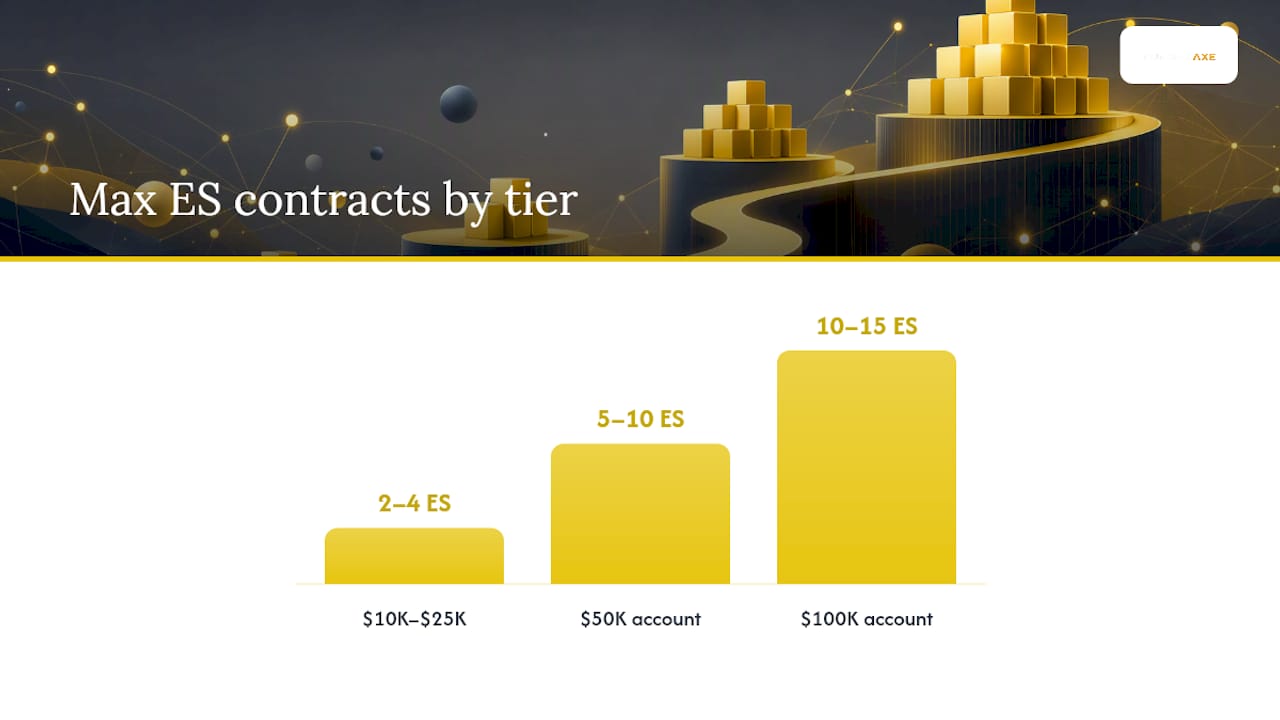
Futures-focused firms tend to publish numbers like this: a $25,000 account might allow 2 to 4 E-mini S&P (ES) contracts or 15 to 25 Micro E-mini (MES) contracts. A $50,000 account often moves to 5 to 10 ES or 25 to 50 MES. Push up to $100,000 and you're commonly looking at 10 to 15 ES or 50 to 75 MES. Most major futures prop firms cap a $50,000 account at roughly 10 contracts, with smaller accounts landing around 4 to 5 contracts and larger accounts scaling well beyond that. Position sizing guides built specifically for prop firm accounts confirm similar tier breakpoints and consistently recommend micro contracts for anything under $100,000.
Forex and CFD firms structure things differently. Instead of a contract count tied to notional value, many publish flat lot caps per instrument category regardless of account size, though larger accounts sometimes get higher ceilings as an add-on. A firm might allow up to 50 lots combined across forex and commodities, and up to 100 lots across index instruments, according to documented rules from one funded account provider. Other firms publish per-index limits, like 10 lots per index category, with combined index exposure counting toward one shared ceiling, a structure spelled out in Instant Funding's help documentation.
Here's how those tiers usually break down across the two dominant markets:
- $10K to $25K accounts: 2 to 4 ES contracts, 15 to 25 MES contracts, or roughly 5 to 15 standard forex lots depending on the firm's risk model.
- $50K accounts: 5 to 10 ES contracts, 25 to 50 MES contracts, or up to 25 to 50 forex lots per category.
- $100K accounts: 10 to 15 ES contracts, 50 to 75 MES contracts, or up to 50 lots per forex/commodity category and 100 for indices.
- $200K and above: Caps generally scale upward again, though the ratio between account size and allowed size tends to flatten rather than double every tier.
Standard forex lots and micro lots create their own confusion here. A standard lot is 100,000 units of the base currency. A micro lot is 1,000 units, or one-hundredth the size. A cap written as "50 lots" almost always means standard lots unless the firm states otherwise, so converting your intended position into standard-lot equivalents before you place a trade matters more than most traders realize.
None of these numbers are universal. Firms revise caps, add instrument-specific carve-outs, and sometimes apply different limits during evaluation versus after funding. Treat every range above as a starting orientation, then confirm the exact figure on your specific firm's rules page before you build a strategy around it. A trader who assumes their new firm mirrors the last one they traded with is the most common way accounts get flagged for rule violations that were entirely avoidable.
How Do Single-Ticket and Aggregate Position Limits Actually Work?
A single-ticket limit caps the size of one order. An aggregate limit caps your total open exposure across every position in a category, meaning several smaller trades can stack up and hit the same wall as one large one.
This distinction trips up more funded traders than any other rule in the book, mostly because the two models produce wildly different outcomes for the same trading style.
- Single-ticket limits restrict each individual order. If your cap is 10 ES contracts per ticket, you could theoretically place three separate 10-contract orders and end up holding 30 contracts, unless the firm also layers an aggregate limit on top.
- Aggregate limits cap your combined exposure across correlated instruments, not just one symbol. If your firm sets an aggregate index cap and you're holding both ES and Nasdaq (NQ) contracts at the same time, both positions typically count toward the same shared ceiling. Some firm rule pages explicitly document that combined positions across index instruments count toward one category total, as Instant Funding's published limits show.
- Mixed models combine both: a per-ticket maximum on any single order, plus a lower aggregate ceiling across all correlated positions, which is the structure most futures-focused firms actually run.
Picture a trader holding 8 ES contracts and deciding to add a 6-contract NQ position because the setups look correlated but not identical. If the firm treats index futures as one aggregate bucket capped at 12 contracts, that NQ order gets rejected outright, or trimmed automatically, the moment it would push total index exposure past the ceiling. The trader isn't violating an ES rule or an NQ rule specifically. They're violating the combined index exposure rule, and most platforms won't explain that distinction in the rejection message.
Forex traders hit a version of the same wall. A firm that caps forex and commodities at a combined 50 lots doesn't care whether you're holding EUR/USD, gold, or five different pairs simultaneously. It's tracking total exposure across the whole category, not per symbol.
If you run a multi-instrument strategy, the practical fix is to map every position you might hold simultaneously against the firm's category definitions before you trade, not after a rejected order interrupts your setup. Pull the rules page, identify which instruments the firm buckets together, and build your maximum simultaneous exposure around that bucket, not around each symbol in isolation. Traders who skip this step usually discover the aggregate rule the hard way, mid-trade, when a second position gets rejected at the worst possible moment.
How Do Evaluation-Phase Position Limits Differ From Funded Limits?
Many prop firms cap you at roughly half your published maximum during evaluation, then unlock the full cap once you clear a drawdown threshold or reach funded status. This half-position structure exists to limit the firm's exposure to traders who haven't proven consistency yet, and it catches new challenge traders off guard constantly.
The logic makes sense once you see it from the firm's side. An evaluation account hasn't demonstrated a repeatable process, so letting a trader run full size from day one creates outsized risk for the firm if that trader is still calibrating their approach. Half-position rules during evaluation are a documented pattern across futures prop firm structures, and they typically expand once the trader crosses a specific milestone, often tied to the point where the trailing or static drawdown floor locks in place.
What that expansion looks like in practice:
- During evaluation, your effective cap might sit at 50% of the account tier's published maximum.
- Once you hit the drawdown lock threshold, often after banking a set profit cushion, the cap opens to the full published number.
- After funding, some firms apply the full cap immediately, while others maintain a probationary period with reduced size for the first stretch of live-simulated trading.
- Scaling plans can raise the cap again as the account grows, separate from the initial lock threshold.
Enforcement happens at the platform level, not through a human reviewing your trades after the fact. When you submit an order that would exceed either the per-ticket or aggregate cap, the trading platform or the broker bridge behind it rejects the order before it fills. It's all or nothing at the order level, and that's worth internalizing before you're staring at a rejected trade during a fast market.
Pro Tip: Test your firm's exact evaluation-phase cap on a demo or simulated trial account before you commit challenge fees to a live evaluation. Firms rarely advertise the half-position threshold prominently, and finding out the hard way, mid-challenge, costs you both time and money.
How Do You Convert a Lot Cap Into Actual Risk Per Trade?
You convert a contract or lot cap into dollar risk by multiplying position size by the contract's dollar value per point, then multiplying that by your stop distance, and comparing the result against your firm's drawdown allowance. Skipping this math is how traders who never technically break a rule still blow through their drawdown limit.
Here's the process laid out step by step.
- Confirm your account size and the firm's published cap for your instrument. If you're trading a $50,000 futures account with a 10-contract ES cap, that number is your ceiling, not your target.
- Convert the contract or lot size into dollar value. An ES contract moves $50 per point (the multiplier is set by the exchange). A micro E-mini (MES) moves $5 per point, one-tenth the exposure. Exchange-published contract specifications are what determine these multipliers, and getting this number wrong invalidates every calculation that follows.
- Choose your stop distance, typically based on average true range (ATR) or a fixed tick count appropriate to the instrument's typical volatility on your trading timeframe.
- Calculate dollar risk: position size times dollar-per-point times stop distance in points. Compare that figure against your firm's maximum drawdown allowance, then check whether it fits comfortably inside a sensible per-trade risk percentage, generally well under the total drawdown ceiling.
Statistic to keep in view: firms that publish contract-based caps for a $100,000 account tier often set the range at 10 to 15 full ES contracts, or 50 to 75 MES contracts, according to detailed position sizing breakdowns for funded traders.
Concrete example on a $25,000 account: say your cap allows 3 ES contracts. At $50 per point and a 10-point stop, that's $1,500 of risk on a single trade, a chunk that could eat a meaningful slice of a typical drawdown limit in one trade. Switch to MES instead. At $5 per point, 3 contracts and the same 10-point stop puts risk at $150, roughly one-tenth the exposure for the same directional bet. On a $50,000 account with a 10-contract ES cap, running even half that cap (5 contracts) at a 10-point stop puts $2,500 on the line, again a substantial bite depending on your firm's total drawdown figure.
The rule of thumb that falls out of this math: smaller accounts should default to micro contracts, not because full contracts are against the rules, but because the dollar swing per point makes precise risk control nearly impossible otherwise. Micro contracts exist specifically to let traders on smaller funded accounts match position size to sensible dollar risk, and treating the published cap as a target rather than a ceiling is one of the fastest ways to blow through a drawdown limit that a smarter sizing approach would have easily respected.
What Do Real Position-Sizing Scenarios Look Like in Practice?
A $50,000 futures account holding both ES and MES at once needs to treat them as a single combined exposure pool, not two separate allowances. If your firm's aggregate index cap sits at 10 ES-equivalents, running 5 ES contracts alongside 10 MES contracts (worth 1 ES-equivalent) puts you at 6 ES-equivalents total, comfortably under the ceiling. Stack another 5 ES on top of that without accounting for the MES position already open, and you've likely triggered a rejected order or an automatic size reduction.

Forex traders on smaller accounts face a parallel situation. A $10,000 to $25,000 account with a 50-lot category cap will never realistically approach that ceiling with standard lots, since even a handful of standard lots on a small account represents dangerous leverage relative to the account's drawdown allowance. Micro lots solve this cleanly: trading 0.10 to 0.50 lots per position lets a trader diversify across two or three currency pairs while keeping total dollar risk aligned with what a $10,000 account can actually absorb without threatening the drawdown floor.
The scaling mistake shows up most often with traders who pass an evaluation, get funded, and immediately try to run the same size on their funded account that felt comfortable during a slower-paced demo. A trader who scales from 5 to 10 contracts without checking whether the funded cap actually doubled will hit a rejected order at the worst possible moment, mid-trend, when the platform blocks the add-on order instead of filling it.
A few situational risks worth flagging regardless of account size:
- Pending orders sometimes count toward your aggregate cap even before they fill, so a stack of unfilled limit orders can quietly eat into your available room.
- Weekend gaps on held positions can turn a comfortably sized trade into a drawdown-threatening one if price gaps against you at Sunday's open.
- Spike risk around news events can trigger stop-outs at prices well beyond your intended stop distance, which matters more when you're running size close to the cap rather than well under it.
How Do You Verify a Firm's Official Max Lot Size Rules?
Check the firm's own rules page or help center before you assume anything, and treat marketing copy or comparison sites as a starting point, never the final word.
Look specifically for five things: the maximum position size stated in exact contract or lot numbers, per-instrument or per-category breakdowns, any difference between evaluation-phase and funded-account limits, the enforcement method (per-ticket rejection versus aggregate exposure tracking), and the effective date of the rule, since firms revise these tables more often than traders expect.
- Confirm the max position figure on the firm's official rules or help center page, not a third-party summary.
- Check whether evaluation and funded accounts carry different caps, and by how much.
- Identify whether enforcement is per-ticket, aggregate, or both.
- Note the effective date. A rule you read in an old forum post or outdated blog comparison may no longer apply.
A free simulated trial account is the cheapest way to confirm these numbers before you pay for a challenge. Placing test orders on a no-cost trial reveals the actual enforced cap faster than reading any documentation, since some firms enforce rules slightly differently than their published tables suggest.
Pro Tip: If a firm changes its lot size rules after you've already paid for a challenge, screenshot the original rules page and save any support replies referencing the old limit. That documentation is your only leverage if a dispute comes up later.
Do Prop Firms Ever Offer Exceptions to Max Lot Size Caps?
Some firms adjust caps for traders who've built a track record, though this happens through direct conversation with the firm's support or account management team rather than through any published, guaranteed process. There's no universal industry standard for negotiated limits, and no firm advertises an automatic path to a higher cap simply based on tenure or account balance.
What does tend to move the needle is a combination of consistent profitability across multiple funded cycles, low drawdown usage relative to the allowance, and a trading style the firm's risk team can predict. A trader who's cycled through several funded periods without approaching the drawdown ceiling represents a different risk profile than someone requesting a larger cap on day one of their first funded account.
Scaling plans built into a firm's standard rule set are the more common and reliable route to higher size. Rather than negotiating an exception, most traders grow their allowed position size by hitting profit targets that trigger a formal account-size increase, which brings a higher published cap along with it. That's a structured, rules-based path rather than a discretionary one, and it's worth treating as the default expectation rather than assuming a special conversation will get you there faster.
If you believe your track record justifies a conversation about limits, the right move is contacting the firm's support directly with your account history in hand, not assuming a higher cap will be offered proactively.
How Do Max Lot Size Rules Differ Between Prop Firms and Retail Brokers?
Retail brokers generally size their limits around margin requirements and their own risk appetite as a market maker or liquidity provider, with caps that are often high enough that most retail traders never approach them. Prop firms size their limits around protecting a fixed drawdown allowance tied to simulated capital, which makes their caps considerably tighter relative to account size.
A retail broker offering $100,000 of trading capital might allow position sizes far beyond what any prop firm publishes for the same account size, because the broker's risk model centers on margin and leverage, not on protecting a specific drawdown ceiling tied to a challenge fee structure. Prop firms, by contrast, build their entire rule set around the idea that a trader could lose the account entirely if drawdown is breached, so position caps exist specifically to prevent one oversized trade from doing that in a single move.
This also explains why prop firm caps feel more rigid and less negotiable than retail broker limits. A retail broker's constraint is largely about margin math you can calculate yourself. A prop firm's constraint is a published rule enforced automatically at the platform level, often with no discretion at the point of order execution.
For traders coming from a retail background, the adjustment period usually involves unlearning position sizing habits built around margin availability and rebuilding them around drawdown-first thinking instead. Sizing a trade because you technically have the margin for it is a retail habit. Sizing a trade because it respects a fixed drawdown ceiling is the prop firm mindset, and the two produce very different position sizes on the same account balance.
How Do Lot Size Limits Change Trading Strategy and Results?
Tight position caps push traders toward strategies that don't depend on size to generate meaningful returns, which reshapes what actually works on a funded account compared to an unrestricted retail account.
Scalpers and high-frequency strategies often adapt well to lot caps because they're already working with tight stops and frequent, smaller wins rather than relying on outsized position size to make a trade worthwhile. Swing traders and trend followers sometimes struggle more, since a strategy built around holding larger size through bigger price swings runs into the drawdown ceiling faster when position size is capped below what the strategy was designed around.
The performance impact isn't automatically negative. Caps force discipline that many traders lack when left unrestricted, and traders who build their strategy around a firm's actual limits from the start, rather than trying to fit an existing retail strategy into prop firm rules after the fact, tend to adapt with fewer disruptions.
The traders who struggle most are usually the ones treating the cap as a target rather than a ceiling, consistently sizing close to the maximum on every trade instead of reserving that room for genuinely high-conviction setups. That approach leaves no cushion for the inevitable string of losing trades every strategy eventually produces, and it's the single fastest way to turn a rule-compliant trading plan into a blown account.
How Does Scaling Change Your Lot Size Cap Over Time?
Scaling plans raise your published lot or contract cap as your account grows, but the increase rarely arrives automatically. It typically triggers after you hit a specific profit threshold, which means your position sizing approach needs to evolve at each new stage rather than staying fixed from day one.
The practical challenge is that a bigger cap doesn't mean you should immediately size up to match it. The drawdown allowance usually scales alongside the cap, which means the relationship between position size and dollar risk should stay roughly consistent, even as the raw numbers get bigger. A trader who was running 3 ES contracts comfortably on a $50,000 account shouldn't necessarily jump to 10 contracts the moment scaling unlocks a higher cap, unless the accompanying drawdown allowance genuinely supports that jump in dollar terms.
This is also where scaling plans built around account growth matter more than the headline cap number. The firms that structure scaling well tie the size increase to a demonstrated track record at the previous size, not just a raw profit number, which protects traders from over-sizing into a bigger cap before their process has proven it can handle the larger dollar swings involved. Reviewing how your specific firm's scaling structure interacts with drawdown before you hit that first threshold saves you from recalculating your entire risk model under pressure.
Fundedaxe's Take on Lot Limits and Flexible Sizing
Position caps exist for a reason, but they shouldn't be the thing standing between a trader and a fair shot at proving their process. That's the lens Fundedaxe applies to account structure: give traders room to test their sizing approach before committing real money to a challenge fee.
Some prop firms offer simulated funded accounts scaling up to large sizes on MetaTrader 5, with 1-step, 2-step, and 3-step evaluation paths so traders can pick a structure that matches how they actually size positions. Some proprietary trading firms offer a Pay After Pass model that lets a trader start an evaluation with a low upfront fee and pay the remaining fee only after passing, lowering the cost of discovering whether a firm's rules genuinely fit a given trading style before real money is committed. Pairing that with a free simulated trial account can give traders a low-cost way to test position sizing behavior against real platform enforcement, rather than guessing from a rules page alone.
Static drawdown, no time limits, and no consistency rules mean a trader's sizing decisions aren't complicated by artificial deadlines stacked on top of the position limits themselves.
— Jean
Compare Fundedaxe's Rules Before You Size Your Next Trade
If everything above made one thing clear, it's that lot size rules vary enough between firms that guessing costs money. Some firms publish account sizes spanning a range of values, often including static drawdown, no time limits on any phase, and no consistency rules to complicate how traders size positions against their caps.

A Pay After Pass structure allows starting an evaluation for a low upfront fee, letting traders see how rules apply to their style before paying the full challenge fee, while some firms also offer a free simulated trial account requiring no card or deposit to test order behavior first. For traders who've been burned by vague or shifting position rules elsewhere, having a clear, published rule set matters as much as the account size itself. Reward splits start at 90% and scale up to 100% with the add on, and rewards can be requested starting day 10.
Head to the package comparison page to see account sizes, evaluation types, and rule sets side by side, then pick the structure that matches how you actually trade.
Sources
Verify every number in this guide against the firm's own documentation before you trade. Useful references include Damn Prop Firms' maximum position glossary, Prop Trading Vibes' position sizing guide, Propvator's breakdown of lot size rules, and Instant Funding's help center for firm-published examples.
- Maximum Position | Damn Prop Firms
- Position Sizing for Prop Firm Accounts: The Complete Guide (2026)
- Upcomers Max Lot Size Rule Explained
FAQ
What lot size can I trade with $100,000?
A $100,000 futures account commonly allows 10 to 15 ES contracts or 50 to 75 MES contracts, based on published tier breakdowns, though forex-focused firms may instead cap the account at a flat lot count per instrument category rather than scaling purely by account size.
What is the best lot size for a $5,000 account?
On an account this small, micro lots are the only sensible choice, since even one standard lot represents leverage far beyond what a typical drawdown allowance on a very small account can absorb.
How many lots can I trade with $1,000?
For very small trading capital, position sizing should stay in a low micro-lot range per trade, keeping dollar risk per position small enough that a normal string of losses doesn't threaten the account.
What lot size can I trade with $500?
For very small accounts, the smallest standard lot increment on most platforms is typically the only size that keeps risk per trade reasonable, since anything larger creates dollar swings that are disproportionate to the account balance.
Does Fundedaxe let me test position sizing before paying for a challenge?
Yes. Fundedaxe's free simulated trial account requires no card and no deposit, and the Pay After Pass model lets traders start an evaluation before committing to the full challenge fee.