

A withdrawal threshold is the minimum profit or balance a funded account must reach before a trader can request a payout, and most firms set it somewhere between $50 and $500, with some first-payout minimums running higher. If you're planning your first request, do two things immediately: finish your KYC verification and read your firm's first-payout rules, since both determine whether your money moves on schedule or sits stuck for another cycle.
TL;DR:
- Most funded accounts have withdrawal thresholds between $50 and $500, with first payouts often requiring higher minimums and additional verification steps.
- Payout timing varies: ACH transfers take 1-3 days, wire transfers 1-5 days, and crypto payouts can be immediate but may involve higher minimums and fees.
- Before requesting a payout, traders should confirm their firm's rules, complete KYC early, and ensure open trades are closed to avoid delays.
- Withdrawals reduce your account balance and can impact your drawdown buffer, so planning modest, regular withdrawals helps manage risk.
- Flexibility in payout scheduling and early identity verification are key to avoiding delays and maximizing payout success.
Table of Contents
- Understanding Prop Firm Withdrawal Thresholds
- Typical Minimums, Payout Cadence, and How Long Funds Take
- What Blocks a Payout: KYC, Rule Checks, and Open Trades
- How a Withdrawal Affects Your Drawdown Buffer
- A Step-by-Step Payout-Planning Checklist
- Fundedaxe's Approach to Payout Thresholds and Timing
- What Actually Determines Payout Success
- Get Your Payout Timing Right With Fundedaxe
- Sources
- FAQ
Understanding Prop Firm Withdrawal Thresholds
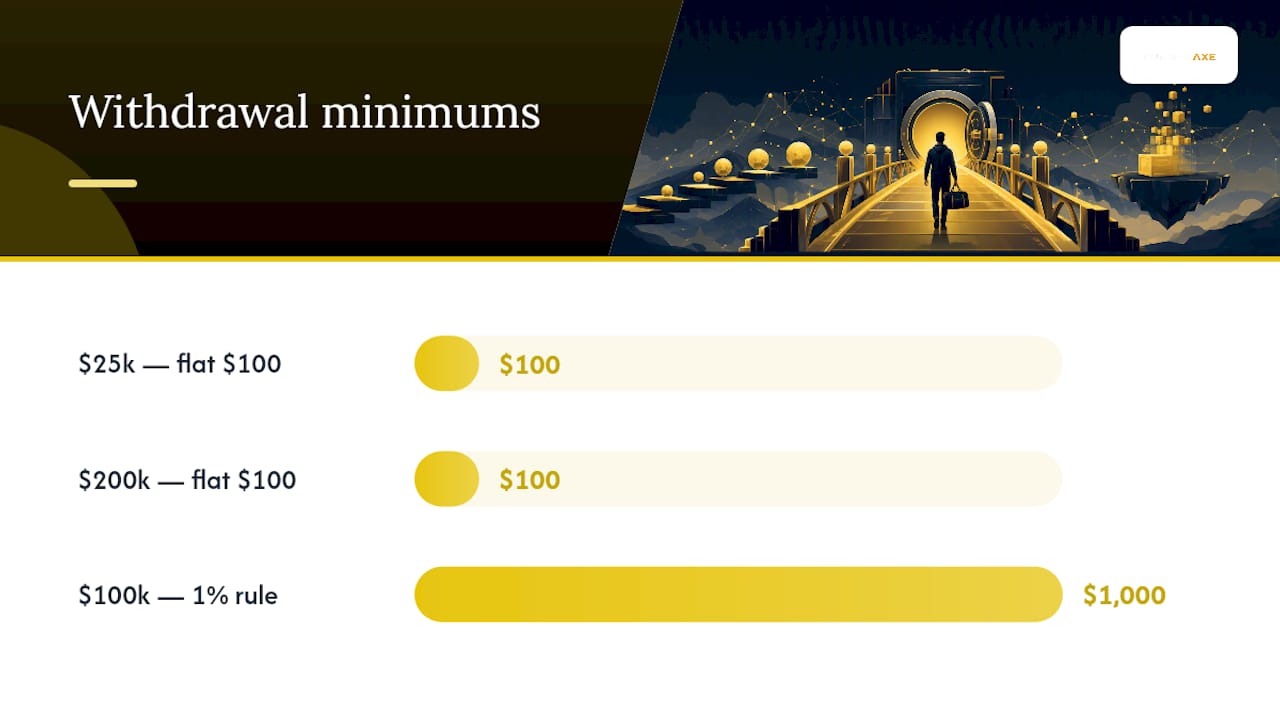
Firms express thresholds two ways: as a flat dollar figure or as a percentage of account size. A flat threshold might read "$100 minimum withdrawal" regardless of whether you're trading a $25,000 or $200,000 account. A percentage-based rule ties the minimum to account size, so a 1% floor on a $100,000 account requires $1,000 in realized profit before you can cash out.
First payouts almost always carry extra conditions. Many firms require a longer waiting period, a higher minimum, or additional identity checks the first time you request money, even if later payouts move faster.
Here's how that plays out across common account sizes:
- $25,000 account: A flat $50 minimum is easy to hit; a 2% rule requires $500 in profit first.
- $50,000 account: A flat $100 minimum is common; a 1% rule needs $500, a 2% rule needs $1,000.
- $100,000 account: Flat minimums often sit at $200 to $250; percentage rules typically demand $1,000 to $2,000.
Always convert the percentage language into a dollar figure for your specific account before you assume you're eligible.
Typical Minimums, Payout Cadence, and How Long Funds Take
Most firms set minimum withdrawal thresholds to avoid processing dozens of tiny transactions, and typical minimums land roughly between $50 and $500, with crypto payouts sometimes carrying higher minimums due to network fees. First-payout minimums can run higher still, occasionally reaching $500 even when routine payouts require far less.
Statistic Callout: Payout cycles at most firms run 14 to 30 days, with processing adding another 1 to 10 business days depending on the method you choose.
Processing speed varies by rail:
- ACH transfer: Usually 1 to 3 business days, with low or no fees.
- Wire/SWIFT: 1 to 5 business days, often with a flat fee attached.
- Crypto: Highly variable, sometimes same-day, but minimums tend to run higher.
- Instant payout add-ons: Faster access for an extra fee, useful when cash flow matters more than the split percentage.
A bigger reward split doesn't mean much if your firm only opens a payout window once a month. Cadence and fees often shape your actual take-home pay as much as the headline split percentage does. Our breakdown of payout schedules and fees walks through exactly how that math shifts by account size.
What Blocks a Payout: KYC, Rule Checks, and Open Trades
A profitable balance doesn't automatically mean withdrawable cash. Firms run several checks before releasing funds, and rule compliance reviews catch far more requests than most traders expect.
- Identity verification (KYC). This usually takes 1 to 3 business days but stretches longer if your documents are incomplete or mismatched.
- Drawdown and consistency checks. Firms confirm you haven't breached your loss limit and that your trading pattern matches their stated rules.
- Open position review. Some firms deny requests if you have live trades open at the moment you submit, since your equity could still move against you.
- Prohibited instrument or strategy flags. Trading restricted symbols or violating news-trading rules can freeze a payout until reviewed manually.
If your request gets denied, ask for the specific rule cited, gather your trade history and account statement, and contact support with both attached rather than a general appeal.
Pro Tip: Submit your KYC documents the day you get funded, not the day you plan to withdraw. Identity review is almost always the slowest part of the process, and starting early keeps you from missing a payout window by 48 hours.
How a Withdrawal Affects Your Drawdown Buffer
Pulling money out changes the math behind your risk limit, and that's where traders get tripped up. Static, balance-based drawdown rules calculate your loss limit off your starting or current balance, so a withdrawal can shrink the cushion protecting you from a breach.
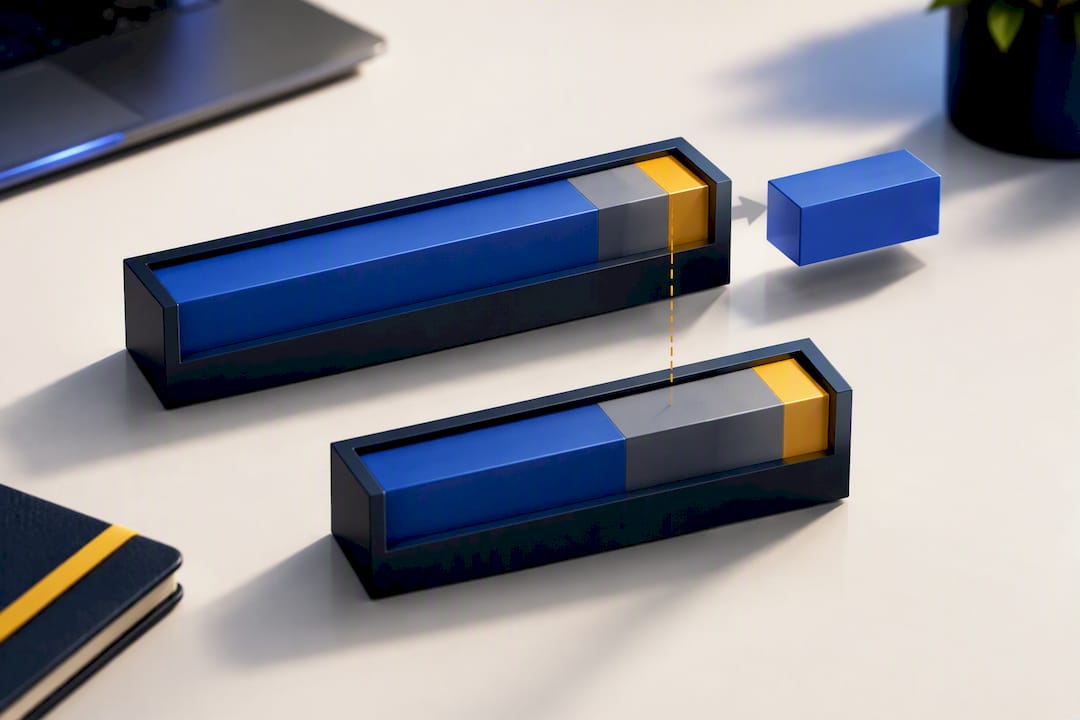
If your balance grows to $105,000 and you withdraw $4,000, your new balance is $101,000, and your floor stays at $90,000. That still leaves an $11,000 cushion, comfortable in most cases.
Statistic Callout: A common rule of thumb is to leave 1% to 2% of your account size untouched after any withdrawal, giving you room to absorb a losing streak without immediately approaching your limit.
- Withdraw only realized, closed-trade profit, never floating equity.
- Leave a flat dollar buffer on smaller accounts (under $50,000) since percentage buffers can be too thin in dollar terms.
- On larger accounts, a 1% buffer often covers normal volatility without tying up excess capital.
For a deeper look at how loss limits interact with position sizing, our guide on risk limits and drawdown math breaks down the per-trade calculations.
A Step-by-Step Payout-Planning Checklist
Getting paid on schedule comes down to preparation, not luck. Run through this before every request, not just your first one.
- Confirm the documented minimum and cadence. Read your firm's payout page directly rather than relying on memory or a forum post.
- Complete KYC and tax paperwork early. Do this the week you get funded, not the week you want to withdraw.
- Calculate your eligible profit and post-payout buffer. Subtract your planned withdrawal from your balance and check it against your drawdown floor.
- Choose your method and submit within the window. ACH for routine payouts, wire or crypto if you need a specific rail, instant add-ons if speed matters more than the fee.
For buffer targets, aim to leave at least 1% of account size in cushion on accounts above $50,000, and consider a flat $250 to $500 floor on smaller accounts where percentages get too thin.
Pro Tip: Keep your first payout modest. A smaller, successful withdrawal proves the process works and builds confidence before you request a larger amount.
If a request gets denied, collect your account statement, trade history, and any correspondence about the rule in question, then escalate through your firm's support channel with those documents attached.
Fundedaxe's Approach to Payout Thresholds and Timing
Some prop firms structure payout systems around flexibility rather than rigid, long waiting periods, allowing traders to request rewards starting early and at regular intervals, with optional faster payout schedules for an additional cost. Using static drawdown rules with no time limits on any phase gives traders more room to plan withdrawals around their own risk buffer rather than a firm-imposed clock.
Completing identity verification as soon as your account is funded remains the single best way to avoid delays, regardless of which firm you trade with.
What Actually Determines Payout Success
Most traders obsess over their reward split and pay far less attention to cadence, minimums, and buffer math, which is backwards.
Securing a first payout, even a small one, does more for a trader's discipline than any partial profit-taking strategy tweak. It proves the system works and breaks the anxiety loop that causes people to overtrade near their profit target. A simple habit fixes most of this: schedule a modest, recurring withdrawal, either weekly or monthly, and treat it as non-negotiable rather than something you decide on the fly based on how your account looks that day. Keep a running log of every withdrawal, date, and amount. You'll want it for taxes, and you'll want it if you ever need to dispute a denied request.
— Jean
Get Your Payout Timing Right With Fundedaxe
Fundedaxe gives funded traders control over payout timing instead of forcing everyone into the same rigid cycle. With Pay After Pass, you start an evaluation for $9.99 and only pay the remaining fee once you've actually passed, so you're not risking a full challenge fee before you know your account is viable.

Rewards can be requested starting day 10 and every 14 days afterward, or every 7 days with the 7-Day Rewards add-on if faster access to your money outweighs the extra cost. Before you request your first payout, check the account terms and KYC steps on the package comparison page so nothing catches you off guard. If you want to test the withdrawal flow with zero cost, the free $1,000 trial account lets you see how the process works before you commit to a paid evaluation.
Sources
Verify your firm's written policy against these before relying on any number:
- Prop Firm KYC and Withdrawal Methods: How You Actually Get Paid (2026) | PROP NAVI
- How Prop Firm Payouts Work in 2026 | PropAccount
- The Complete Payout Guide — PropScorer Academy
- How Prop Firm Payouts Work: Rules, Splits and Timing
FAQ
What Is the Withdrawal Threshold at a Funded Firm?
A withdrawal threshold is the minimum profit or balance a funded account needs before the trader can request a payout. Typical minimums run $50 to $500, though first payouts sometimes require more.
How Hard Is It to Get a Payout From a Prop Firm?
It depends more on preparation than luck. Completing KYC early, closing open trades before you request, and staying within drawdown and consistency rules resolves most delays before they happen.
What Is the Safest Way to Withdraw Money From a Prop Firm?
ACH transfer is generally the most predictable option, usually clearing in 1 to 3 business days with minimal fees. Wire transfers work well for larger amounts but take longer and often carry a flat fee.
Do Prop Firms Ban You if You Make Too Much Money?
No legitimate firm bans profitable traders for hitting large gains within its stated rules. Denials and account flags almost always trace back to rule violations like prohibited strategies, consistency breaches, or incomplete verification, not the size of the profit itself.
Does Fundedaxe Charge for Faster Payouts?
Fundedaxe offers optional add-ons like the 7-Day Rewards schedule for traders who want quicker access than the standard 14-day cadence. Exact pricing for add-ons and account packages is listed on the package comparison page.