

Some prop firms let you officially merge funded accounts into one balance, but eligibility depends on matching currency, product type, and having zero open trades. It's rarely reversible. Before requesting one, confirm how the merged account's drawdown and payout rules will work, because the strictest rule in your account stack usually wins.
TL;DR:
- Merging accounts requires matching currency, product type, zero open trades, and often results in a stricter combined rule than individual accounts.
- Confirm in writing how the merge will affect drawdown limits, payout timing, and whether it is reversible before proceeding.
- Using a trade copier offers a safer, reversible alternative to merging accounts when testing consolidation or managing multiple accounts.
- Merging often inherits the stricter drawdown rules and can reset payout progress or change profit splits, affecting scaling plans.
- Always verify the firm’s specific merge policy and document your eligibility checks to avoid support rejections and disputes later.
Table of Contents
- What Does It Mean to Merge Prop Firm Accounts?
- What Are the Eligibility Rules for Merging Accounts?
- How Do You Request an Official Account Merge?
- Trade Copiers and Multi-Account Dashboards: The Reversible Alternative
- What Happens to Drawdown and Payouts After a Merge?
- Should You Merge Your Accounts or Run Them in Parallel?
- How FundedAxe's Structure Fits Into a Multi-Account Strategy
- My Workflow Before I Merge Any Funded Account
- Scale Smarter With FundedAxe's Flexible Account Options
- Where to Verify Firm Policy and Multi-Account Tooling
- Sources
What Does It Mean to Merge Prop Firm Accounts?
Merging prop firm accounts means the firm consolidates two or more of your funded accounts into a single account with one balance, one drawdown limit, and one payout stream. This is a firm-side administrative action, not something you can do from your dashboard. Firms like FTMO, FundedNext, and FundingPips each run their own merge process with different eligibility rules and outcomes, and some, like PipFarm, have rolled out dedicated merge features that combine multiple funded accounts into one payout stream.
That's different from simply owning multiple accounts, or from running a trade copier across them. A copier or multi-account dashboard replicates your trades across separate accounts that remain legally and operationally distinct. Your capital stays split. Your risk limits stay separate. You just get one screen to manage them from.
Firms that do offer official merging typically require:
- Matching base currency across every account involved
- The same product or challenge model (you generally can't merge a 1-step evaluation with a funded account, for example)
- Zero open positions at the time of the request
This distinction matters more than most traders realize going in. A merge changes your legal account structure. A copier just changes how you interact with accounts that stay separate, which is why it's the safer starting point if you're not sure a merge is right for you.
What Are the Eligibility Rules for Merging Accounts?
Before you even ask support about a merge, run through these checks yourself. Most rejected merge requests fail for reasons the trader could have caught in five minutes.
- Currency match. Confirm every account runs on the same base currency. A USD account and a EUR account rarely qualify for consolidation.
- Product type match. Verify whether the firm allows merging across different challenge tiers, or only within the same evaluation model. Some firms block merging an evaluation account into a funded one.
- Open trades and pending payouts. Close every open position and confirm no payout request is sitting unresolved on any account you want merged.
- Positive balance requirement. Accounts sitting below their starting balance or in drawdown territory often get excluded automatically.
- Household and device rules. If your accounts were opened under separate logins tied to the same device or IP, check the firm's multi-account policy before requesting anything, since some treat undisclosed multiple accounts as a violation on its own.
- Combined allocation caps. Ask whether the firm has a maximum funded size per trader, and whether a merge would push you over it.
- Fees and irreversibility. Ask directly whether the merge carries a fee and whether it can be undone once processed.
Pro Tip: Screenshot the firm's merge policy page the day you read it. Policies change, and a dated screenshot is the only proof you have of what you were told when you made your decision.
Skipping any one of these checks is how traders end up with a support ticket denied for a reason that was sitting in the help center the whole time.
How Do You Request an Official Account Merge?
Once you've confirmed eligibility, the actual request is mostly about documentation. Firms process merges manually, and a clean, specific request moves faster than a vague one.
Before you submit anything:
- Take screenshots of your current balance, equity, and open trade count on every account involved.
- Close all open positions and let any pending payout clear completely.
- Gather every account ID, challenge type, and the exact policy page or line item that says merging is available.
When you write the support ticket, be explicit. Don't just ask "can you merge my accounts." Ask:
- Will the merged account use the drawdown model of the larger account, the smaller account, or a new blended calculation?
- Does the merge reset my trading day count or consistency history?
- What happens to a payout that's currently in progress?
- Is this merge reversible if something goes wrong?
Get the answers in writing. A verbal confirmation on a live chat that disappears the next day is worth nothing if a dispute comes up later. Dated screenshots, ticket numbers, and explicit written confirmation are your strongest protection once an irreversible merge has actually gone through.
Once support confirms the merge is complete, log into the resulting account and verify the balance, the drawdown limit, and the daily loss figure match what you were told, before you place a single new trade. If any number looks off, flag it immediately. Fixing a miscalculated drawdown limit before your first trade is far easier than after you've already breached it.
Trade Copiers and Multi-Account Dashboards: The Reversible Alternative
When a firm doesn't offer merging, or when you'd rather keep your accounts separate for now, a trade copier or multi-account dashboard does most of the same job without touching your account structure.
These tools replicate trades across accounts, group accounts for centralized monitoring, and let you set a single stop signal that closes positions everywhere at once if things go wrong. Platforms in this space, including PropSyncPro's dashboard for futures prop traders, unify tracking, payout readiness, and risk-rule context across dozens of accounts from one interface. Others, like PropTerminal, connect to Tradovate, NinjaTrader, and Rithmic and add group management with auto-sizing multipliers so lot size scales correctly per account.
The tradeoffs are real, though:
- Latency between the master trade and the copied trade can cause slippage, especially during fast news moves.
- Symbol or contract mismatches between accounts can throw off position sizing if you're not careful.
- Some firms explicitly prohibit copy trading between accounts under the same ownership, so check your firm's copy trading rules before you connect anything.
Choose a copier when you want to test a consolidated workflow without giving up reversibility, or when you want to preserve each account's individual trading history for scaling purposes. Choose an official merge only when you're certain you want the accounts combined permanently and you've confirmed the post-merge terms in writing.
What Happens to Drawdown and Payouts After a Merge?
Merging accounts almost never averages the rules. Firms typically apply whichever limit is stricter across the accounts involved. If one account runs a static balance-based drawdown and the other runs an equity-based model, the merged account frequently inherits the tighter of the two, which usually means the equity-based rule if it's more conservative.
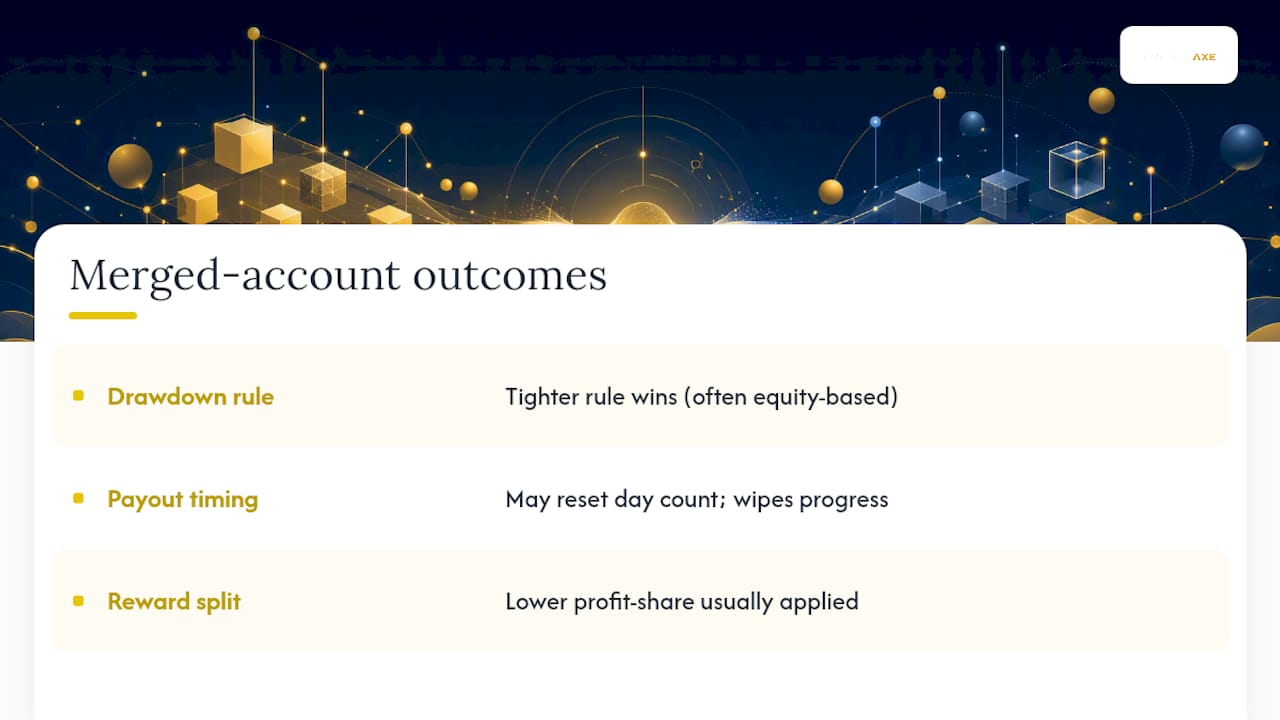
Payout timing gets affected too. A merge can reset your trading day count or wipe consistency stats, effectively treating the new combined account as a fresh entity for scaling and payout eligibility. If you were three days away from payout readiness on one account, that progress may not carry over.
Reward splits can shift as well. If your accounts have had different profit-share percentages, the merge often applies the lower split of the two accounts involved rather than the higher one. Ask about this specifically before you request anything.
The safest approach regardless of what the firm does internally: build your own portfolio-level stop that uses the strictest rule across your entire stack as the operating constraint, not just the rule on paper for the merged account, as explained in this practical guide for funded traders on daily loss limits. Community guidance on multi-account risk consistently points to the same principle: identify your tightest daily loss limit, your tightest overall drawdown limit, and any consistency rule still active, then trade to the tightest of the three, not the average. Reviewing how much you risk per trade against that single tightest number, rather than per account, is what keeps a merge from turning into an accidental breach.
If custody or reporting questions come up during a merge, the NFA's member resources on account structures and disclosures are worth a read, even though prop firm accounts are simulated rather than live brokerage accounts.
Should You Merge Your Accounts or Run Them in Parallel?
The decision usually comes down to one question: do you need a single balance and a single payout, or do you need to preserve each account's individual history for scaling?
| Situation | Better fit |
|---|---|
| You want one combined payout stream | Official merge |
| You're mid-way through a scaling plan on separate accounts | Run in parallel |
| You want to test consolidation before committing | Trade copier |
| Your accounts have mismatched currencies or product types | Not eligible to merge |
| You value account history and consistency stats | Run in parallel |
Before requesting anything, confirm you have: policy screenshots, every account ID involved, proof of zero open trades, and a written answer on the new drawdown and payout treatment.
Pro Tip: If you're unsure which way to go, size every account to its weakest rule for two full weeks before deciding. If that constraint doesn't feel limiting, a merge probably won't hurt you. If it does, you're not ready to combine balances yet.
How FundedAxe's Structure Fits Into a Multi-Account Strategy
FundedAxe's accounts scale up to $400,000, and traders can choose a 1-step, 2-step, or 3-step evaluation with the Pay After Pass model starting at $10,000, meaning the challenge fee is only paid in full once the evaluation is passed.
For a trader running several FundedAxe accounts at once, those static, balance-based drawdown limits make risk calculation simpler when deciding whether to coordinate accounts with a copier or request a firm-side merge. There's no consistency rule and no time limit on any phase, which removes two of the variables that usually complicate multi-account decisions elsewhere. A trader scaling from a $10,000 Pay After Pass account toward a $400,000 allocation still needs to size to the tightest active drawdown across every account in the stack, exactly as with any other firm.
My Workflow Before I Merge Any Funded Account
I never request a merge without three things confirmed in writing: the new drawdown model, the payout treatment, and whether the process can be reversed. If support can't answer all three clearly, I don't proceed.
My rule of thumb is simple: size every account to its strictest rule weeks before I even consider combining balances, and I test any consolidation with a copier first, since it's reversible and a merge isn't. A trader with a static-drawdown account and an equity-based account, for instance, should assume the merged account will inherit the equity-based limit and trade accordingly from day one.
— Jean
Scale Smarter With FundedAxe's Flexible Account Options
If you're weighing whether to merge accounts or simply want room to grow without the hassle, FundedAxe gives you more flexibility to structure your funded trading the way you actually trade. Pay After Pass lets you start an evaluation for $9.99 and only cover the rest of the fee once you pass, so testing a new account size doesn't mean committing full price upfront.

Account sizes run from $5,000 up to $400,000, reward splits go up to 100% with the add-on, and every plan allows EAs and news trading with no consistency rule to work around. There's also a free simulated $1,000 trial account if you want to test a platform before committing to a paid challenge. Once you've worked through the eligibility checklist above, compare FundedAxe's challenge tiers side by side, then reach out to support with your documented drawdown and payout questions before opening a new account.
Where to Verify Firm Policy and Multi-Account Tooling
Check a firm's own help center for its merge policy before assuming it applies to you, since terms vary by provider and change over time. For execution and monitoring across multiple accounts, review PropTerminal's platform documentation for connection requirements. Save every dated support reply and screenshot from these checks. It's the only record you'll have if a merge or payout dispute comes up later.
Sources
- Prop firms with account merging explained with examples
- PropSyncPro | Multi-Account Management for Futures Prop Traders
- PropTerminal multi-account platform features
- NFA member resources — security & futures disclosure