

Headline splits alone don't determine your take-home. Payout rules, fees, and add-on breakeven math do that job, and most traders never run the numbers before clicking buy. Profit-split add-ons at prop firms like FundedAxe can be worth the extra money, but only when the eligible-profit definition, drawdown type, payout frequency, and refund terms actually let you hit breakeven. Check those four variables before the percentage sign ever enters the decision.
TL;DR:
- Profit splits are based on eligible net profit after deducting fees and commissions, not gross gains, and most firms offer fixed, tiered, scaling, or bonus models.
- Add-on upgrades, such as split boosts or payout frequency improvements, only make financial sense if your typical profit quickly covers the extra cost based on the breakeven formula.
- Fees for processing payouts, currency conversions, and platform charges can reduce the effective split by up to 2-4%, impacting overall profitability.
- Drawdown rules, especially equity or trailing types, affect your withdrawal ability and should be managed with a sufficient buffer to prevent accidental breaches.
- Diversifying multiple funded accounts and running calculations before committing helps traders maximize long-term net income and avoid costly mistakes.
Table of Contents
- How Profit Splits Are Calculated and Common Split Models
- Profit-Split Add-Ons: Types, Pricing, and the Fine Print
- What's the Real Breakeven on a Split Upgrade?
- Payout Mechanics and the Fees That Quietly Shrink Your Split
- Rules That Can Quietly Erase Your Eligible Profit
- How to Compare Any Two Prop Firm Offers Fairly
- FundedAxe as a Working Example of the Checklist
- What Traders Get Wrong About Chasing the Split
- Try the Math on a Transparent Offer
- Where to Verify These Numbers Yourself
- Sources
- FAQ
How Profit Splits Are Calculated and Common Split Models
A profit split applies to eligible net profit, not gross gains. Firms typically close out commissions, swap charges, and platform or data fees before calculating what counts toward your share. So a trader who nets $5,000 on paper might only have $4,600 in eligible profit once deductions run through, and the split percentage applies to that smaller number, not the bigger one on the equity curve.
Most retail prop firms structure splits one of four ways:
- Fixed split: one percentage for the life of the account, commonly 80/20 in favor of the trader.
- Tiered split: the split increases at defined profit or balance milestones, often moving from 80/20 to 90/10.
- Scaling split: tied to account growth over time, sometimes triggered after several months of consistent net profit.
- Front-loaded bonus: a temporary 100% split on an early payout, usually the first one, to reward new funded traders.
Most modern retail prop firms calculate profit splits on eligible net profit using closed trades as the baseline, with starting splits around 80/20 and scaling paths toward 90/10 or better. Some firms also vary the split by payout frequency: wait longer between withdrawals, and you might unlock a higher percentage as a reward for reduced processing load on their end. That trade-off matters more than it looks, since a delayed payout schedule ties up capital you might need sooner.
Profit-Split Add-Ons: Types, Pricing, and the Fine Print
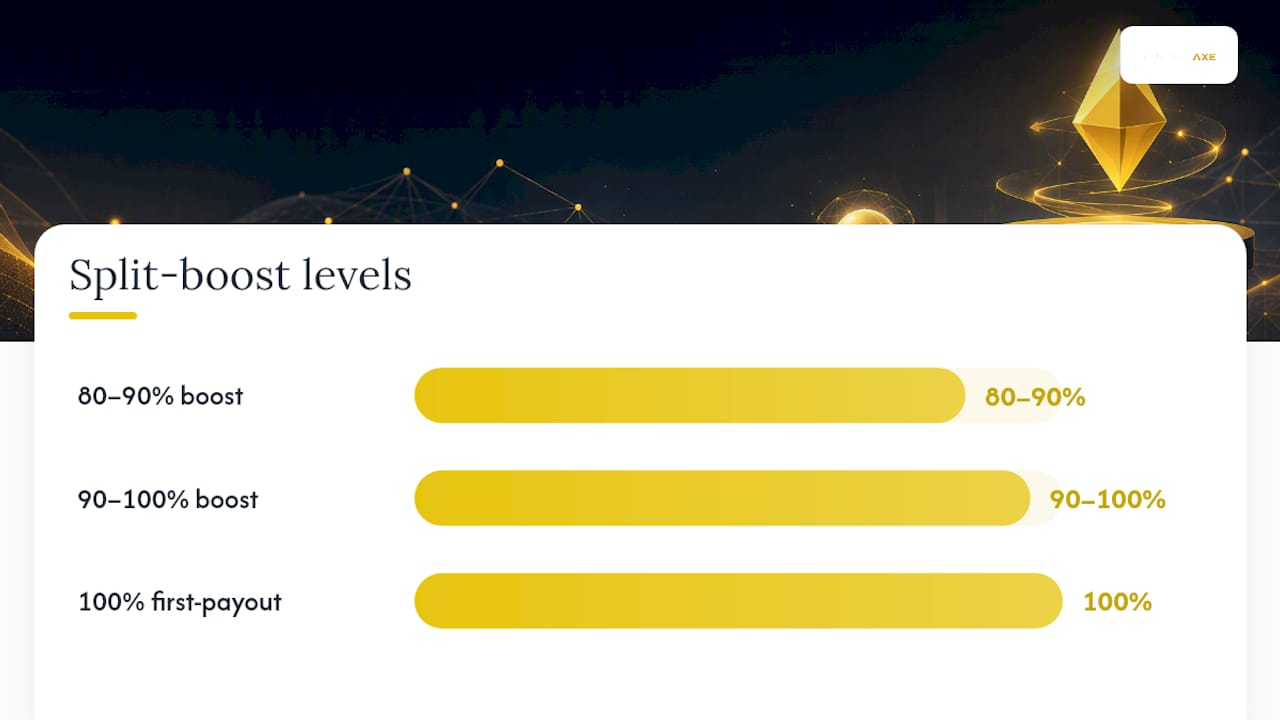
An add-on is a checkout upgrade that changes one specific term of your funded account, not the whole package. The four most common types are a split boost (usually 80% to 90% or 90% to 100%), a payout-frequency upgrade (weekly instead of bi-weekly, or on-demand instead of fixed cycles), a first-payout bonus that temporarily sets your split to 100%, and a swap-free conversion for traders who hold positions overnight.
Pricing usually falls into two camps:
- A flat dollar add-on, charged once at checkout regardless of account size.
- A percentage of the base challenge fee, which scales with the size of the account you're funding.
Refund mechanics change the real cost more than the sticker price does. If a split-boost add-on refunds on your second reward instead of charging a permanent fee, your effective cost drops to whatever interest or opportunity cost you lose during the wait, not the full dollar amount.
Watch the marketing language closely. Headline splits sometimes come bundled with rules that quietly lower your odds of reaching a payout at all, which is the opposite of what the percentage implies.
What's the Real Breakeven on a Split Upgrade?
The math is simple once you strip away the marketing: required eligible profit to break even = add-on cost ÷ marginal increase in your split (as a decimal). Practitioners commonly estimate needing a 1.5% to 3% account return to recoup a typical 90% split add-on, depending on account size and add-on price.
Pro Tip: Run this formula before checkout, not after your first payout request. It takes thirty seconds and it tells you exactly how many dollars of profit you need before the add-on stops being a cost and starts being income.
Two examples show how differently this plays out:
- Day trader, a typical low-cost add-on, 80% to 90% upgrade, weekly payouts. The marginal gain is 10 percentage points, or 0.10. Breakeven profit equals the add-on cost divided by 0.10 in eligible net profit. On a standard account size, this corresponds to a modest return achievable inside one or two payout cycles for an active scalper.
- Swing trader, a typical higher-cost add-on, 80% to 90% upgrade, bi-weekly payouts, plus a moderate data fee per cycle. The adjusted cost increases accordingly, raising the breakeven eligible profit required. This remains reasonable, but the longer payout cycle means time to realize gains is longer.
The add-on earns its keep when your typical trade frequency and win rate make that breakeven number look small compared to your usual monthly profit. It becomes a sunk-cost risk when you're a low-frequency trader chasing an upgrade you might not touch again before the evaluation ends.
Payout Mechanics and the Fees That Quietly Shrink Your Split
Payout frequency is a trade-off between liquidity and platform risk. Weekly payouts get cash in your hands faster but sometimes carry smaller minimum thresholds or extra processing steps; bi-weekly or monthly cycles let profit accumulate but leave more capital exposed to a rule violation before you ever request a withdrawal.
Fees are where a clean 90% split quietly turns into something closer to 84% in practice:
- Payout processing fees: flat charges of $10 to $30 per withdrawal, more painful on smaller payouts.
- Currency conversion: 1% to 3% loss when your payout currency doesn't match your bank's.
- Data and platform fees: recurring monthly charges of $10 to $50, unrelated to whether you profit that month.
- Activation fees: one-time charges to unlock a funded account after passing evaluation.
Fees like data, swap, activation, and payout processing materially change the effective split even when the advertised percentage stays fixed. Here's the fold-in: on a $2,000 payout at a 90% split, a $25 processing fee and a 2% currency conversion loss bring your effective take-home closer to 88.5% instead of 90%. Small on paper, but it compounds every cycle. Reviewing prop firm payout timing and cycles before committing to a firm helps you spot these deductions ahead of time instead of discovering them on your first withdrawal.
Rules That Can Quietly Erase Your Eligible Profit
Drawdown type decides how much room you actually have to trade, and it changes your withdrawal strategy more than most traders realize. A balance-based (static) drawdown only moves when you withdraw funds, giving you a fixed floor to work against. An equity-based drawdown tracks unrealized losses in real time, meaning open positions can trigger a breach even before you close a trade. A trailing drawdown ratchets upward with your peak balance, which punishes early gains by shrinking your buffer just when you'd expect more room.
Consistency rules add another layer: many firms cap how much of your total profit can come from a single trading day, and prohibited strategies (like certain high-frequency arbitrage setups) can void an entire payout cycle if flagged.
- Static drawdown gives the most predictable withdrawal planning.
- Equity-based drawdown requires closing positions before big data releases.
- Trailing drawdown rewards patience over early aggression.
Pro Tip: Leave a 2% buffer of your account balance before requesting a withdrawal. This cushion protects you against a drawdown breach that might otherwise trigger the moment your payout processes and your balance resets lower.
How to Compare Any Two Prop Firm Offers Fairly
Run this checklist before comparing splits on percentage alone:
- Starting split and the path to max split (fixed, tiered, or scaling).
- Add-on cost and whether it refunds on a milestone payout.
- Payout frequency and average processing time.
- Full fee list: data, swap, activation, and payout processing.
- Drawdown type and whether it's balance, equity, or trailing based.
- Refund policy on the challenge fee itself.
Once you have those six data points, multiply your average monthly eligible profit by the effective split (after fees) to estimate real monthly take-home. Then compare that number against the add-on's breakeven requirement from the earlier formula.
Running multiple funded accounts with different rule profiles can raise long-term net income more reliably than concentrating everything behind one firm's highest advertised split. Diversifying also limits your exposure if one account breaches a rule during a rough week.
FundedAxe as a Working Example of the Checklist
One prop firm maps cleanly onto that checklist, making it a useful benchmark rather than just another option on a list. Rewards can be requested starting day 10, then every 14 days, or every 7 days with the 7-Day Rewards add-on for traders who want faster liquidity.
Pay After Pass changes the upfront math specifically: you pay $9.99 to start the evaluation and only owe the remaining base fee once you've actually passed, cutting the capital at risk before you know if the strategy works on that account. The drawdown model is static (balance-based), which keeps withdrawal planning predictable compared to equity or trailing models.
Before buying any split add-on, run the breakeven formula against your own trade history using a free $1,000 simulated trial account offered by some firms. It costs nothing and shows whether your typical monthly profit clears the threshold.
What Traders Get Wrong About Chasing the Split
The biggest mistake I see traders make is treating the split percentage as the whole decision instead of one input into it. Withdrawing every dollar the moment it's eligible is another habit that backfires, since it strips the buffer that protects against a technical breach on the very next trade.
The traders who do well treat the effective split, not the advertised one, as the real number. They compute it, leave a small cushion before withdrawing, and often run more than one funded account so no single rule set controls their entire income.
— Jean
Try the Math on a Transparent Offer

If you want to test the breakeven formula against your own trading style before spending anything, start with the free $1,000 simulated trial account. No card, no deposit, just a real look at whether your typical trade frequency clears the numbers. From there, compare account sizes and add-on pricing on the package comparison page, or start an evaluation through Pay After Pass if you'd rather confirm you can pass before committing the remaining fee.
Where to Verify These Numbers Yourself
- Prop Firm Profit Split Explained: background on eligible net profit and typical split ranges across the industry.
- How Prop Firm Profit Splits Work: detail on fee categories that reduce effective take-home.
- Payout Maximization Guide: the breakeven approach used in this article's ROI section.
- Prop Firm Profit Splits Explained 2026: scaling triggers and milestone mechanics for reaching 90/10 or better.
Always confirm current terms against a firm's own funded-account agreement before trading or requesting a payout, since add-on pricing and rules change over time.
Sources
- Prop Firm Profit Split Explained: How Funded Traders Get Paid
- How Prop Firm Profit Splits Work
- Prop Firm Payout Maximization: How to Optimize Split Add-ons and Withdrawal Timing
- Prop Firm Profit Splits Explained 2026: 90/10, 80/20 & Scaling
FAQ
What Is the Typical Profit Split for a Prop Firm?
Most retail prop firms start traders around an 80/20 split in the trader's favor, with scaling paths to 90/10 or better as accounts grow.
How Much Can a Trader With a $50,000 Account Make Per Day?
Daily income varies enormously by strategy and market conditions, so there's no reliable industry-wide average. A more useful approach is calculating your own expected monthly eligible profit and applying your effective split, including fees, rather than relying on a generic daily figure.
What Does an 80% Profit Split Actually Mean?
The remaining 20% goes to the firm as its share for providing the funded account.
What Percentage of Prop Firm Traders Are Profitable?
Public, verified data on trader profitability rates varies by firm and isn't consistently published, so any specific percentage should be treated cautiously. What's better documented is that survival depends heavily on drawdown type and consistency rules, not just trading skill, which is why comparing account conditions matters as much as comparing splits.
Are Profit-Split Add-Ons Worth Buying?
They're worth it when your typical eligible profit clears the breakeven threshold quickly, calculated as add-on cost divided by the marginal split increase. They're a weaker bet for infrequent traders or those on accounts with strict drawdown rules that make reaching a payout less certain.