

Crypto on-demand and 7-day early payout add-ons deliver the fastest usable withdrawals for active retail traders. Roughly 7% of all traders who start a challenge ever receive a payout, so when you do hit that milestone, how quickly you can access your money matters. Direct USDC/USDT transfers can land in your wallet in minutes; bank wires can take five or more business days after the request window opens.
Here are the fastest practical options right now:
- Crypto on-demand (USDC/USDT direct): Minutes to same-day. Best for active traders who redeploy capital frequently or want maximum flexibility. Requires a firm that supports on-demand requests and a crypto wallet.
- 7-day early payout add-on (crypto rail): Payout every 7 days instead of the default 14. Best for swing traders who want predictable weekly cash flow without waiting for the biweekly window. Fundedaxe offers this as a purchasable add-on.
- Biweekly via Rise or specialist processor: 1–3 business days after the request window. Best for traders who prefer fiat and can plan around a 14-day cycle.
Fundedaxe's 7-Day Rewards add-on cuts the default 14-day cycle in half and pairs with a 90% reward split (up to 100% with the reward-split add-on), making it one of the more practical setups for payout-conscious traders.
Key Takeaways
Pairing a 7-day payout add-on with a crypto rail is the fastest practical withdrawal setup for most retail traders, and no consistency rules means every profitable day counts toward your next payout.
| Point | Details |
|---|---|
| Fastest withdrawal combo | Crypto on-demand or 7-day add-on plus USDC/USDT rail delivers same-day settlements. |
| Default cadence reality | Most firms default to biweekly (14 days); the first payout typically takes 7–14 days due to KYC verification. |
| Add-on cost signal | Flat-fee add-ons beat percentage-based fees for accounts generating over $1,000 per cycle. |
| Red flag to avoid | A buffer or post-withdrawal balance rule buried in the help center can block withdrawals even when profit qualifies. |
| Fundedaxe advantage | No consistency rules, a 7-Day Rewards add-on, and up to 100% reward split make it a strong fit for payout-focused traders. |
Table of Contents
- What payout frequency options exist and why cadence matters for your cash flow
- How early-payout add-ons work and what to check before buying one
- Payout cadence and add-on comparison by firm type
- How to choose the right cadence and add-on for your trading profile
- What the data says about how often traders actually receive payouts
- Final recommendation for payout-conscious traders
- Why payout speed deserves more weight than most traders give it
- Fundedaxe's payout setup for traders who want faster withdrawals
- Frequently asked questions
- Sources
What payout frequency options exist and why cadence matters for your cash flow
Prop firm payouts are almost always request-based, not automatic. The firm opens a request window on a schedule, you submit a withdrawal, and then processing begins. That two-step structure means the calendar cadence and the processing rail are separate variables, and both affect how fast money reaches your account.
The four standard cadences:
- On-demand: You request a payout whenever your profit qualifies. Rare among standard accounts; more common as a premium add-on. Processing starts immediately after approval, so the rail determines the rest.
- Weekly (every 7 days): Request windows open every seven days. Common as an add-on upgrade from a biweekly default. Predictable for income planning.
- Biweekly (every 14 days): The most common default across the industry. Balances operational overhead for the firm with reasonable frequency for traders.
- Monthly: One request window per month. Standard for some legacy structures. Useful for traders who treat prop income as a salary supplement and batch their tax records monthly.
The cadence choice interacts directly with your trading style. A scalper pulling profits every few days needs on-demand or weekly access; a position trader holding multi-week setups rarely notices the difference between weekly and biweekly. Income traders, particularly those using prop payouts to cover living expenses, tend to prefer weekly for cash-flow predictability.
How payment rails change the real timeline:
| Rail | Typical settlement after request | Notes |
|---|---|---|
| Crypto (USDC/USDT direct) | Minutes to same-day | Fastest option; requires a crypto wallet |
| Rise (crypto) | Under 1 business day | Specialist processor; widely used in 2026 |
| Rise (bank transfer) | 1–3 business days | Reliable and faster than SWIFT |
| Wise / ACH | 2–4 business days | Good for fiat; lower fees than SWIFT |
| SWIFT / international wire | 3–7 business days | Slowest; high fees; avoid if alternatives exist |
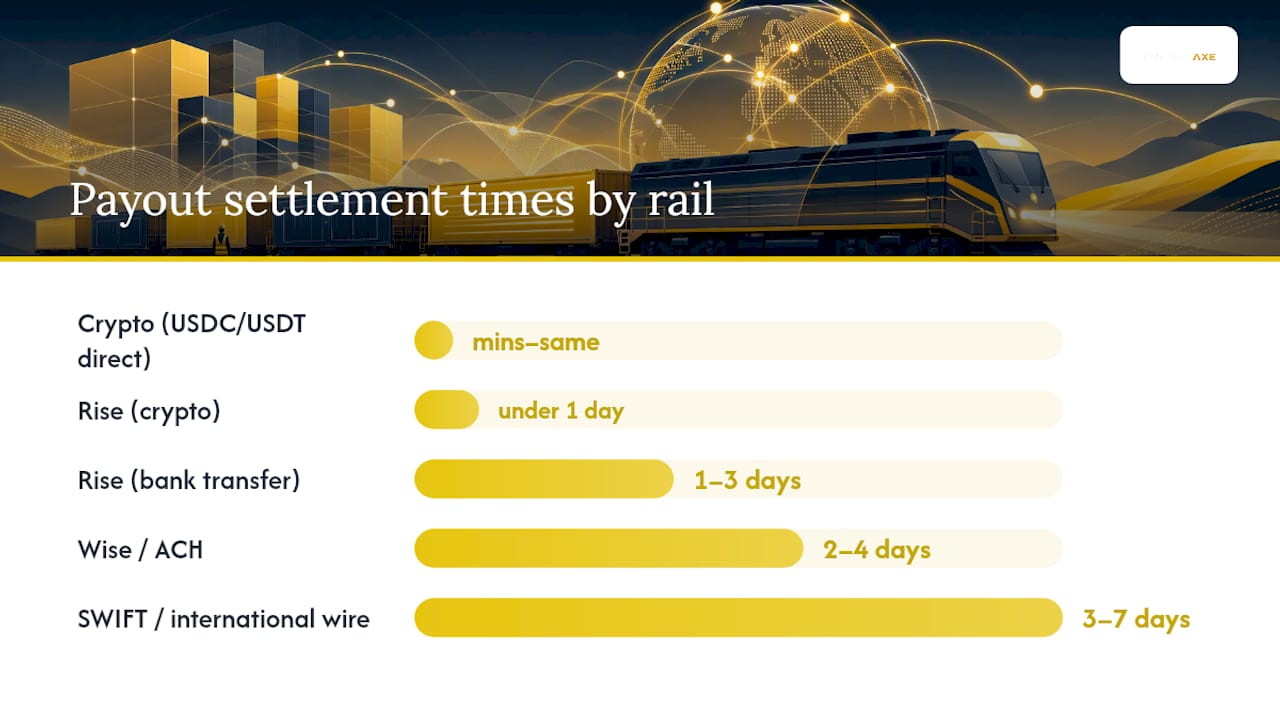
Pairing crypto with on-demand gives maximum speed and flexibility, while Wise or ACH paired with a weekly or biweekly cadence gives predictability at lower cost. The rail choice alone can shift your effective wait time by four or more business days.
How early-payout add-ons work and what to check before buying one
An early-payout or fast-payout add-on is a purchasable upgrade that changes one or more of three things: the request window frequency, the minimum hold period before a request is valid, or the processing priority. Most add-ons target the first variable, shortening the default 14-day window to 7 days or enabling on-demand requests.
Common add-on mechanics:
- Cadence reduction: Moves the request window from 14 days to 7 days (or monthly to biweekly). The most common type. You pay once at checkout or per cycle.
- On-demand unlock: Removes the fixed window entirely. Rarer and usually more expensive. Processing still depends on the rail.
- Priority processing: Your request jumps the queue. Useful when a firm's processing backlog is the bottleneck, less useful when the rail itself is the delay.
- Fee-per-withdrawal model: Instead of a flat add-on purchase, you pay a percentage of each withdrawal (typically 1%–5%) for faster processing.
Typical pricing signals: Flat add-on fees commonly cover a 7-day cadence upgrade. Percentage-based fee models may result in higher ongoing costs for larger accounts. Subscription models (monthly fee for ongoing faster access) appear at some firms but are less common.
Pro Tip: Before buying any add-on, calculate your expected monthly payout and multiply by the percentage fee. Run the math for your actual account size.
Terms that can negate the add-on's value:
- Minimum payout threshold: Most firms require $50–$200 minimum per withdrawal. If your profit hasn't cleared the threshold, the faster window is useless.
- Buffer / post-withdrawal balance rule: Some firms require your account balance to remain above a set floor after the withdrawal. This is a common trap. Check the help center, not just the pricing page.
- Consistency rules: Four of six firms reviewed in the Velotrade 2026 transparency report apply consistency rules that cap how much of total profit can come from a single day, typically reducing a strong day's attributable profit by 33%–50%. This directly limits what qualifies for payout.
- KYC / verification hold: First payouts often take 7–14 days regardless of cadence because identity verification runs on the first request. Factor this into your timeline expectations.
Payout cadence and add-on comparison by firm type
The table below covers Fundedaxe explicitly and uses generic category labels for other firm types to avoid recommending direct competitors.
Key caveats by row:
- Fundedaxe's default window opens on day 10 of the funded account, then every 14 days. The 7-Day Rewards add-on halves that cycle. No consistency rules apply, which means a strong single-day profit counts in full toward payout eligibility. Verify current terms at Fundedaxe payouts.
- Standard biweekly firms are the most common type. The add-on cost and minimum vary widely. Always check the help center for buffer rules before purchasing.
- Weekly-default firms often offset the faster cadence with a lower profit split or higher minimum payout. Confirm the net math.
- Monthly-default firms suit traders who prefer salary-style income but are a poor fit for active traders who need to redeploy capital.
- On-demand firms can be the fastest in theory but often carry the strictest buffer rules and highest minimum thresholds. Verify the post-withdrawal balance requirement.
For a side-by-side challenge comparison that includes add-on pricing, Fundedaxe's package page is the most direct reference for its own terms.
How to choose the right cadence and add-on for your trading profile
Run through this checklist in order. The first criterion that applies to you usually determines the right choice.
- How often do you generate withdrawable profit? If you hit your profit target most weeks, a 7-day add-on or on-demand access pays for itself quickly. If you rarely hit the minimum threshold, a faster window adds no value.
- Do you need to redeploy capital between accounts? Traders who run multiple accounts or reinvest profits into new challenges benefit most from on-demand or weekly access. The faster the cash arrives, the sooner you can fund the next position.
- What is your average payout size? A percentage-based add-on fee (e.g., 3%) costs $30 on a $1,000 payout and $150 on a $5,000 payout. Flat-fee add-ons are almost always better for larger accounts.
- What is your tax reporting cycle? Traders in jurisdictions with quarterly estimated tax payments often prefer weekly or biweekly payouts to match cash flow to tax deadlines. Monthly payouts can create a mismatch if a large payout lands in the wrong quarter.
- What rail does the firm support? If the firm only offers SWIFT wires, even an on-demand add-on will take 3–7 business days. Confirm the rail before the cadence.
- Can you tolerate verification friction on the first payout? First payouts typically take 7–14 days regardless of add-on. If you need cash fast after passing, plan for this delay.
Questions to copy into a support chat before purchasing:
- "What is the minimum account balance required after a withdrawal is processed?"
- "Does the 7-day add-on apply from day 1 of the funded account, or does a minimum hold period still apply?"
- "Which payment rails are available in my country, and what is the typical processing time for each?"
Red flags that suggest an add-on won't deliver:
- The help center mentions a "buffer" or "remaining balance" requirement not listed on the pricing page.
- The minimum payout threshold is above your typical profit per cycle.
- The firm's processing rail is SWIFT-only with no crypto or specialist processor option.
- The add-on terms are only described in a help-center article, not the main rulebook. Payout-affecting clauses buried in help-center articles are a documented pattern across the industry. Always read both.
For a practical prop firm comparison scorecard that weights payout cadence alongside other criteria, the Fundedaxe blog covers the full evaluation framework.
What the data says about how often traders actually receive payouts
The numbers here are sobering, and they matter for how you evaluate any payout add-on. FPFX Tech data summarizing more than 300,000 accounts across ten firms found that A minority of traders pass a challenge and obtain a funded account. Of those who do, fewer than half receive at least one payout, so only a small portion of all starters get payouts. The average payout is a small fraction of the account size.
That 4% figure is worth sitting with. On a $100,000 simulated account, the average payout is around $4,000. On a $10,000 account, it's closer to $400. The cadence and add-on you choose matters most when your payout size is large enough to justify the add-on cost and fast enough to benefit from the shorter window.
What this means for add-on decisions:
- If you are in the 14% who pass, the payout add-on is a real tool. If you haven't passed yet, the add-on is a future consideration, not an immediate purchase.
- Firms that disclose pass rates and payout rates publicly are easier to evaluate. The Velotrade 2026 report found that the terms most likely to determine whether a funded trader receives a payout often appear in evaluation guides and help-center material rather than on headline pricing pages.
- User reviews on platforms like Trustpilot can surface payout delay patterns and processing complaints that don't appear in official documentation. Use them as a qualitative signal, not as definitive proof.
For context on what funded traders actually earn and how payout frequency compounds over time, the Fundedaxe blog breaks down the math by account size and cycle.
Final recommendation for payout-conscious traders
If you trade actively and need capital back quickly, the combination of a 7-day add-on and a crypto rail is the most reliable path to fast withdrawals under current industry conditions. If you trade less frequently and prefer fiat, a biweekly default with a Rise or Wise rail gives predictability without the crypto setup.
Next steps:
- Confirm which payment rails the firm supports in your country before committing to any add-on.
- Check the help center, not just the pricing page, for buffer rules and minimum balance requirements.
- Ask support the three questions listed in the decision checklist above.
- If the add-on cost exceeds your expected monthly payout benefit, skip it and optimize the rail instead.
- For traders comparing Fundedaxe specifically, review the payout rules that affect eligibility before purchasing any add-on.
Why payout speed deserves more weight than most traders give it
The conventional framing in prop firm marketing puts profit split front and center. A 90% split sounds better than an 85% split, and it is, but only if the money actually arrives when you need it. A 5% split difference on a $2,000 payout is $100. A four-day processing delay on a bank wire, when you needed that capital to fund the next challenge by Friday, costs you the opportunity entirely.

Payout frequency and rail choice are operational decisions, not just financial ones. Traders who treat them as afterthoughts often discover the friction only after passing, when the urgency is highest. The firms that publish their payout mechanics clearly, including buffer rules, consistency caps, and rail options, in the main rulebook rather than buried in help-center articles, are the ones worth trusting with your time and challenge fees.
Fundedaxe's structure, no consistency rules, static drawdown, and a purchasable 7-day cadence add-on, addresses the most common friction points directly. The absence of consistency rules alone means a strong trading day counts in full, which is not a given across the industry.
Fundedaxe's payout setup for traders who want faster withdrawals
Fundedaxe starts at $9.99 with its Pay After Pass model: you pay the remaining challenge fee only after you pass, which means less capital at risk before you ever reach a payout. Once funded, the default reward window opens on day 10 and repeats every 14 days.

No consistency rules, no time limits on any phase, and support for news trading and weekend holding mean fewer of the common disqualifiers that delay or block payouts at other firms. Account sizes run from $5,000 to $400,000, with scaling to $2M. For traders who want to see the full add-on pricing and challenge structure side by side, the package comparison page has everything in one place. Start with the $9.99 Pay After Pass entry and only commit the full fee when you've already proven you can pass.
Frequently asked questions
How often do prop firms pay out? Most firms use a biweekly (14-day) default cadence. Weekly and on-demand options are typically available as paid add-ons. Monthly cadences exist at some firms but are less common for active traders.
What is a payout frequency add-on at a prop firm? A purchasable upgrade that shortens the default request window, typically from 14 days to 7 days, or enables on-demand requests. Some add-ons also provide priority processing.
Which payment rail is fastest for prop firm payouts? Direct crypto (USDC/USDT) is the fastest, often settling in minutes to same-day. Rise-based crypto transfers typically settle in under one business day. Bank wires via SWIFT are the slowest at 3–7 business days.
Does Fundedaxe have a faster payout add-on? Yes. The 7-Day Rewards add-on moves the default 14-day reward window to every 7 days. Both are purchasable at checkout.
What is a consistency rule and how does it affect payouts? This reduces the withdrawable amount after a strong day. Fundedaxe does not apply consistency rules.
Why does the first payout take longer than subsequent ones? Identity verification (KYC) runs on the first withdrawal request regardless of cadence. This typically adds 7–14 days to the first payout. Subsequent payouts follow the standard cadence and processing time.
What is a buffer rule and why does it matter? A buffer or post-withdrawal balance rule requires your account to maintain a minimum balance after a withdrawal is processed. If your profit minus the withdrawal would drop the balance below that floor, the request is blocked. Always check the help center for this rule before buying a faster-cadence add-on.
This article is general information, not a substitute for advice from a qualified financial advisor. Consult a qualified financial professional about your own circumstances before acting on anything here.
Sources
Use these links to confirm payout rules, add-on pricing, and processing times before purchasing:
- Velotrade releases 2026 prop firm transparency report comparing the published rules of six trading firms | Currency News | Financial and Business News | Markets Insider
- The Complete Payout Guide — PropScorer Academy
- How to Withdraw Your Earnings: Prop Firm Payment Methods Explained
How to verify a firm's current payout terms: Go to the firm's help center and search "payout" and "withdrawal." Read the full article, not just the summary. Then check the main rulebook or trader agreement for any mention of "buffer," "remaining balance," or "consistency." If those terms appear only in the help center and not the rulebook, ask support to confirm in writing before purchasing an add-on.