

Spot interbank forex is closed on weekends. Full stop. The major currency pairs you trade Monday through Friday — EUR/USD, GBP/JPY, USD/CHF — have no live interbank market from Friday's New York close until Sunday's Sydney session open. What does exist on weekends: cryptocurrency markets (always open), and a limited set of broker-created CFDs on indices, metals, and select FX pairs that some platforms keep quoted. Those instruments are not the same as the real thing, and the differences matter more than most traders realize.
Before you do anything else this weekend:
- Close or hedge positions you can't monitor. If a major central bank decision, election result, or geopolitical event is scheduled for Saturday or Sunday, holding an unhedged spot FX position into the weekend is a gap-risk bet, not a trade.
- Test any weekend instrument in demo first. Broker-created weekend CFDs behave differently from weekday spot FX. Spreads widen, execution slows, and fills can surprise you.
- Check your broker's swap and rollover schedule. Weekend forex trading mechanics include a triple-swap charge applied on Wednesday to account for Saturday and Sunday financing — a cost that compounds on carry-sensitive strategies.
Pro Tip: Before every weekend, scan an economic calendar (Forex Factory or Investing.com) for scheduled events between Friday close and Sunday open. A surprise rate decision or geopolitical headline can cause significant price moves before you can react Monday morning.
Key Takeaways
Weekend forex trading is possible through broker-created CFDs and crypto markets, but spot interbank FX is closed from Friday's New York close until Sunday's Sydney open, and the structural risks of weekend instruments require specific preparation and reduced sizing.
| Point | Details |
|---|---|
| Spot FX closes Friday | The interbank market pauses from ~22:00 UTC Friday until ~22:00 UTC Sunday — no live FX quotes exist outside broker-created instruments. |
| Crypto trades continuously | Bitcoin, Ethereum, and crypto pairs are the only assets that unconditionally run through weekends without broker-created pricing. |
| Gap risk is the main hazard | Sunday opens can skip your stop-loss entirely; size positions so a 150-pip adverse gap stays within your drawdown limit. |
| Triple swap applies Wednesday | Brokers charge three days of financing on Wednesday to cover Saturday and Sunday, directly affecting carry-sensitive strategies. |
| Fundedaxe allows weekend holding | Fundedaxe simulated funded accounts permit weekend holding and offer swap-free as an add-on, making them a practical environment to test weekend strategies. |
Table of Contents
- Which markets and instruments actually trade over weekends
- When does forex close Friday and reopen Sunday?
- How brokers create weekend FX markets
- Why traders use weekends: when weekend trading makes sense
- The real risks of weekend forex trading every retail trader must know
- Concrete weekend trading strategies retail traders actually use
- How to check your broker for weekend trading
- What to do before Friday's market close: a practical checklist
- How weekend pricing and liquidity actually behave in practice
- Is weekend forex trading actually worth it for retail traders?
- Practice weekend strategies safely with Fundedaxe
- Sources
Which markets and instruments actually trade over weekends
The short answer: crypto trades, most FX doesn't, and broker weekend CFDs sit somewhere in between.
Cryptocurrencies trade continuously and are the only asset class that unconditionally runs through weekends. Bitcoin, Ethereum, and the broader altcoin market never close. That makes crypto the default weekend market for retail traders who need live price action.
Beyond crypto, here's what you might actually find available on a weekend platform:
- Broker weekend FX CFDs: A small number of brokers quote synthetic versions of major pairs (EUR/USD, GBP/USD) over weekends. These are broker-priced instruments, not interbank quotes. Spreads are typically two to five times wider than weekday norms.
- Weekend index CFDs: Some brokers offer weekend versions of the S&P 500, DAX, or FTSE 100. These are separate instruments with independent quotes, lower volume, and wider spreads than the weekday equivalents.
- Metals (gold, silver): Spot gold and silver CFDs are available on some platforms over weekends, again with wider spreads and reduced depth.
- Tokenized stocks: A handful of platforms offer weekend trading on tokenized versions of major equities. Volume is thin and pricing is broker-dependent.
The critical distinction is this: traditional interbank spot FX is closed on weekends, and the alternative markets that do operate carry higher costs, lower liquidity, and greater volatility than regular weekday sessions. Weekend CFDs are priced by the broker's own model, not by the global interbank network. That changes everything about how you should approach execution and sizing.
When does forex close Friday and reopen Sunday?
The forex market runs 24 hours a day on weekdays, driven by the rolling overlap of four major sessions: Sydney, Tokyo, London, and New York. The weekday window ends at the New York close on Friday and doesn't resume until the Sydney session opens Sunday evening.
Here are the standard reference times in UTC:
| Event | UTC | New York (ET) | London (GMT/BST) | Sydney (AEDT) |
|---|---|---|---|---|
| Friday FX close | 22:00 | 22:00 UTC | 22:00 UTC / 23:00 UTC | 8:00 AM Sat |
| Sunday FX open | 22:00 | 22:00 UTC | 22:00 UTC / 23:00 UTC | 8:00 AM Mon |
Note: London times shift by one hour during British Summer Time (BST, late March to late October). Sydney times shift during Australian Daylight Saving Time (AEDT, early October to early April). Always verify with your broker — some platforms use a server time that differs from UTC by one hour.
The 48-hour gap between Friday 22:00 UTC and Sunday 22:00 UTC is when the interbank market is dark. Brokers that offer weekend instruments set their own open/close times within that window, and those times vary. One broker might open weekend CFD trading at Saturday 06:00 server time; another might keep it continuous from Friday close. Check your platform's trading hours page directly — don't assume.
Pro Tip: Set a calendar reminder for 21:30 UTC every Friday. That 30-minute window before the New York close is when you should be reviewing open positions, checking the economic calendar, and deciding whether to close, hedge, or hold into the weekend.
How brokers create weekend FX markets
When a broker offers EUR/USD on a Saturday, they are not routing your order to the interbank market. There is no interbank market. What they are doing is one of the following:
- Synthetic/rolling CFD pricing: The broker generates a quote based on Friday's closing price, adjusted for expected carry costs and their own risk model. You are trading against the broker's book, not against other market participants.
- Internalization: The broker matches your order internally against other clients' positions. If they can't match it, they hold the risk themselves.
- Alternative liquidity venues: A small number of brokers source weekend quotes from non-bank liquidity providers or dark pools, but this is less common for retail platforms.
The execution implications are real. Spreads widen because the broker carries more risk with no interbank hedge available. Order depth is shallow, so larger orders face slippage. Requotes are more likely. And because there is no settlement until Monday, the trade technically remains open against the broker's book until the interbank market reopens.
A simple example: you open a 0.1-lot EUR/USD CFD at Saturday 10:00 AM at a broker-quoted price of 1.0850. The spread is 8 pips (versus 1–2 pips on a weekday). On Sunday evening when the interbank market reopens, the pair gaps to 1.0780. Your position is now 70 pips offside, plus the 8-pip spread cost. Your stop-loss, set at 1.0820, was skipped entirely because the market never traded there — it jumped straight through.
Execution reality check: Weekend FX CFDs and synthetic weekend instruments are not interbank spot forex. They carry the broker's pricing model risk, wider spreads, and no guarantee that stop-loss orders will execute at the level you set. Treat them as a different product category, not a substitute for weekday trading.
Why traders use weekends: when weekend trading makes sense
Weekend trading isn't for everyone, but there are specific situations where it serves a real purpose.
- Reacting to weekend news: Political elections, central bank emergency meetings, and geopolitical events don't wait for Monday. Crypto markets let you position around weekend headlines in real time. Weekend index CFDs, where available, let you hedge equity exposure.
- Using crypto as a Monday sentiment gauge: Bitcoin and Ethereum price action over the weekend often previews risk appetite for Monday's FX open. A sharp weekend crypto selloff frequently correlates with a risk-off gap in AUD/USD or USD/JPY at Sunday's open.
- Eliminating gap risk by closing or hedging: Swing traders holding positions through the weekend can use weekend CFDs or crypto correlations to partially hedge directional exposure rather than closing entirely and re-entering Monday.
- Demo testing and strategy development: Weekends are the best time to run backtests, test new setups on demo accounts, and practice execution on weekend instruments without real capital at risk.
- Exploiting broker-specific weekend moves: Some brokers' weekend quotes drift from Friday's close in predictable ways due to their pricing model. Experienced traders who understand a specific broker's weekend behavior can sometimes find edges — though this requires significant observation time before committing real capital.
The most defensible use case for most retail traders is the last one before the last: using weekends for preparation, not speculation. Running through your funded account session rules and testing setups in demo costs nothing and builds the discipline that weekday trading demands.
The real risks of weekend forex trading every retail trader must know
Weekend trading concentrates risk in ways that weekday trading doesn't. These are the specific failure modes to understand before you hold or open any position over the weekend.
- Gap risk at Sunday open: News that breaks while the interbank market is closed gets priced all at once when Sydney opens Sunday evening. A position that looked fine Friday afternoon can open 50–150 pips offside with no chance to exit at your stop level. The Sunday gap is the primary operational hazard of holding FX positions over the weekend.
- Stop-loss orders don't protect against gaps: A stop at 1.0820 does not execute if the market opens at 1.0780. You get filled at the open price, not your stop price. This is standard gap behavior, and it applies to both spot FX positions held over the weekend and weekend CFDs.
- Wide spreads on weekend instruments: Broker-created weekend CFDs routinely carry spreads two to five times wider than weekday norms. On a 0.1-lot position, an 8-pip spread costs $8 to enter. That's a meaningful drag on any short-term trade.
- Counterparty and model risk: When you trade a broker-priced weekend CFD, you are exposed to that broker's financial health and pricing integrity. There is no interbank counterparty on the other side.
- Financing costs: Triple-swap on Wednesday accounts for Saturday and Sunday financing. If you hold a position from Wednesday through the weekend, you pay three days of swap in one charge. For carry-negative positions, this adds up quickly.
- Execution uncertainty: Slippage, requotes, and partial fills are more common on weekend instruments. Market orders on thin weekend books can move the price against you before the fill completes.
Risk sizing rule: If you choose to hold or trade over the weekend, reduce your position size by at least half compared to your normal weekday sizing. The combination of wider spreads, gap risk, and execution uncertainty means the same nominal position carries materially more risk than it would on a Tuesday afternoon.
Practical mitigations: use limit orders instead of market orders where your broker supports them on weekend instruments, set stops wider than your normal weekday levels to account for expected spread expansion, and never hold a position size that would breach your drawdown limit if the market gaps 100 pips against you at Sunday open.
Concrete weekend trading strategies retail traders actually use
1. Pre-weekend hedge
Before Friday close, identify any open position that would cause significant drawdown on a 100-pip adverse gap. Rather than closing it entirely, open a partial hedge: a smaller opposing position in a correlated instrument (or the same pair if your broker allows it). Close the hedge Monday morning once the market has settled and you can assess direction cleanly.

2. Crypto-as-sentiment strategy
Monitor Bitcoin and Ethereum from Saturday through Sunday afternoon. Set limit orders at levels that would represent a gap-down open, with tight stops and conservative targets. This isn't a mechanical system — it's a directional bias tool.
3. Range breakout on weekend index CFDs
Weekend index CFDs often trade in a tight range for most of Saturday and Sunday, then break direction as Sunday evening approaches and traders begin positioning for Monday. Identify the Saturday range high and low, then place limit orders just outside those levels with stops inside the range. Target the first 15–20 pips of breakout movement, not a full trend.
4. The conservative close-on-Friday plan
The most reliable weekend strategy for most retail traders: close all speculative positions by 21:00 UTC Friday, leave only positions you are genuinely comfortable holding through a 100-pip gap, and use the weekend for analysis and preparation. This isn't passive — it's a deliberate risk-management decision that keeps your account intact for Monday's opportunities.
Position-sizing rules for weekend exposure:
- Cap total weekend exposure at 50% of your normal weekday maximum.
- Never hold a position where a 150-pip adverse gap would breach your account's static drawdown limit.
- If your broker charges triple swap Wednesday, factor that cost into your carry calculation before holding through the week.
Pro Tip: *Before opening any weekend CFD trade, calculate the break-even point including the spread. On an 8-pip spread, the market needs to move 8 pips in your favor before you're at zero.
Pro Tip: Run your weekend strategy in demo for at least four weekends before using real capital. Broker execution on weekend instruments can differ significantly from weekday behavior — fills, spreads, and order types all need testing. Practical forex hygiene starts with demo before live.
How to check your broker for weekend trading
Not every broker offers weekend instruments, and those that do vary significantly in quality. Run through this checklist before committing capital to any weekend setup.
- Confirm the instrument list: Ask support or check the platform directly — which specific instruments are available on weekends? Are they labeled as CFDs or synthetic instruments?
- Check weekend spreads: Request historical spread data for weekend sessions, or open a demo account and observe spreads on a Saturday morning. Compare to weekday norms.
- Verify order type support: Do limit orders and stop-loss orders work on weekend instruments? Are they guaranteed, or are they "best efforts" fills that can gap through?
- Review margin and overnight policies: Does the broker increase margin requirements for weekend positions? Some do, and a margin call at 2:00 AM Saturday is not a pleasant surprise.
- Confirm the swap schedule: When exactly does the triple-swap charge apply? Wednesday server time — but which time zone is the server in?
- Check demo availability for weekends: If the broker doesn't offer weekend demo trading, that's a red flag. You can't test what you can't practice.
- Ask about liquidity partners: Where does the broker source weekend quotes? "Internalized" is an honest answer; "interbank" on a weekend is not.
- Verify regulatory status: For EU-based brokers, MiFID II requires best-execution obligations and client protections you can check. For offshore brokers, search the relevant regulator's public register — CySEC for Cyprus-regulated firms, FSC Mauritius for Mauritius-licensed entities.
Questions worth asking support directly: "What is your worst-case slippage example on a weekend gap?" and "Are stop-loss orders guaranteed on weekend instruments?" The answers tell you more about a broker's honesty than any marketing page.
What to do before Friday's market close: a practical checklist
Start this process 30–60 minutes before your broker's Friday close (target: 21:00–21:30 UTC).
- Review every open position. For each one, ask: can I tolerate a 100-pip adverse gap? If no, close it or reduce size.
- Convert market orders to limit orders where your broker supports it on weekend instruments. Limit orders give you price control; market orders on thin weekend books do not.
- Check the economic calendar for any scheduled events between Friday close and Sunday open: central bank emergency meetings, major elections, geopolitical summits, or significant data releases.
- Verify your swap schedule. If Wednesday has already passed this week, confirm whether triple-swap has been charged. If not, factor it into your hold decision.
- Check account settings: Is swap-free mode active if you need it? Are your stop-loss levels set correctly given expected weekend spread expansion?
- Run a platform connectivity test. Log out and back in. Confirm your broker's mobile app is working. Weekend technical issues are harder to resolve than weekday ones.
- Note your account's current drawdown status. If you're already close to your static drawdown limit, holding risky positions over the weekend is a poor risk/reward decision regardless of your directional view.
| Action | Do | Consider | Avoid |
|---|---|---|---|
| Open positions | Close or hedge speculative ones | Hold only positions with wide gap tolerance | Holding full-size positions in high-volatility pairs |
| Orders | Convert to limit where possible | Set wider stops for gap risk | Relying on tight stops to protect against gaps |
| Calendar check | Scan for weekend events | Note any scheduled political events | Ignoring scheduled news entirely |
| Account settings | Verify swap and margin settings | Enable swap-free if available | Assuming settings carried over from last week |
How weekend pricing and liquidity actually behave in practice
The forex market's 24-hour weekday structure is built on four overlapping sessions. When New York closes Friday, that structure disappears entirely. What replaces it on weekends is a patchwork of broker-created instruments, crypto markets, and thin alternative venues — none of which replicate the depth or pricing efficiency of the interbank market.
The most documented operational hazard is the Sunday gap. News that accumulates over 48 hours of market closure gets priced in a single moment at Sunday's open. That structural feature means weekend gap moves are often larger than typical intraday moves, and they are directional — the market doesn't oscillate around Friday's close, it reprices to where participants think fair value is given the weekend's news flow.
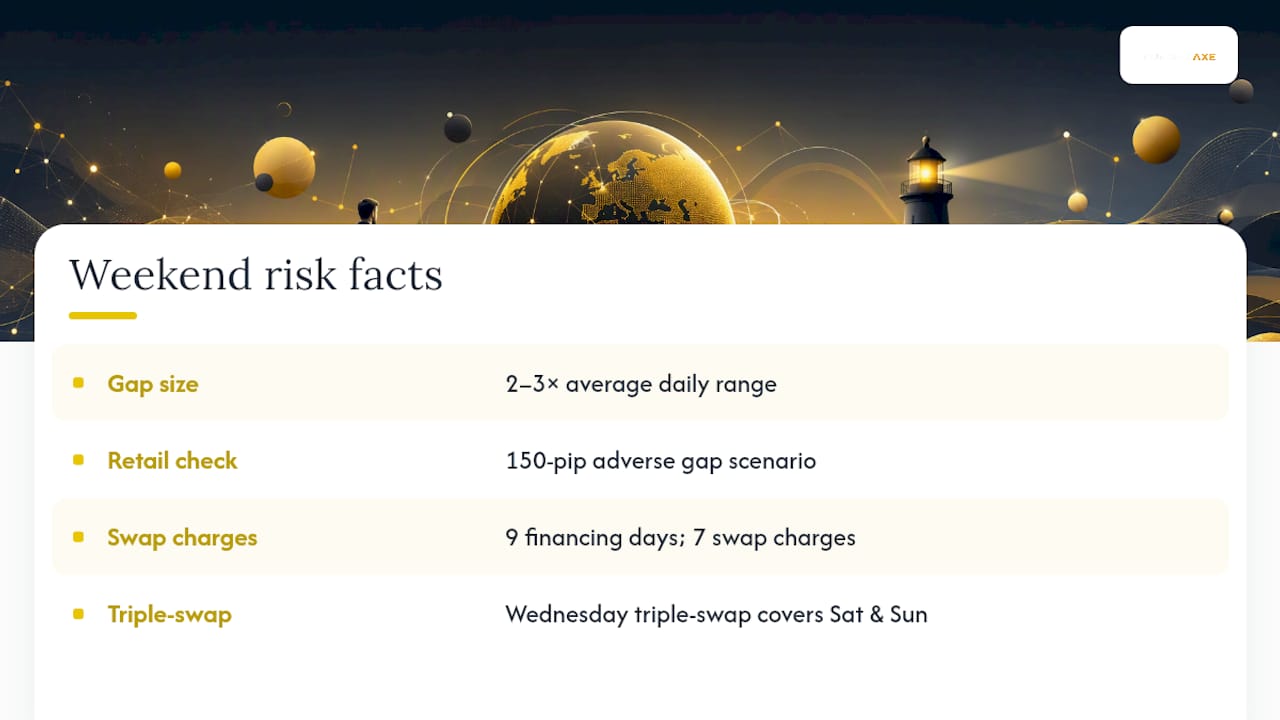
Operational note: Professional trading desks model weekend gap risk into their margin and stress-test calculations explicitly. They assume a worst-case gap scenario (typically 2–3 times the average daily range) and size positions so that even the worst-case gap doesn't breach risk limits. Retail traders should apply the same logic: before holding any position into the weekend, calculate what a 150-pip adverse gap would do to your account balance.
Swap mechanics add another layer. Because forex settlement uses T+2 (trade date plus two business days), Wednesday's swap charge covers Saturday and Sunday's financing. A position opened Monday and held through the following Monday accumulates nine days of financing but only seven swap charges — the Wednesday triple-swap accounts for the two missing weekend days. For carry-positive positions this is neutral; for carry-negative ones, it's a cost that compounds across weeks.
Pro Tip: Trading desks use "gap scenarios" in their pre-weekend risk reviews: they model the position P&L at Friday close, then at Friday close minus 150 pips, then at Friday close plus 150 pips. Run the same three-scenario check on your own positions every Friday afternoon. It takes five minutes and prevents the most common weekend surprise.
Is weekend forex trading actually worth it for retail traders?
Most retail traders should not be actively trading forex on weekends. The combination of wider spreads, gap risk, broker-priced instruments, and reduced liquidity means the risk/reward ratio is structurally worse than weekday trading in almost every scenario. That's not a conservative opinion — it's what the mechanics of weekend instruments produce.
The exception is crypto. If you trade crypto pairs, the weekend is simply part of your trading week. Continuous markets don't have a weekend problem; they have a volatility management problem, which is a different challenge with different tools.
For FX-focused retail traders, the most productive weekend use is preparation: reviewing the week's trades, updating your watchlist, testing setups in demo, and running the pre-weekend checklist on any positions you're holding. The traders who consistently perform well on funded accounts aren't the ones who trade more on weekends — they're the ones who use weekends to trade better the following week.
One nuance worth flagging: weekend trading on prop firm accounts for swing traders carries specific rule considerations. Some prop firms restrict weekend holding or charge additional fees for it. Fundedaxe explicitly allows weekend holding and offers swap-free as an add-on, which changes the calculus for carry-sensitive strategies. But even with those conditions in place, the structural risks of weekend FX instruments don't disappear — they just become manageable with the right sizing and preparation.
The traders who get hurt on weekends aren't usually the ones who planned to trade on weekends. They're the ones who forgot to close a position Friday afternoon.
Practice weekend strategies safely with Fundedaxe
Weekend holding is explicitly allowed on all Fundedaxe simulated funded accounts, and swap-free is available as an add-on for traders who want to eliminate carry costs on held positions. That combination makes Fundedaxe a practical environment to test weekend strategies before risking live capital.

The Pay After Pass evaluation starts at $9.99 upfront — you pay the remaining challenge fee only after you pass, not before. There are no consistency rules, no time limits, and news trading is permitted alongside weekend holding. For traders who want to test gap-trade setups, pre-weekend hedging strategies, or crypto-as-sentiment approaches in a simulated funded environment, Fundedaxe's free $1,000 trial account (no card required) is the lowest-friction starting point. Compare all challenge packages to find the account size and evaluation structure that fits your weekend trading plan.
Trading involves risk. All Fundedaxe accounts are simulated — rewards are paid in real money based on simulated performance under the Fundedaxe trader agreement.
Sources
- Forex market trading hours
- Weekend forex trading — why the market is closed and the gap
- Weekend trading: what's open and what isn't
- How to start forex trading | Saxo
- Directive 2014/65/EU of the European Parliament and of the Council (MiFID II)