

Yes, prop firms that allow weekend holding exist, but the permission is rarely unconditional. Most gate it by account phase, instrument, or a paid add-on, so a firm advertising "weekend trading allowed" for evaluations can still flatten you on a funded account. The fix is simple: look for rulebook parity between evaluation and funded phases before you fund anything, and use the checklist later in this guide to verify it in writing, not marketing copy.
TL;DR:
- Most prop firms restrict weekend holding by account phase or instrument, so verify rule parity between evaluation and funded accounts in writing.
- Forex market gaps are typically 10 to 20 pips, but larger gaps can occur unexpectedly during major geopolitical or economic events, risking account drawdown.
- Crypto trading avoids classic gaps since markets never close, but funding costs and rules still create distinct weekend risks.
- Checking for fee add-ons, instrument exclusions, and automatic closures in the rulebook helps traders avoid hidden restrictions or costs.
- Using a free trial account or Pay After Pass can help traders test weekend holding strategies without risking significant capital upfront.
Table of Contents
- What Does Weekend Holding Actually Mean for Prop Traders?
- What Rule Patterns Show Up Across Prop Firm Rulebooks?
- How Do Gaps and Swaps Actually Eat Your Trading Edge?
- How Do You Choose a Weekend-Friendly Prop Program?
- How Fundedaxe Supports Traders Who Hold Over Weekends
- Why Most Weekend-Holding Advice Misses the Real Risk
- Start Weekend-Friendly on Fundedaxe
- Verify the Rules Before You Hold
- Sources
What Does Weekend Holding Actually Mean for Prop Traders?
Weekend holding means keeping a position open from Friday's close through the next session open, which lands Sunday evening for forex and crypto and Sunday afternoon for most futures contracts. It sounds like one concept. It is not. Forex markets close entirely between Friday afternoon and Sunday evening (US time), leaving positions frozen and unable to react to news that breaks during the gap. Futures follow exchange-specific calendars; the CME's E-mini S&P 500 (ES) reopens Sunday evening but halts for maintenance windows most weekdays too. Crypto never really closes, which changes the entire risk conversation.
Firms don't treat these three markets the same way, and that's the part most traders miss. A prop firm's weekend holding policy often defines "weekend holding" instrument by instrument rather than account-wide, meaning your EUR/USD swing might be fine while your gold position gets excluded entirely.
Daily loss limits are where the real danger hides. Most firms calculate daily loss on floating equity, not closed profit and loss, and they don't pause that calculation because markets are closed. If Sunday's open gaps against you by enough to breach your daily loss threshold the instant trading resumes, the account can be flagged or closed before you've had a chance to react. There's no grace period for a weekend gap; the enforcement clock doesn't know it's Monday.
"Allowed" can still mean restricted in practice. Common patterns include:
- Weekend holding permitted during evaluation but revoked once you're funded.
- Permission covers major forex pairs but excludes indices, metals, or exotics.
- A firm allows it but charges a swap or holding fee that erodes the trade's edge.
- Crypto positions face no market closure but still accrue funding costs that behave like a slow weekend tax.
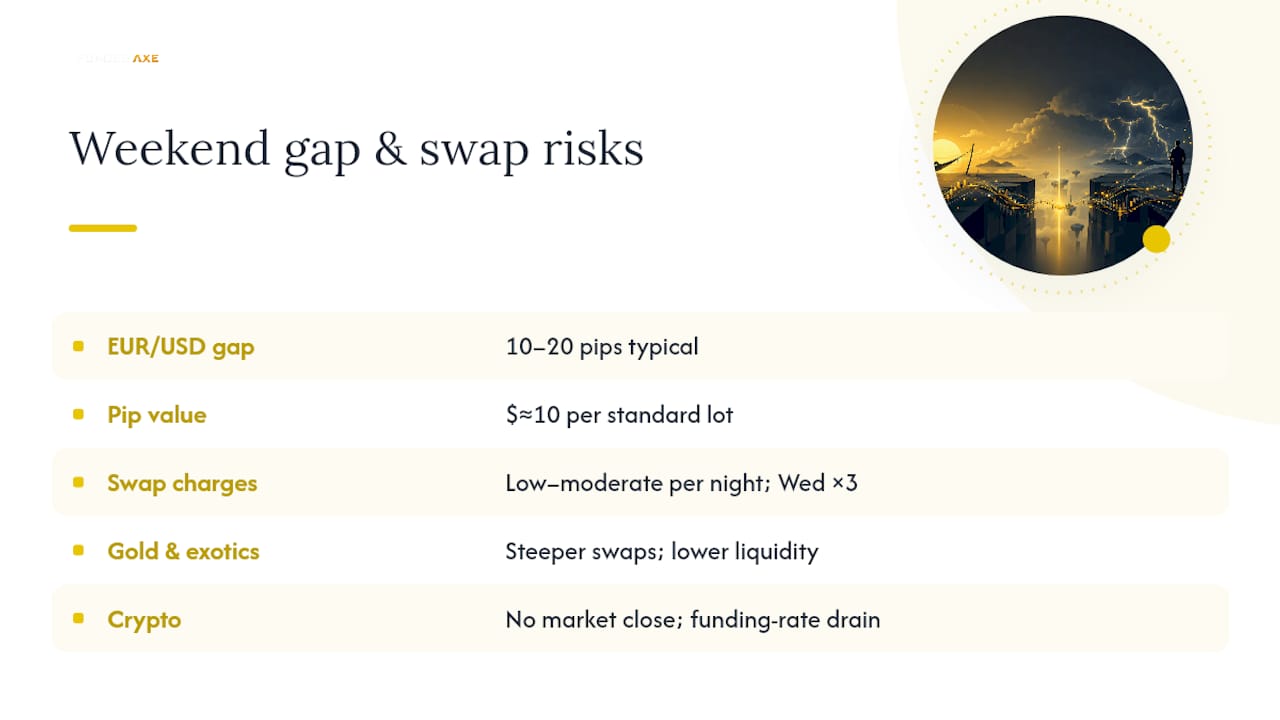
A typical EUR/USD weekend gap runs 10 to 20 pips, which barely dents a well-sized position. But occasionally, large gaps occur around major geopolitical or central bank surprises, and on a $50,000 account trading standard lots, such swings can consume a significant portion of a typical daily loss allowance.
What Rule Patterns Show Up Across Prop Firm Rulebooks?
Reading prop firm rulebooks feels like reading three different contracts stitched together, because most firms mix and match these four policy types depending on account phase and product line:
- Unrestricted weekend holding. Applies across evaluation and funded phases, no add-on required, though it's less common than marketing pages suggest.
- Program-dependent holding. Weekend holding exists as a specific product tier, often called a "swing account" or unlocked through a paid add-on.
- Evaluation-only holding. You can hold over the weekend while proving yourself but lose that right the moment you get funded, which quietly kills swing strategies right when real money is on the line.
- Funded-only holding. Rarer, but some firms restrict weekend exposure during evaluation to control blow-up risk, then loosen rules once you've demonstrated consistency.
Instant funding products complicate this further. Skipping the evaluation sounds convenient, but instant accounts sometimes carry their own separate weekend clause, unrelated to whatever the standard challenge track allows. Add-ons that unlock weekend holding, swap-free trading, or higher leverage all raise the effective cost of running a swing strategy, and that math matters more the smaller your account size.
Rule taxonomies documented across the industry consistently show program parity, meaning the same weekend rule applying in both evaluation and funded phases, as the single strongest predictor of whether a firm actually fits a swing trader's needs. Everything else is secondary.
Instrument caveats deserve their own scrutiny. Crypto trades 24/7 so there's no classic weekend gap, but perpetual contracts still charge funding rates that behave differently than a forex swap. Futures follow the exchange's own calendar, meaning a Friday close on ES doesn't line up neatly with a Friday close on EUR/USD, and traders juggling both often misjudge when their real "weekend" risk window starts.
Pro Tip: Skim the rulebook for the phrase "subject to change" near any weekend clause. Firms that reserve unilateral rule changes without notice are telling you exactly how much you can trust their current policy.
When you're scanning a rulebook fast, three lines tell you almost everything: does the weekend clause repeat identically in both the evaluation and funded sections, does the daily loss definition reference "equity" or "balance," and is there a separate fee schedule for swap or holding costs. If any of those three is missing or vague, treat the firm as unverified until support confirms it in writing.
How Do Gaps and Swaps Actually Eat Your Trading Edge?
Every weekend hold carries two costs traders underestimate: the price gap itself, and the ongoing charge for holding the position at all. Swap, sometimes called rollover, is the interest rate differential between two currencies applied nightly, but on Wednesdays most brokers apply a triple charge to account for weekend settlement. Hold a position through a weekend and you're paying that triple swap regardless of whether the market moved a single pip.
Typical costs vary by pair and direction, but per-lot swap charges on major pairs commonly run from low to moderate amounts per night, and triple-charged Wednesdays increase this cost more than many swing traders expect. Gold and exotic pairs often carry steeper costs because of wider interest rate spreads and lower liquidity.
Gap risk stacks on top of that. Average EUR/USD weekend gaps run 10 to 20 pips, but the tail events matter more for account survival than the average.
Occasionally, gaps exceeding large pip amounts occur on EUR/USD following major weekend news, and futures contracts like ES can gap even wider in point terms when a Sunday session opens after a significant geopolitical shock.
Here's a worked example. Say you're running a funded account with a daily loss limit capped at a small percentage of the account. You hold one standard lot of EUR/USD over the weekend, where each pip is worth roughly $10. An adverse gap costing tens of pips results in several hundred dollars lost outright, before spread or swap. Add several nights of swap charging a few dollars per lot and you've lost some additional amount, trivial by comparison but not zero.
Weekend holding is most defensible on liquid major forex pairs with wide stops already built into the plan, and least defensible on thinly traded exotics, leveraged metals, or any position sized as if the weekend carries the same risk as a Tuesday afternoon. Crypto positions on prop programs sidestep the classic gap entirely since the market never closes, but funding-rate drains and equity-based limit enforcement still apply, so the risk doesn't disappear so much as change shape.
How Do You Choose a Weekend-Friendly Prop Program?
Vetting a firm's weekend policy takes about fifteen minutes if you know exactly what to check, and skipping that fifteen minutes is how most swing traders end up blindsided on a Monday morning. Run through this before you ever fund a challenge:
- Confirm rule parity. Read the weekend clause in both the evaluation and funded sections. If the wording differs at all, assume the more restrictive version applies once you're funded.
- Check the daily loss definition. Does it reference floating equity or closed balance? Equity-based enforcement means weekend gaps count immediately on Monday's open.
- Ask how drawdown gets enforced. Some platforms auto-flatten positions the instant equity breaches a threshold, with no manual override window.
- Price the add-ons. If weekend holding requires a paid upgrade, calculate whether your typical swing trade's expected profit justifies that fixed cost.
- Verify instrument coverage. A firm might allow forex holds but exclude indices, metals, or single-stock CFDs from the same weekend policy.
- Confirm EA and news trading allowances. Some firms that permit weekend holding still restrict algorithmic entries or trading through high-impact news windows.
- Check payout timing. Understand how holding positions interacts with your next scheduled reward request.
Once the firm checks out, the real discipline happens every Friday afternoon. Reduce position size on anything you plan to carry, since the risk regime over a weekend is fundamentally different from intraday exposure, not just smaller in scale. Consider partial closes to bank some profit and reduce the notional at risk. Move stops to reflect a realistic Monday gap scenario rather than your normal intraday distance, and set price alerts so you're not blindsided if the Sunday open moves hard against you.
Pro Tip: Build a written "Friday checklist" naming which instruments you always close, which you'll hold with reduced size, and where your stops move. Turning the hold/close decision into a fixed rule set removes the temptation to gamble on a feeling.
Watch for red flags that should end the conversation immediately: funded-only weekend permission with no matching evaluation clause, an add-on priced high enough to erase a typical swing trade's edge, or any mention of automatic forced closes without advance notice. Firms serious about supporting swing traders spell out their weekend rules clearly in their published documentation rather than burying the caveats in a support ticket response.
How Fundedaxe Supports Traders Who Hold Over Weekends
Fundedaxe builds weekend holding into the account structure itself rather than treating it as a bolt-on privilege. Weekend holding is allowed, EAs and algorithmic trading are permitted, and news trading isn't restricted, which matters if your swing setups depend on catching momentum through a scheduled release. Leverage runs up to 1:100, and a swap-free add-on is available for traders who want to remove the nightly and triple-Wednesday holding cost from the equation entirely.
The detail that matters most for swing traders specifically is phase parity. The same weekend rules that apply during your evaluation carry through once you're funded, so there's no unpleasant surprise the week you finally get paid.
| Feature | What it means for weekend holding |
|---|---|
| Pay After Pass | Start an evaluation for $9.99, pay the remaining fee only after passing |
| Weekend holding allowed | Applies across evaluation and funded phases |
| Swap-free add-on | Removes nightly and weekend holding charges |
| Free $1,000 trial account | Test weekend holds with no card or deposit required |
| Static drawdown | Balance-based, no trailing recalculation that punishes early gains |
If you're deciding whether a swing approach fits your trading, the free simulated $1,000 trial account is the lowest-risk way to test how weekend holds behave in practice before committing real evaluation fees. Pay After Pass keeps the upfront cost to under $10, which changes the math for anyone who wants to test a swing thesis without paying full price for a challenge that might not fit their timeframe.
Why Most Weekend-Holding Advice Misses the Real Risk
The conventional advice on weekend holding treats it as a binary: either a firm allows it or it doesn't. That framing misses where traders actually get hurt, which is the gap between evaluation rules and funded rules. A firm can advertise weekend trading loudly on its marketing page while burying a phase restriction three pages into the actual agreement.

What's overrated is obsessing over average gap size. Averages don't blow up accounts; tail events do, and they happen rarely enough that traders talk themselves into ignoring them until the one weekend it matters. What's underrated is reading the daily loss definition itself. Equity-based enforcement with no grace period is the mechanism that actually ends accounts, not the gap in isolation.
If you trade swings, prioritize rule parity over headline permission. Verify it in writing, size weekend positions as a distinct risk category, and test the behavior on a trial account before risking a real challenge fee.
— Jean
Start Weekend-Friendly on Fundedaxe
Fundedaxe is the direct route for swing traders who need weekend holding without gambling on whether a firm's rules survive the jump from evaluation to funded. The package comparison page lays out every account size and evaluation type side by side, so you can match your swing risk tolerance to the right static drawdown and reward split before paying anything.

Pay After Pass keeps your upfront cost to $9.99 while you confirm weekend holding, EA support, and news trading behave the way this guide describes. If you'd rather test it with zero cost first, the free $1,000 simulated trial account gives you a real feel for holding through a Friday close before you commit. Ready to pick your account size and evaluation type? Head to the Fundedaxe challenges page and start the evaluation that matches your swing strategy.
Verify the Rules Before You Hold
Rulebooks change, and the firm's own documentation always outranks a summary article, including this one. Check these sources directly before committing capital to a weekend hold:
- Weekend Holding Rules for Prop Firms | PropJournal for definitions and typical gap-size data.
- Weekend Holding Rules at Prop Firms | PropScorer for policy-to-strategy matching.
- Prop Firm Rules Explained for a breakdown of evaluation versus funded conditions.
- Trading Hours, Rollover and Session Rules for instrument-specific session calendars.
Sources
- Weekend Holding Rules for Prop Firms (2026) | PropJournal
- Prop Firms That Allow Weekend Holding | TheGodFunded
- Weekend trading on a crypto prop firm: rules & risks | Roya Trading