

Most prop firms technically allow scalping, but "allowed on paper" and "workable in practice" are two different things. Whether your strategy survives depends on four rule categories: the minimum-hold boundary, the drawdown model, daily loss limits, and consistency or payout rules. Check each one in the firm's actual terms before you buy a challenge, not after you get a rejection email.
TL;DR:
- Most prop firms' rules on paper do not reflect actual scalping restrictions, so reading the full terms before starting is essential.
- Static drawdown models benefit scalpers by preventing the ratchet effect that penalizes quick gains during sessions.
- Spotty execution quality, high latency, and untested platform support can erase a scalper’s edge despite favorable rule sets.
- Tighter risk controls, such as risking no more than 1% per trade and monitoring hold times, boost survival chances in evaluations.
- Firms like FundedAxe offer clear, scalper-friendly conditions, including no time limits, static drawdowns, and support for automated strategies.
Table of Contents
- The Four Rule Categories That Decide Scalping Compatibility
- Execution, Platform Support, and Latency: Why Fills Matter
- Holding-Time Rules, Automation, and Banned Micro-Scalping Patterns
- Markets and Instruments That Suit Scalpers in Funded Accounts
- Risk Management Scalpers Should Apply Before and After Funding
- FundedAxe's Approach to Scalping-Friendly Rules
- What Successful Scalpers Change When They Go Funded
- How FundedAxe Supports Scalpers Who Want Clear Rules
- Sources
- FAQ
The Four Rule Categories That Decide Scalping Compatibility
A firm's marketing page saying "scalping allowed" tells you almost nothing. The rule text tells you everything, and it's usually buried three clicks deep in the terms of service.
Minimum-hold rules set a floor on how long a position must stay open before it counts as a legitimate trade. Some firms write this loosely ("no excessive scalping"), others write a hard number: trades closed under 5 to 10 seconds get flagged or excluded from profit calculations. If your average hold time is 3 seconds, that firm's rule just deleted your entire edge on paper even though the marketing copy never used the word "banned."

Drawdown model is the bigger trap. A static drawdown calculates your loss limit against the starting balance and stays fixed. A trailing intraday drawdown ratchets upward with every new equity peak, which means a scalper who runs $600 profit mid-session just watched their allowable loss tighten in real time. Give back $400 of that on the next three trades and you can breach a limit that never would have touched you under a static model. This ratchet effect is the single most common reason profitable scalpers fail evaluations they should have passed.
Daily loss limits matter more for scalpers than for swing traders simply because of trade volume. Ten trades a day means ten chances to stack small losses into a session stopout, especially in the first hour when spreads are wider and fills are less predictable.
Consistency and payout rules hit last, and they hit hardest. Profit-contribution tests can cap how much of your total gain is allowed to come from any single day. A scalper who nails one volatile session and grinds flat the rest of the month can meet the profit target and still get denied a payout, because the consistency trap treats concentrated returns as a red flag rather than a win.
- Minimum-hold boundary: often 5 to 10 seconds, sometimes unstated
- Drawdown model: static (balance-based) versus trailing intraday
- Daily loss limits: fixed dollar or percent, checked intraday or end-of-day
- Consistency/payout rules: caps on single-day profit contribution
Execution, Platform Support, and Latency: Why Fills Matter
Rules on paper mean nothing if your fills don't match your backtest. Scalping lives and dies on execution quality, and that comes down to platform and connection, not strategy theory.
MetaTrader 5, Rithmic, and NinjaTrader cover most of the funded-account market, and each behaves differently under load. MT5 is the standard for forex-focused evaluations. Rithmic and NinjaTrader dominate futures execution, where tick charts, Level 2 data, and consistent fills are treated as baseline requirements, not extras.
Here's how to validate execution before you commit real money to a challenge fee:
- Run a VPS colocated near your broker's or platform's data center, targeting ping under 20 to 30 milliseconds where possible.
- Test the qualification environment specifically, since some firms route demo accounts through different servers than live evaluations.
- Place a series of small test orders during both quiet and volatile hours to measure real slippage against your expected fill price.
- Set up hotkeys for market and limit orders so entry speed doesn't cost you the spread advantage you're scalping for.
- Log every fill discrepancy for a week before scaling up size.
Pro Tip: A free trial that mirrors the actual qualification server, not a generic demo, is the only real way to know if your scalping edge survives contact with a firm's live execution stack.
Holding-Time Rules, Automation, and Banned Micro-Scalping Patterns
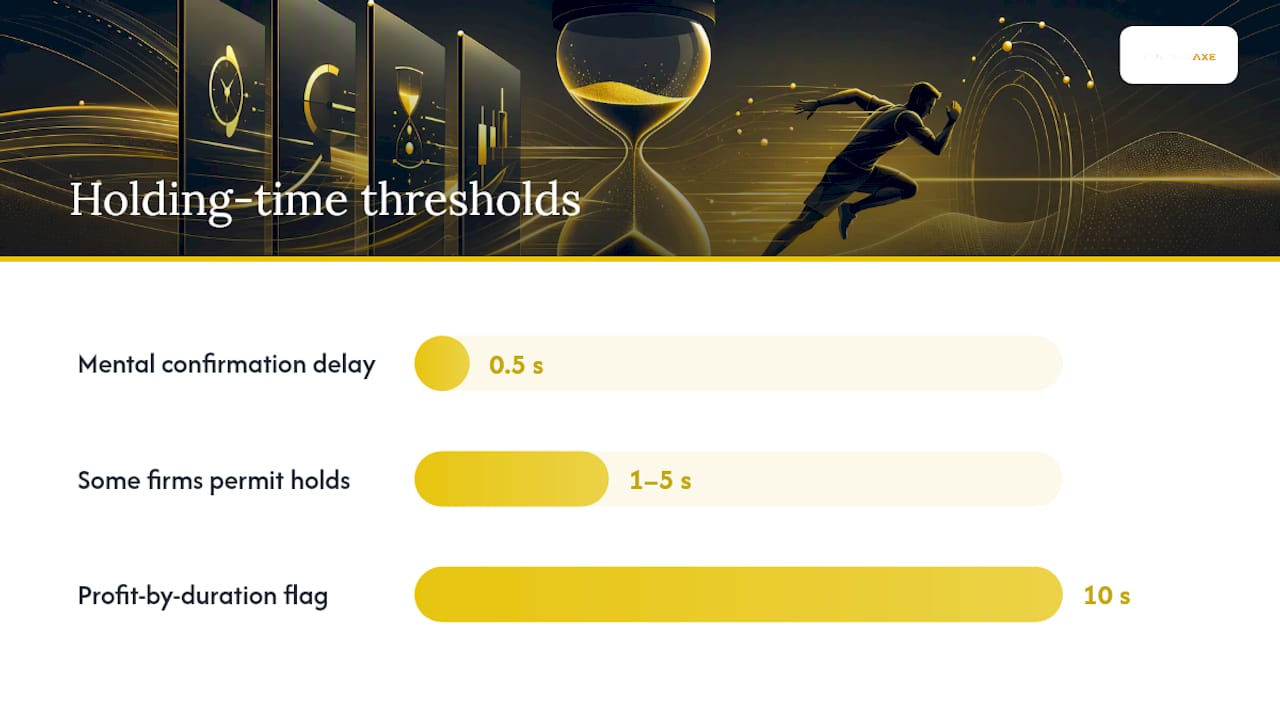
Firms don't all draw the line at the same spot. Some explicitly permit holds as short as 1 to 5 seconds, while others run profit-by-duration tests that flag any trade where more than half the gain comes from positions held under 10 seconds. That's a very different constraint than a blanket "no scalping" clause, and it rewards traders who actually read the fine print instead of assuming.
Automation gets treated the same nuanced way. Most firms allow trader-owned expert advisors when they execute normal discretionary-style logic, but explicitly ban high-frequency and latency-arbitrage setups that exploit gaps between a simulated feed and real market pricing. The distinction is intent: an EA that manages your existing trade plan is fine; a bot built to snipe stale quotes is not, and firms actively look for that pattern.
Practical adaptations that keep you compliant without gutting your edge:
- Add a half-second mental confirmation step before firing entries, which naturally pushes hold times past the shortest flagged bucket.
- Log every trade's duration alongside its result so you can see your own profit-by-duration distribution before a firm does.
- Avoid stacking multiple trades on the exact same tick, a pattern that reads as latency exploitation even when it isn't.
- Review a firm's stance on hedging and other banned strategies before assuming your setup is safe by default.
Markets and Instruments That Suit Scalpers in Funded Accounts
Futures generally give scalpers the cleanest environment: a centralized order book, fixed commissions per contract, and fills that don't depend on a broker's internal pricing model. That predictability matters when you're placing dozens of trades a day and every tick of slippage compounds.
Forex evaluations run almost entirely on the MT5 ecosystem, but spread variability between brokers and liquidity providers means the same strategy can perform differently across two firms using the same platform. CFDs carry the most caveats: spreads can widen sharply around news releases, and pricing is often model-based rather than pulled straight from an exchange feed.
- Futures: consistent fills, fixed costs, best for high-frequency micro-scalping
- Forex: MT5 standard, but spread quality varies by firm and liquidity provider
- CFDs: watch for spread expansion during high-impact news windows
- Session choice matters as much as the instrument. London and New York overlap hours generally offer tighter spreads than late-Asia sessions
Risk Management Scalpers Should Apply Before and After Funding
Surviving a scalping evaluation is less about strategy and more about position sizing discipline that respects the firm's rules before they force the issue.
- Cap risk per trade at 0.5% to 1% of account balance, then convert that percentage into actual ticks or pips for whatever instrument you're trading, since a flat dollar number means nothing without that conversion.
- Set a personal daily stop noticeably tighter than the firm's daily loss limit, so a bad morning doesn't force a session-ending breach later that afternoon.
- Watch for profit concentration. If one trade or one session is carrying most of your monthly gain, spread future risk more evenly to avoid tripping a consistency rule at payout time.
- Run a two-minute pre-session check: confirm VPS ping, confirm the day's news calendar, confirm your daily loss ceiling is set in the platform, not just in your head.
- Run a post-session check: log hold times, log slippage versus expected fill, and take a deliberate cooling-off period after any outsized win or loss before opening the next position.
Pro Tip: A profit spike that blows past your normal daily average is the moment to reduce size, not increase it. That single trade is exactly what a consistency rule will scrutinize later.
FundedAxe's Approach to Scalping-Friendly Rules
Some proprietary trading evaluations run on MetaTrader 5, permit expert advisors and algorithmic trading, and use a static drawdown model instead of a trailing intraday ratchet, which removes the mechanism most likely to punish a strong scalping session.
- No time limit on any evaluation phase, so a slow week doesn't force rushed trades
- No consistency rules, which removes the single biggest payout risk for concentrated scalping gains
- Some pay-after-pass models let traders validate execution before committing the full challenge fee
- News trading and weekend holding may be permitted in certain evaluations
These features map directly onto the rule checklist earlier in this piece. A static drawdown alone eliminates the ratchet effect that trips up so many scalpers at other firms.
What Successful Scalpers Change When They Go Funded
The traders who make the jump successfully stop treating every micro-move as a trade. They document their edge in writing, verify execution with a VPS and real logs instead of assuming their demo numbers hold, and build in a cooling-off period after any unusual spike. Size increases come gradually, tied to a track record, not to a good week.
— Jean
How FundedAxe Supports Scalpers Who Want Clear Rules
Some trading firms aim to provide clear scalping account conditions, such as static drawdown, no time limits, no consistency rules, and support for EAs on MetaTrader 5, allowing traders to build strategies against a stable rule set.

Start by testing your execution risk-free with the free $1,000 trial account, no card or deposit required. If your fills and latency check out, the Pay After Pass model lets you begin an evaluation for $9.99 and only pay the remaining base fee once you actually pass, which limits your upfront exposure while you confirm a strategy works under real conditions. From there, compare account sizes and phase structures on the package comparison page to find the 1-step, 2-step, or 3-step evaluation that fits how you trade.
Sources
- Prop Trading for scalpers: Getting the most out of high-leverage trading
- Prop Firms That Allow Scalping (1–5 second holds)
- 10 Key Rules for Scalping Futures | Practical Intraday
- Prop Firm Trading Rules Explained 2026: EAs, News, Copy Trading - PropFirmMap
FAQ
Is Scalping Allowed in Prop Firms?
Most firms with published policies allow scalping in some form, with one dataset showing 41 of 53 firms permitting it. Allowance often comes with conditions like minimum-hold times or automation restrictions, so the practical answer depends on reading the specific rule text, not just the marketing claim.
What Is the 3-5-7 Rule in Trading?
There's no single standardized "3-5-7 rule" recognized across prop firms or trading education. Definitions vary by source, so treat any specific version you encounter as one trader's personal framework rather than an industry standard.
Which Prop Firms Are Best for Scalpers?
The best fit for a scalper is a firm with a static drawdown model, no minimum-hold trap, and no consistency rule penalizing concentrated gains. FundedAxe meets that description with static drawdown, no time limits, and EA support on MetaTrader 5, though you should always confirm current terms before buying an evaluation.
What Is the Most Successful Scalping Strategy?
There's no single strategy proven universally most successful, since results depend heavily on instrument, session, and execution quality. What consistently separates working scalping approaches from failing ones is tight risk per trade, verified low-latency execution, and rules that don't punish normal short-term variance, as outlined in NinjaTrader's execution guide.