

For active retail forex traders who scalp or day-trade frequently on liquid majors, a raw-spread account usually delivers a lower all-in cost. For low-frequency or beginner traders, a standard account is often simpler and cheaper once you account for the per-lot commission a raw account charges on every single trade.
The core trade-off comes down to three things:
- Cost structure: Raw accounts charge a tight spread plus an explicit commission per lot. Standard accounts bundle the broker's fee inside a wider spread, so there's no separate commission line.
- Complexity: Raw accounts require you to calculate all-in cost yourself. Standard accounts show one number, which is easier to budget but harder to audit.
- Suitability: The more you trade and the larger your lots, the more the raw account's tighter spread outweighs its commission. Trade infrequently or in small sizes, and the standard account's simplicity often wins on total cost.
Key Takeaways
Raw-spread accounts cost less per trade for active traders on liquid majors, but only when the all-in cost (spread plus commission converted to pips) is lower than the standard account's bundled spread.
| Point | Details |
|---|---|
| All-in cost is what matters | Add spread pips and commission pips together; never compare headline spread figures alone. |
| Raw wins for high frequency | Scalpers and EA traders saving even 0.5 pips per trade accumulate significant cost advantages over many trades. |
| Standard suits beginners | No commission math, single visible cost, and simpler position sizing make standard accounts easier to manage early on. |
| Test before you commit | Run both account types on demo simultaneously for 24–72 hours during your actual trading session to record real spreads and slippage. |
| Exotics change the math | Raw accounts lose their edge on exotic pairs where interbank spreads are wide and unpredictable; check pair-specific averages. |
Table of Contents
- What is a raw-spread account, and how does a standard account differ?
- How do raw and standard accounts compare side by side?
- How do you calculate the true all-in cost of each account?
- Which trader profile actually benefits from each account type?
- What questions should you ask a broker before choosing an account?
- Common misconceptions about raw and standard accounts
- A practical note on testing real costs
- Ready to trade with costs that work for you?
- Sources
What is a raw-spread account, and how does a standard account differ?
Raw-spread accounts (also called ECN or STP accounts) pass the interbank bid/ask spread directly to you with minimal or no markup. The broker charges a separate, explicit commission per standard lot, typically per side or as a round-turn figure. Because the spread itself is not padded, you see prices very close to what liquidity providers are quoting. Execution tends to be faster and more transparent, since the broker earns from commissions rather than from widening your spread.
Standard accounts work differently. The broker, usually operating as a market maker, adds a markup on top of the raw interbank spread and quotes you the resulting wider price. There is no separate commission line. The fee is hidden inside the spread itself, which makes the account look "commission-free" but rarely is.
One execution implication worth noting: raw/ECN accounts route orders through a network of liquidity providers, which tends to reduce requotes and conflict of interest. Standard market-maker accounts fill orders internally, which can be faster in calm markets but introduces the possibility of spread manipulation during volatility.
How do raw and standard accounts compare side by side?
| Dimension | Raw-spread account | Standard account |
|---|---|---|
| Typical spread (EUR/USD, active hours) | 0.0–0.2 pips | 1.0–1.5 pips |
| Commission structure | $3–$7 round-turn per standard lot | None (fee in spread) |
| Execution model | ECN/STP, external liquidity | Market maker, internal fill |
| Cost transparency | High: spread + commission visible | Low: fee bundled in spread |
| Best for | Scalpers, EAs, high-frequency day traders | Beginners, swing traders, low-frequency |
| Volatility impact | Spread widens at source; commission fixed | Spread widens AND markup stays, amplifying cost |
A 2026 broker comparison matrix confirms that raw accounts on EUR/USD frequently average approximately a tenth to a third of a pip during active sessions, and when you add a typical moderate round-turn commission on a standard lot, the all-in cost remains well below the standard account spread. That's still well below the 1.0–1.5 pip standard spread on most retail accounts.
Typical commission range: $3–$7 round-turn per standard lot. At $10 per pip on a standard lot, a $5 commission equals 0.5 pips. Add a 0.2-pip raw spread and your all-in cost is 0.7 pips, compared to 1.2 pips on a standard account.
Scalpers and EA users benefit most from this gap. A scalper targeting 3–5 pips per trade on EUR/USD loses a much smaller percentage of their target profit to spread cost on a raw account. Swing traders holding positions for days care less about the per-trade spread and more about swap rates and overnight costs, which makes the standard account's simplicity more appealing. Beginners benefit from the single-number simplicity of a standard account while they're still learning to read position sizing and risk.
How do you calculate the true all-in cost of each account?
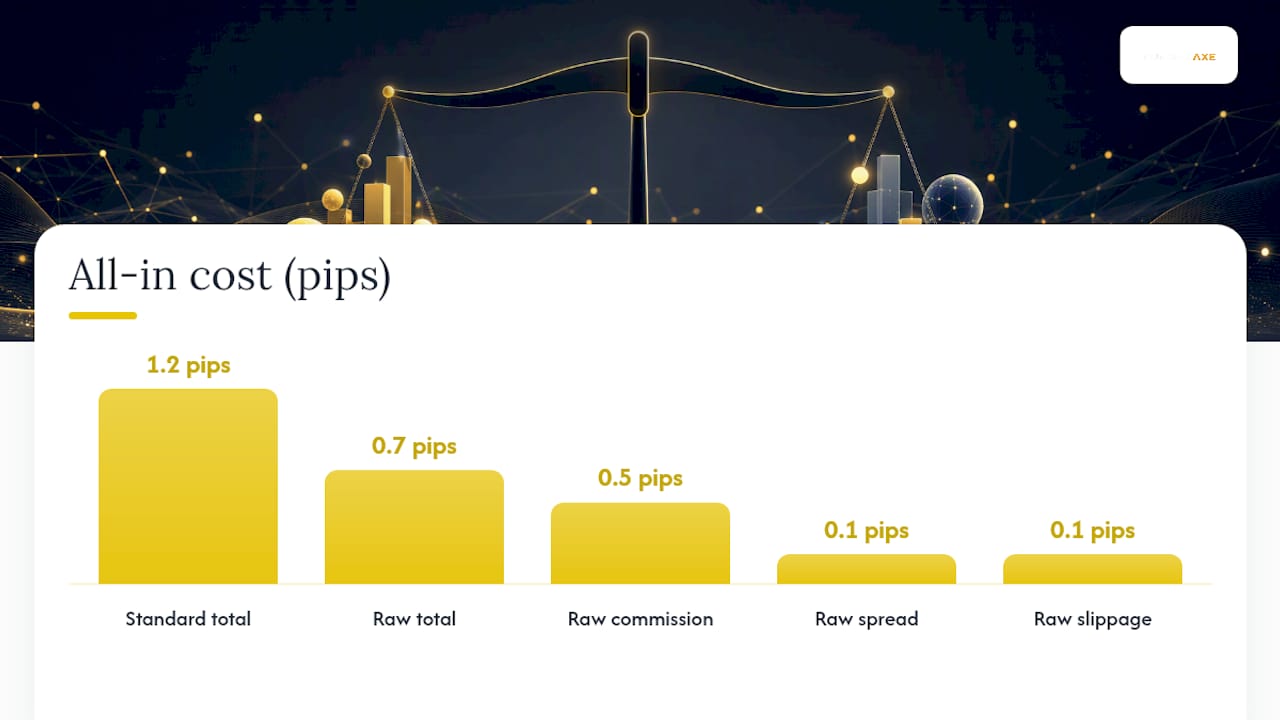
The correct method is to convert everything to a pip-equivalent at your lot size, then add spread, commission, and any slippage estimate.
Formula:
- Identify the spread in pips at the time of your trade.
- Convert round-turn commission to pips: divide commission in USD by the pip value in USD at your lot size. For a standard lot on EUR/USD, 1 pip = $10, so a $5 commission = 0.5 pips.
- Add spread pips + commission pips + estimated slippage pips.
- That total is your all-in cost per trade.
Example A: Scalper on EUR/USD, London–NY overlap
A scalper trades 1 standard lot on EUR/USD during peak liquidity. Raw spread: 0.1 pip. Commission: $5 round-turn = 0.5 pips. Slippage estimate: 0.1 pip. All-in cost: 0.7 pips ($7.00 per trade).
On a standard account with a 1.2-pip spread and no commission, the same trade costs $12.00. The raw account saves $5 per trade. At 20 trades per day, that's $100 saved daily.
Example B: Swing trader on EUR/USD, 2 trades per week
A swing trader takes 2 trades per week at 1 standard lot. Raw account: 0.2 pip spread + $5 commission = 0.7 pips = $7.00 per trade. Standard account: 1.2-pip spread = $12.00 per trade. Saving: $5 per trade, or $10 per week. At that frequency, the raw account still wins on cost, but the margin is small enough that swap differentials or platform fees can flip the result.
Slippage sensitivity table
Slippage hurts both account types, but spread doubling during a news event hits the standard account harder because the broker's markup compounds on top of the widened interbank spread.
Which trader profile actually benefits from each account type?
Scalpers and high-frequency day traders almost always come out ahead on a raw account. The math is straightforward: more trades mean more times the spread cost is paid, and even a 0.5-pip saving per trade compounds fast across dozens of daily entries.

Algorithmic and EA traders share the same logic. Automated strategies often execute dozens to hundreds of trades per session, and the commission-based raw model gives them predictable, auditable costs per lot, which is easier to factor into backtests and live performance tracking.
Swing and position traders are less clear-cut. If you're holding EUR/USD for three days, the spread cost is a one-time entry and exit expense. A standard account's 1.2-pip spread on entry and exit costs $24 round-trip on a standard lot. A raw account costs $14 ($7 each way). That $10 saving matters less when your target profit is 100 pips ($1,000). Swap rates, which apply every night you hold, often dwarf the spread difference entirely.
Beginners benefit from starting on a standard account. There's no commission math to manage, no per-lot fee to forget when sizing positions, and the all-in cost is visible in the spread. The day trading beginner's guide at Fundedaxe covers how early traders can build habits around cost awareness before switching to a raw account.
Pair selection shifts the recommendation too. On EUR/USD, GBP/USD, or USD/JPY during London or New York hours, raw accounts shine because liquidity is deep and spreads stay tight. On exotics like USD/TRY or USD/ZAR, raw spreads can be wide and unpredictable, and the commission still applies, so the standard account's fixed markup can actually be cheaper. The BIS FX turnover data shows that major pairs dominate global volume, which is exactly why raw accounts are optimized for them.
For funded-account applicants, raw accounts tend to align better with challenge rules. Tight spreads mean your profit target is easier to reach per trade, and the explicit commission makes cost modeling more precise. Fundedaxe's forex prop trading guide covers how spread drag affects funded-account performance across pairs and sessions.
What questions should you ask a broker before choosing an account?
Before committing to either account type, run through this checklist:
- What is the average spread on EUR/USD by session (London, New York, Asian)? Ask for published stats, not just "from 0.0 pips."
- What is the exact round-turn commission per standard lot? Is it tiered by volume?
- What execution model does the account use: ECN, STP, or market maker?
- What platforms are supported, and what is the typical order latency?
- Are swap/rollover rates published, and do they differ between account types?
- What is the minimum deposit, and does it affect execution priority or lot-size restrictions?
- Are average spreads published by hour or session, not just as a single daily average?
Red flags to watch:
- "From 0.0 pips" marketing with no published average spread data by session.
- Commission language buried in footnotes or described as a "platform fee" rather than a per-lot charge.
- No regulatory disclosure of execution model or order routing.
- Average spread statistics that only cover the quietest market hours.
Quick test protocol: Open a demo or micro account for both account types simultaneously. For 24–72 hours, record the actual spread at the open of each trade you would take with your real strategy. Note slippage on any market orders. BrokerChampion's spread comparison guide recommends re-running this check quarterly, since broker pricing drifts as their liquidity arrangements change. The CFTC's retail forex advisory also recommends verifying broker disclosures and execution statements before committing capital.
Common misconceptions about raw and standard accounts
"Zero spread" means free trading. It doesn't. A 0.0-pip spread with a $7 round-turn commission costs 0.7 pips on a standard lot. The Benzinga comparison makes this explicit: the honest comparison is always all-in cost, not the headline spread figure.
"No commission" means cheaper. Standard accounts hide the broker's fee inside the spread. A 1.2-pip spread on EUR/USD includes roughly 0.8–1.0 pips of broker markup on top of the interbank rate. That's not free; it's just less visible.
Real risks to track:
- Spread widening during news: On raw accounts, the interbank spread widens sharply around NFP, FOMC, or CPI releases. On standard accounts, the markup compounds on top of that widening.
- Slippage: Both account types experience slippage, but ECN/STP raw accounts can show more slippage during thin liquidity because orders go to external providers.
- Commission tiers: Some brokers reduce per-lot commission at higher monthly volumes. If you're trading at low volume, you may be paying the highest commission tier without knowing it.
- Platform fees: A few brokers charge a separate platform or data fee that doesn't appear in the spread or commission. Always ask.
Pro Tip: Before you compare two accounts, convert the standard account's spread to a dollar cost and the raw account's commission to a pip-equivalent at your exact lot size. Only then do the numbers sit on the same scale.
A practical note on testing real costs
The most reliable way to confirm which account type actually suits your trading is to run both simultaneously on demo for a week, using the same entry signals and lot sizes you'd use live. Record the spread at the moment of each entry, the fill price versus the quoted price (slippage), and the commission deducted. After 30–50 trades, the all-in cost difference becomes statistically meaningful.
One thing experienced traders do that beginners miss: they sample spreads specifically during the session they trade, not across the full 24-hour day. A raw account that averages 0.1 pips during London hours might average 0.8 pips during the Asian session when liquidity thins. If you trade Asian hours, that changes the math entirely.
For funded-account applicants, this matters even more. Every pip of unnecessary spread cost works against your profit target. Fundedaxe's spreads and commissions guide walks through exactly how execution costs interact with challenge targets.
Ready to trade with costs that work for you?

Fundedaxe gives you simulated funded accounts up to $400,000 on MetaTrader 5, with leverage up to 1:100, no consistency rules, and news trading allowed. The Pay After Pass challenge starts at $9.99 upfront and you only pay the remaining fee after you pass. There's also a free $1,000 simulated trial account with no card required.
Start your funded challenge at Fundedaxe
Sources
- Customer Advisory: Must Know Forex (CFTC)
- 2026 Global Forex spread & commission comparison matrix (BrokerAnalysis)
- EUR/USD spread comparison: 42 brokers tested
- Spread vs Commission: Standard vs Raw account costs compared (KenMacro)
- Raw Spread vs. Standard Account for Forex Traders — Benzinga
This article is general information, not a substitute for advice from a qualified financial advisor. Consult a qualified financial professional about your own circumstances before acting on anything here.