

U.S. prop firm payouts are taxable as ordinary self-employment income in most cases. Report them on Schedule C and pay self-employment tax via Schedule SE. That's the short answer. Here's what to do right now:
- Set aside a tax reserve. A working rule of thumb among CPAs is to set aside a portion of each payout to cover federal income tax, self-employment tax, and state tax combined. The exact percentage depends on your income level and state, but starting at 30% is a reasonable default for most traders.
- Start a payout log today. For every payout, record the date, gross amount, payment method, and the payer's name. Save the confirmation email and the corresponding bank deposit. You'll need this whether or not a 1099 arrives.
- Make quarterly estimated payments if you expect to owe $1,000 or more. Use Form 1040-ES to calculate and submit payments. Missing them triggers underpayment penalties even if you pay in full at filing.
Key takeaways
Prop firm payouts are taxable as ordinary self-employment income in the U.S., reported on Schedule C and Schedule SE, with quarterly estimated payments required once expected tax liability reaches $1,000.
| Point | Details |
|---|---|
| Payouts are ordinary income | Report gross payouts on Schedule C; self-employment tax applies via Schedule SE. |
| You're taxed on cash received | Simulated account balances don't create taxable income; only actual payouts do. |
| Deductions reduce both taxes | Business expenses cut Schedule C net profit, lowering both income tax and SE tax. |
| Quarterly payments are required | Use Form 1040-ES if you expect to owe $1,000 or more; safe harbor is 90% of current-year tax or 100%/110% of prior-year tax. |
| Fundedaxe provides payout statements | Documented payout records from Fundedaxe simplify Schedule C reporting for U.S. traders. |
Table of Contents
- How prop firm taxes actually work in the U.S.
- Which legal structure fits your tax situation?
- What expenses can you deduct as a prop trader?
- Which IRS forms apply, and what do you do without a 1099?
- How to calculate and pay quarterly estimated taxes
- Should you elect mark-to-market under Section 475(f)?
- State and local taxes add another layer
- Three worked tax examples for U.S. funded traders
- What to do when your prop firm is offshore or skips the 1099
- A practical note on staying ahead of the tax curve
- Fundedaxe makes payout documentation straightforward
- Sources
How prop firm taxes actually work in the U.S.
The IRS looks at the substance of what you're doing. When a prop firm pays you a profit split for trading their simulated account, you're performing a service. That makes the payout compensation income, not a capital gain. Investing puts it plainly: you're taxed on the cash that hits your bank account, not on simulated profits or unrealized balances inside the funded account.
That distinction matters more than most traders realize. Your funded account might show $50,000 in simulated gains, but if you only withdrew $18,000 in payouts, your taxable income is $18,000. Nothing more.
The income flows like this: gross payouts go on Schedule C as business revenue. Subtract deductible expenses to get net profit. That net profit flows to Form 1040 as ordinary income and to Schedule SE for self-employment tax. IRS guidance on self-employment tax confirms that Schedule SE funds Social Security and Medicare and is calculated separately from federal income tax.
Pro Tip: Many funded traders assume their payouts are capital gains because they're trading. They're not. The firm owns the capital; you're paid a split for your service. That's ordinary income, and the IRS treats it accordingly.
| Income Type | Tax Rate | SE Tax? | Deductible Expenses? | Reported On |
|---|---|---|---|---|
| Ordinary self-employment (prop payout) | Ordinary income rates | Yes, 15.3% on net | Yes, Schedule C | Schedule C + Schedule SE |
| Capital gains (personal trading) | 15.3% | No | Limited | Schedule D |
| W-2 employee income | Ordinary income rates | No (employer pays half) | Very limited | W-2 / Form 1040 |
| K-1 partnership income | Varies by allocation | Sometimes | Depends on entity | Schedule K-1 |
Which legal structure fits your tax situation?
Most funded traders start as sole proprietors by default. If you're an individual receiving payouts under your Social Security number, you're already a sole proprietor. A single-member LLC changes nothing by default; the IRS treats it as a disregarded entity, so income still flows to Schedule C.
The four structures, ranked by complexity:
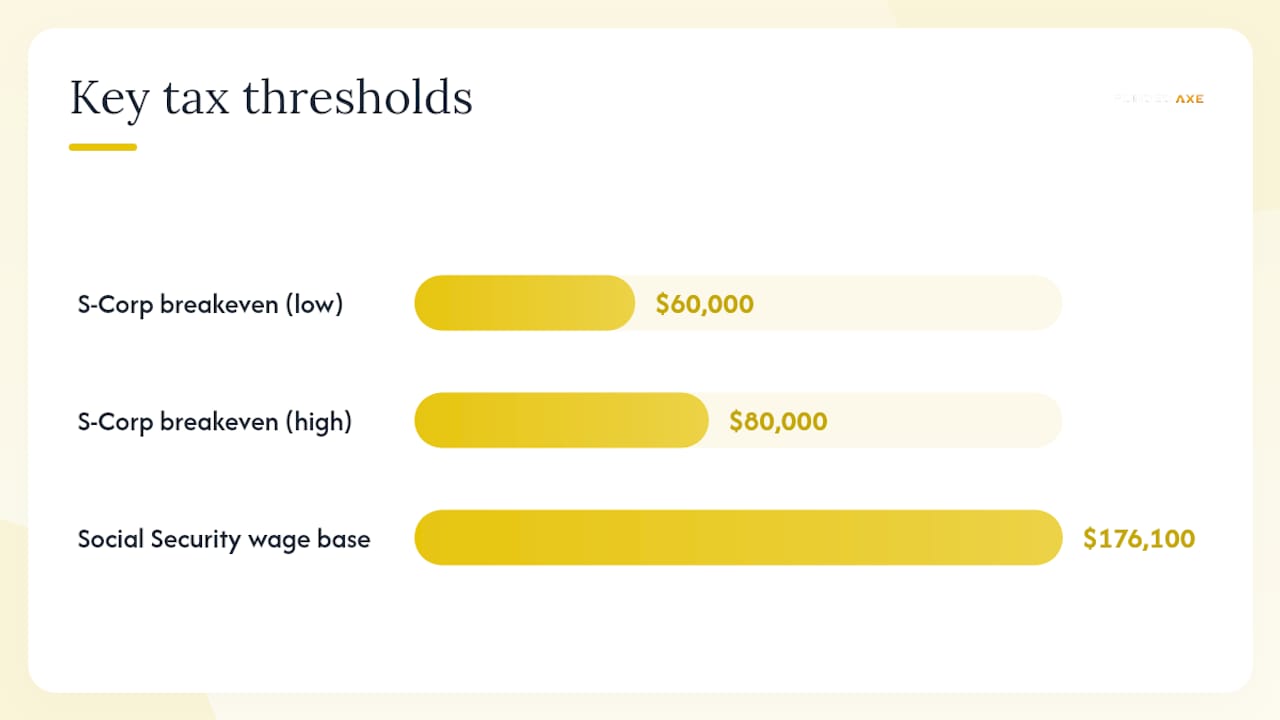
- Sole proprietor / single-member LLC (default): Simplest. All net profit is subject to self-employment tax at 15.3% up to the Social Security wage base ($176,100 for 2025), then 2.9% on amounts above that. No payroll, no separate business return.
- Multi-member LLC: Treated as a partnership by default. Partners receive K-1s and may owe SE tax depending on their role. Adds complexity without a clear tax benefit for most solo traders.
- S-Corp election: An S-Corp lets you split income between a "reasonable salary" (subject to payroll taxes) and distributions (not subject to SE tax). At roughly $60,000–$80,000 in net profit, the SE tax savings can start to outweigh the added compliance costs (payroll service, separate return, state fees). PropFlow's practitioner guide notes that this structure works best for mid- to high-earning traders who can sustain the administrative overhead.
- C-Corp: Rarely the right answer for individual funded traders. Profits are taxed at the corporate level and again when distributed as dividends. Unless you have a specific reason to retain earnings inside a corporation, the double-taxation problem usually outweighs any benefit.
Before forming an entity, ask yourself:
- Will the prop firm pay an LLC or corporation, or only individuals?
- Is your net profit consistently above $60,000 per year?
- Can you afford payroll software, a separate business return, and state registration fees?
- Do you have a CPA who can handle S-Corp payroll compliance?
Pro Tip: An S-Corp requires you to pay yourself a "reasonable salary" before taking distributions. The IRS scrutinizes this. If your salary is too low relative to distributions, expect an audit. Get a CPA to set the salary before you file.
What expenses can you deduct as a prop trader?
Deductions reduce your Schedule C net profit, which cuts both your income tax and your self-employment tax. That double benefit makes tracking expenses worth the effort.
Deductible categories with examples:
- Evaluation and challenge fees: The fees you pay to enter a funded challenge are a direct business expense. A $250–$1,000 challenge fee is deductible in the year paid. Note: if a firm refunds the fee upon passing, the refund reduces your deduction. FundedAxe's fee refund policy is worth reviewing so you know what you actually paid net.
- Platform subscriptions: TradingView runs $15–$60 per month depending on the plan, or $180–$720 per year. Fully deductible as a business tool.
- VPS hosting: A VPS for running trading algorithms or keeping platforms live typically costs $15–$30 per month, or $180–$360 per year.
- Market data feeds: Real-time data subscriptions from exchanges or data providers are deductible.
- Hardware: A trading computer or monitor used exclusively for trading can be depreciated or expensed under Section 179. If it's also used personally, only the business-use percentage is deductible.
- Internet service: The business-use percentage of your internet bill is deductible. If you use the internet 70% for trading, 70% of the bill is deductible.
- Home office: If you trade from a dedicated space used exclusively and regularly for business, you can deduct either the actual expenses (pro-rated by square footage) or use the IRS simplified method ($5 per square foot, up to 300 square feet).
- Education and subscriptions: Trading courses, books, and newsletters directly related to your trading business are deductible.
- Professional fees: CPA fees, tax preparation software, and legal fees related to your trading business are deductible.
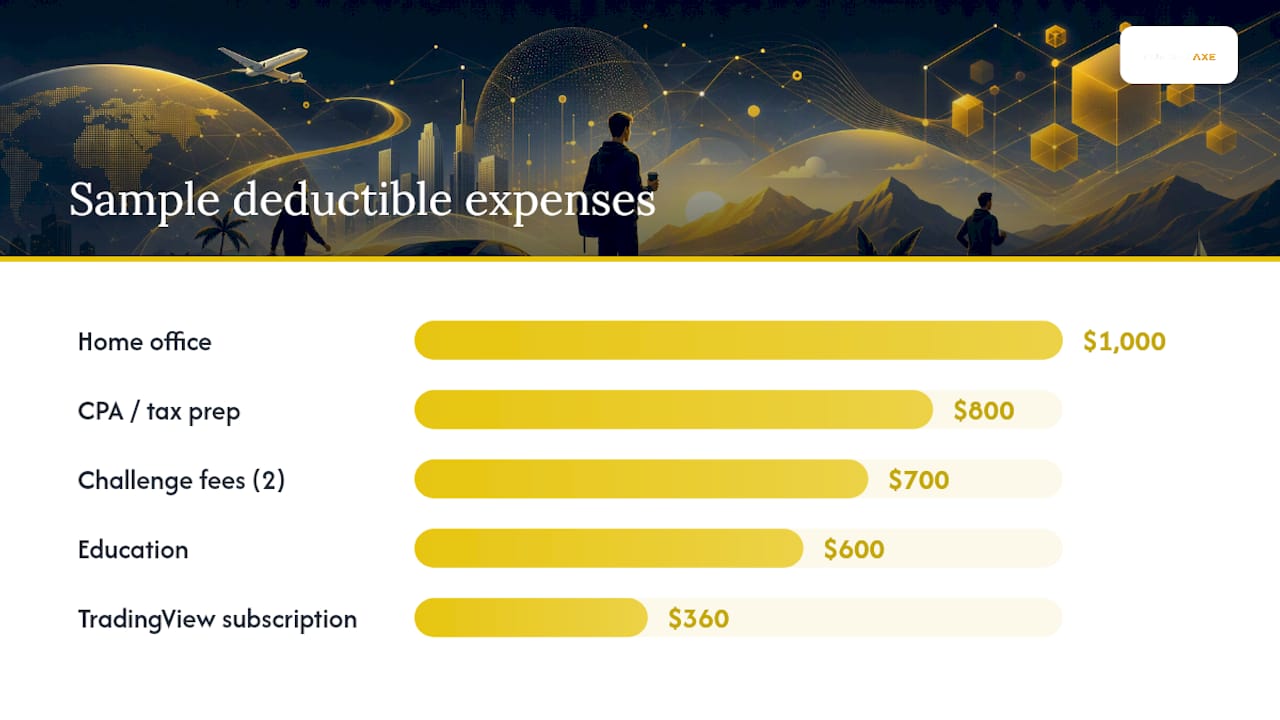
Sample math: A trader with $40,000 in gross payouts and $4,000 in deductible expenses (VPS $300, TradingView $360, two challenge fees $700, internet $240, CPA $800, education $600, home office $1,000) reduces taxable net profit to $36,000.
What's not deductible: losses on the firm's simulated account (you never bore that capital risk), personal expenses, or any expense you can't substantiate with a receipt.
Record-keeping by category: Keep receipts and invoices for every expense. Digital copies in a dedicated folder (organized by year and category) are sufficient. The IRS generally has three years to audit a return, but six years if it suspects underreported income exceeding 25% of gross income. Keep records for at least six years.
Which IRS forms apply, and what do you do without a 1099?
The forms you'll encounter as a funded trader:
| Form | What It Reports | Your Action |
|---|---|---|
| 1099-NEC | Nonemployee compensation from a firm that paid you $600+ (or $2,000+ under 2026 threshold changes) | Report gross amount on Schedule C |
| Schedule C | Business income and expenses | Complete and attach to Form 1040 |
| Schedule SE | Self-employment tax calculation | Complete and attach to Form 1040 |
| Form 1040-ES | Quarterly estimated tax payment vouchers | Submit with payment each quarter |
| Schedule K-1 | Partnership/S-Corp income allocation | Report per instructions on Form 1040 |
| Form 8938 / FinCEN 114 | Foreign financial accounts / FBAR | File if foreign account thresholds are met |
TraderTax's filing guide notes that the 1099-NEC reporting threshold changed under recent legislation, rising to $2,000 in 2026. That means some firms that previously issued 1099s may not issue one at lower payout amounts. The threshold change affects whether the firm sends a form. It does not affect whether the income is taxable.
If no 1099 arrives:
- Pull your payout ledger and reconcile it against bank statements.
- Report the total gross payouts on Schedule C regardless. PropNavi's U.S. tax guide is explicit: missing 1099s do not remove the reporting obligation.
- Attach a note to your records explaining how you reconstructed the income figure.
- If the amounts are large and the firm is offshore, escalate to a CPA before filing.
Pro Tip: Open a dedicated bank account or payment-processor account for prop payouts only. When every deposit in that account is a payout, reconciliation takes minutes instead of hours.
How to calculate and pay quarterly estimated taxes
IRS guidance on estimated taxes sets the threshold clearly: if you expect to owe $1,000 or more when you file, you're generally required to make quarterly estimated payments.
2025 quarterly due dates:
- April 15 — covers January 1 through March 31
- June 16 — covers April 1 through May 31
- September 15 — covers June 1 through August 31
- January 15 (following year) — covers September 1 through December 31
Safe-harbor rules to avoid penalties:
- Pay at least 90% of your current-year tax liability, OR
- Pay 100% of your prior-year tax liability (110% if your prior-year AGI exceeded $150,000)
Sample quarterly calculation (simplified):
Assume $60,000 expected net profit for the year.
- SE tax base: $60,000 × 92.35% = $55,410
- SE tax: $55,410 × 15.3% = $8,478
- Deduct half of SE tax from income: $60,000 − $4,239 = $55,761 adjusted income
- Federal income tax (rough, 22% bracket): $55,761 × 22% ≈ $12,267
- Total estimated annual tax: $8,478 + $12,267 = $20,745
- Quarterly payment: $20,745 ÷ 4 ≈ $5,186 per quarter
Pay through the IRS Direct Pay portal or via EFTPS (Electronic Federal Tax Payment System). Both are free. Mail a check with Form 1040-ES vouchers if you prefer paper.
Treat it as untouchable until the quarterly due date.
Should you elect mark-to-market under Section 475(f)?
Section 475(f) lets qualifying traders elect mark-to-market (MTM) accounting, which means all trading positions are treated as if sold at fair market value on December 31 each year. Gains and losses become ordinary, not capital.
Pros for prop traders:
- Avoids the $3,000 annual capital-loss deduction cap that applies to personal trading accounts.
- Eliminates wash-sale rule complexity on securities (though futures under Section 1256 already have favorable treatment).
- Simplifies loss recognition — no need to track holding periods.
Cons:
- The election is generally irrevocable without IRS consent for prior years. You're locked in.
- Can accelerate tax on appreciated positions at year-end, even if you haven't received cash.
- Adds complexity to your return and requires a CPA familiar with trader tax status.
How to elect:
File a statement with your timely tax return (or with a timely extension request) for the year before the election takes effect. The statement must identify the election, the tax year it applies to, and the asset class (securities, commodities, or both). The deadline is the due date of your return for the year before the election year, which means you must decide by April 15 of the year you want MTM to begin.
Pro Tip: Before electing 475(f), have a CPA review all your investment accounts, not just your prop trading activity. MTM affects every account covered by the election. If you hold long-term stock positions elsewhere, the ordinary-income treatment on those could cost you the preferential capital-gains rate.
State and local taxes add another layer
Federal tax is only part of the picture. State income tax can shift your effective rate significantly, and the variation across states is wide.
What to check by state:
- No state income tax states: Florida, Texas, Nevada, Washington, Wyoming, South Dakota, Alaska, and Tennessee (on wages) have no state income tax. A trader in Florida pays zero state tax on prop payouts.
- High-rate states: California taxes ordinary income up to 13.3%. New York state tops out around 10.9%, with New York City adding another layer. A trader earning $80,000 net in California faces a combined federal, SE, and state effective rate well above 40%.
- Flat-tax states: Several states (Illinois, Pennsylvania, Colorado) tax all income at a flat rate, which simplifies planning.
Example comparison: Two traders each net $60,000 from prop payouts. Trader A lives in Texas (no state income tax). Trader B lives in California. After federal income tax and SE tax, both owe roughly $20,745 in federal obligations. Trader B owes an additional estimated $6,000–$7,000 in California state tax, depending on deductions and filing status. That's a meaningful difference in take-home pay from identical trading results.
Multi-state and domicile issues: If you travel frequently or split time between states, the state where you're domiciled (your permanent home) generally taxes all your income. Some states also assert tax on income earned while physically present there, even temporarily. If you're considering relocating to a no-tax state, the move must be genuine and documented. States like California aggressively audit part-year residents who claim to have moved.
Confirm your state's treatment with a CPA or your state's department of revenue before filing.
Three worked tax examples for U.S. funded traders
These examples use 2025 tax parameters. They're illustrative, not tax advice.
Example 1: Lower-income trader, $25,000 gross payouts
Example 2: Mid-tier trader, $80,000 gross payouts, $10,000 expenses
At this income level, an S-Corp election might reduce SE tax if the reasonable salary is set below $70,000 net. But payroll costs, a separate 1120-S return, and state fees typically run $2,000–$4,000 per year. The math only favors the S-Corp if SE tax savings exceed those compliance costs.
Example 3: High-income trader, $200,000 gross payouts, $15,000 expenses
An S-Corp election becomes much more compelling here.
One rule that applies to all three examples: you're taxed on cash received. The simulated account balance is irrelevant. If your funded account shows $500,000 in simulated gains but you withdrew $25,000, your taxable income is $25,000.
What to do when your prop firm is offshore or skips the 1099
Offshore firms and smaller domestic firms often issue no U.S. tax documents. That doesn't change what you owe.
Immediate action checklist:
- Save every payout confirmation email or platform notification the day it arrives.
- Download bank statements monthly and highlight every prop-related deposit.
- Keep payment-processor records (Wise, PayPal, Deel, or similar) showing the gross amount received.
- Build a running spreadsheet: date, payer name, gross amount, currency, exchange rate if applicable, net USD received, and payment method.
- Keep a copy of your trader agreement with the firm.
- Reconcile your ledger against bank statements before filing. Any gap needs an explanation.
International reporting triggers: U.S. citizens and residents must report worldwide income regardless of where it originates. If you hold a foreign financial account (including a payment processor account held offshore) with an aggregate balance exceeding $10,000 at any point during the year, you must file FinCEN Form 114 (FBAR). If the value exceeds $50,000 (single filer), Form 8938 may also be required. These are separate from your income tax return and carry steep penalties for noncompliance.
If large payouts are routing through offshore intermediaries or nonstandard processors, bring a CPA into the conversation before you file. The income reporting is straightforward; the international compliance layer is not.
A practical note on staying ahead of the tax curve
The traders who get into trouble aren't usually the ones who misunderstand the tax code. They're the ones who wait until April to figure out what they owe. By then, the quarterly deadlines have passed, the records are scattered, and the number on the screen is a surprise.
A monthly habit fixes most of this. On the first of each month, spend 20 minutes: download your payout records, log them in a spreadsheet, pull receipts for any business expenses, and move the tax reserve into a separate account. That's it. Twelve sessions a year, and you arrive at filing with everything already organized.
One more thing worth saying plainly: this article covers general principles, not your specific situation. Tax law changes, state rules vary, and your income mix may create nuances that a general guide can't anticipate. A CPA who works with traders is worth the fee, especially once your annual payouts exceed $40,000.
Fundedaxe makes payout documentation straightforward
Keeping clean records starts with a firm that gives you clean records. Fundedaxe generates payout statements for every reward issued, so U.S. traders have a documented paper trail that matches their bank deposits. That's the foundation of accurate Schedule C reporting.

When you're ready to compare account sizes, payout timing, and challenge structures side by side, the FundedAxe package comparison page lays out every option clearly. Fundedaxe's Pay After Pass model means you start for $9.99 and only pay the remaining challenge fee after you pass, which also makes the deductible fee amount easy to track: you know exactly what you paid and when. Full payout details, including timing and statement access, are on the FundedAxe payouts page.
This is not tax advice. For guidance specific to your income level, state, and filing situation, consult a qualified U.S. tax professional.
Sources
These are the primary IRS pages and practitioner resources to bookmark before you file.
- Investing
- Irs
- How Are Prop Firm Payouts Taxed in the US? A 2026 Guide for Funded Traders | PROP NAVI
- Prop Firm Taxes 2026: How Funded Payouts Are Taxed | TraderTax
Download the IRS forms directly from IRS.gov and bookmark the estimated-tax page for updated due dates each year. Tax rules shift; the IRS page is always current.
This article is general information, not a substitute for advice from a qualified financial advisor. Consult a qualified financial professional about your own circumstances before acting on anything here.