

Yes, U.S.-facing prop firms must implement KYC and AML controls before paying traders. This is not optional. The moment your firm sends real money to a trader, that payment is treated as a contractor payout, which triggers identity verification and tax documentation obligations under U.S. law. The single most important first action: confirm who is the counterparty of record for payouts before you process a single withdrawal.
The minimum KYC elements every prop firm needs in place:
- Proof of identity (POI): government-issued photo ID, such as a passport, driver's license, or national ID
- Proof of address (POA): recent bank statement or utility bill, typically dated within a few months
- Sanctions screening: OFAC/SDN list check at minimum, plus PEP screening for higher-risk profiles
- Liveness check: selfie or video liveness to confirm the ID belongs to the person submitting it
Skipping these controls does not just create regulatory exposure. It creates payment-rail exposure. Banks and payment processors will terminate merchant relationships when verification is absent, and chargebacks from stolen-card challenge purchases become your firm's liability.
Pro Tip: Place your first full verification gate at the payout request, not at account creation. This protects conversion during signup while ensuring every trader receiving real money is fully verified before funds move.
Key Takeaways
Prop firms operating in the U.S. must implement KYC controls before paying traders, with the first payout request serving as the non-negotiable full-verification gate.
| Point | Details |
|---|---|
| KYC is required before payouts | U.S.-facing prop firms must verify trader identity before sending real money, regardless of entity structure. |
| Three critical KYC moments | Apply lightweight checks at onboarding, full verification at first payout, and ongoing monitoring after each payment. |
| Counterparty of record matters | Confirm in writing who holds AML and tax reporting responsibility before the first payout cycle. |
| Progressive KYC protects conversion | Silent background checks at signup and full ID at payout preserve conversion without sacrificing compliance. |
| Fundedaxe publishes payout rules clearly | Traders can review verification timing and payout schedules before committing to a challenge. |
Table of Contents
- Why KYC/AML compliance matters for prop firms in the U.S.
- How prop firm KYC works across the three critical moments
- What documents and verification levels does your firm actually need?
- How sanctions and PEP screening work for U.S. prop firms
- How to design a risk-based KYC program that protects conversion
- Integrating an identity-verification vendor like Sumsub
- Data handling, recordkeeping, and the counterparty-of-record question
- A practical operational checklist and sample KYC workflow
- Common fraud red flags and how to respond
- U.S. regulatory overview and recommended next steps
- Where KYC fits in the bigger picture of running a prop firm
- Fundedaxe: built for traders who want to get paid
- Sources
Why KYC/AML compliance matters for prop firms in the U.S.
Prop firms occupy an unusual regulatory position. Because they trade on firm capital rather than client funds, many operators assume they fall outside the traditional broker-dealer compliance framework. That assumption is partly correct and entirely dangerous.
The Bank Secrecy Act (BSA) and FinCEN's implementing regulations impose AML program requirements on a range of financial businesses, and the OFAC sanctions program applies to virtually every U.S. person and entity regardless of industry. Even if your firm is not a registered broker-dealer, paying traders in multiple jurisdictions creates sanctions exposure the moment a payment touches a blocked person or country.
The business risks are just as concrete:
- Chargebacks and fraud: Traders who purchase challenges with stolen cards and then request payouts create double liability. Catching this requires early verification.
- Account selling and sharing: A verified account sold to a third party creates a name mismatch at payout, which triggers bank rejection and potential fraud flags.
- PSP de-risking: Payment processors increasingly require prop firms to demonstrate KYC controls as a condition of maintaining merchant accounts. Firms without documented programs are being dropped.
- Regulatory enforcement: FinCEN and OFAC enforcement actions are not limited to large institutions. Smaller firms with inadequate controls and documented violations face civil penalties.
The trend heading into 2026 is tighter, not looser. KYC and compliance requirements for prop firm payouts have intensified as payout volumes grew and regulators took notice of the sector. PSPs that once processed prop firm payouts without documentation requirements now routinely require written AML policies and verification records before onboarding a new merchant.
How prop firm KYC works across the three critical moments
Not every KYC check needs to happen at signup. The goal is to apply the right level of scrutiny at the right moment in the trader lifecycle. A progressive KYC strategy does exactly that: lightweight checks early, full verification before money moves.
Onboarding
At account creation, collect the minimum needed to establish identity and assess risk without killing conversion:
- Email address and phone number (OTP verification)
- Country of residence (used for jurisdiction risk scoring)
- Device fingerprint and IP address (flags VPN use, shared devices, multi-accounting)
Full document collection at this stage is optional for most firms. The exception: if your PSP requires it as a condition of the merchant agreement, you have no choice.
Payments and payouts
The first payout request is the single most important KYC gate in the entire trader lifecycle. This is where full verification must occur: government-issued ID, selfie liveness, and proof of address. PSPs trigger their own verification requirements at this point regardless of what you collected earlier, so having the data ready prevents payout delays.

Running KYC only at payout also carries a specific risk: a trader who purchased a challenge with a stolen card will have already passed the evaluation before you catch the fraud. That is why a light purchase-time check (card name vs. submitted name) is worth adding even if full verification waits until payout.
Runtime monitoring
After the first payout, monitoring does not stop. Ongoing controls should include:
- Session and IP consistency checks (flagging sudden geographic jumps)
- Periodic re-screening against OFAC and PEP lists
- Transaction monitoring for unusual payout patterns or frequency spikes
- Liveness re-checks for accounts flagged for sharing
IP and VPS mismatches are among the most common technical triggers for compliance reviews in prop trading. Algo traders running on shared VPS infrastructure frequently trigger these flags. Requiring a dedicated IP or additional account-level proof for automated trading accounts prevents most of these false positives.
Pro Tip: Use silent background checks during the evaluation phase. Device fingerprinting and IP risk scoring run without asking the trader for anything, giving you a risk profile before the first payout request arrives.
What documents and verification levels does your firm actually need?
The industry has converged on two tiers. Verification can be split into basic and full verification, with funded account activation and payout eligibility requiring full verification before any funds move.
Basic verification is sufficient for account creation and evaluation access:
- Email address (confirmed via OTP)
- Country of residence
- Phone number (SMS OTP)
- Device fingerprint
Full verification is required before funded account activation or payout:
- Government-issued photo ID (passport, national ID card, or driver's license)
- Selfie liveness check (matching the submitted ID)
- Proof of address (bank statement or utility bill, dated within a recent period)
| Verification level | Required documents | Typical processing time |
|---|---|---|
| Basic | Email OTP, phone OTP, device fingerprint | Instant (automated) |
| Full | Government photo ID + selfie liveness + POA | typically minutes to hours (automated); can take up to a day with manual review |
Accepted POI documents are passports, national ID cards, and driver's licenses. For POA, bank statements and utility bills are standard. Mobile phone bills, screenshots of online statements, and outdated documents are the most common rejection causes. Name mismatches between the ID and the payout destination account are the second most common cause of verification failure and the most common source of payout delays.
Pro Tip: Tell traders upfront exactly which POA documents you accept. A single clear instruction at the verification step cuts rejection rates significantly and reduces support ticket volume.
How sanctions and PEP screening work for U.S. prop firms
Sanctions screening is not optional for any U.S. entity. OFAC's Specially Designated Nationals (SDN) list applies to all U.S. persons and entities, and a payment to a blocked individual or jurisdiction carries strict liability regardless of intent.
For a U.S.-facing prop firm, the minimum screening scope includes:
- OFAC/SDN list: mandatory for all U.S. operations
- UN consolidated sanctions list: relevant for traders in multiple jurisdictions
- EU sanctions lists: relevant if your firm accepts EU-resident traders or processes payments through EU banks
- PEP (Politically Exposed Person) screening: required for enhanced due diligence decisions
A sanctions hit requires an immediate payment freeze and legal review before any funds move. Do not attempt to resolve a sanctions match without counsel. OFAC's enforcement posture treats voluntary self-disclosure as a significant mitigating factor, so the response protocol matters.
PEP screening generates more false positives than sanctions screening. A common name in a high-PEP country will match dozens of records. The practical approach is to score matches by confidence level, route high-confidence matches to manual review, and document the disposition of every match in your audit log. Prop firms should maintain audit logs and apply enhanced due diligence for customers in higher-risk jurisdictions or when payment sources are suspicious.
Screening frequency: run a full check at onboarding and again at each payout request. Periodic batch re-screening (monthly or quarterly) catches status changes for existing traders. Most vendor platforms, including Sumsub, support automated re-screening on a schedule.
How to design a risk-based KYC program that protects conversion
A risk-based approach means you apply stricter controls where the risk is higher, not uniformly across every trader. This protects your conversion rate while satisfying PSP and bank requirements.
Risk tiers
Assign every trader to a risk tier at signup based on observable signals:
- Low risk: Trader from a low-risk jurisdiction, low-value challenge, clean device/IP, card name matches submitted name
- Medium risk: Trader from a FATF grey-list country, VPN detected, mid-value account, or card name mismatch
- High risk: Trader from a sanctioned or high-risk jurisdiction, multiple accounts from one IP, high-value account, or suspicious payment method
Decision rules
- Auto-approve: Low-risk profile, basic verification passed, no sanctions match
- Soft block: Medium-risk profile, request additional verification before payout (not before trading)
- Manual review: High-risk profile, sanctions/PEP match, or technical anomaly (IP jump, device mismatch)
Enhanced due diligence (EDD) applies to high-risk cases and may include source-of-funds documentation, additional ID verification, or a video interview. For traders requesting payouts above a defined threshold from high-risk corridors, source-of-funds checks are a reasonable and defensible control.
Running KYC only at payout leaves the firm exposed to chargebacks from stolen-card challenge purchases. A light purchase-time check, such as matching the card name to the submitted name, catches most of these cases without adding friction for legitimate traders.
Pro Tip: Run silent device fingerprinting and IP risk scoring at every session, not just at signup. Background signals accumulate over the evaluation period and give you a richer risk picture before the first payout request.
Integrating an identity-verification vendor like Sumsub
Manual KYC does not scale. Automated KYC through providers like Sumsub reduces verification time from tens of minutes to under a few minutes and provides the audit trail regulators expect. Manual review still matters for edge cases, but it should be the exception, not the default.
Vendor selection criteria
When evaluating identity-verification vendors, check these dimensions:
- Country coverage: Does the vendor accept IDs from every jurisdiction your traders come from?
- Liveness accuracy: What is the false-rejection rate for selfie liveness? A high false-rejection rate creates support burden.
- Sanctions coverage: Does the vendor screen OFAC, UN, and EU lists, plus PEP databases?
- API/webhook model: Can the vendor push real-time decisions to your payout system?
- Latency: What is the median verification time for automated decisions?
- PSP compatibility: Has the vendor been accepted as a verification provider by your payment processor?
Sumsub bundles ID verification, selfie liveness, and sanctions screening in a single API, which is why it appears frequently in prop firm compliance stacks. The API/webhook model allows your payout system to receive a verified/rejected signal automatically, blocking payouts for unverified traders without manual intervention.
Integration steps
- Connect the vendor API to your account creation and payout-request flows
- Configure decision orchestration: auto-approve, soft-block, and manual-review routing
- Set up async passthrough for payouts: payout requests queue until verification status is confirmed
- Build a manual-review dashboard for your compliance team
- Configure webhook alerts for sanctions hits and high-risk flags
Metrics to track
- Median verification time (automated vs. manual)
- False-positive rate on liveness checks
- Rejection reasons by category (expired ID, POA mismatch, liveness failure)
- Conversion impact at each verification gate
Pro Tip: Test your payout failure modes in the vendor's sandbox before going live. Simulate a sanctions hit, a liveness failure, and an expired ID, then confirm your payout system responds correctly to each webhook signal. Finding a gap in sandbox is far cheaper than finding it in production.
Data handling, recordkeeping, and the counterparty-of-record question
Confirming who is the counterparty of record is one of the highest-impact decisions a prop firm operator makes, and one of the most commonly deferred. The counterparty of record is the entity legally responsible for the payout, which determines where tax reporting, AML obligations, and misclassification risk sit.
If your payout provider operates an Agent of Record (AOR) model, they take on classification and reporting responsibility contractually. If they do not, your firm retains that exposure regardless of who processed the payment. Get this confirmed in writing before the first payout.
Practical data-handling rules
- Store raw identity documents in encrypted storage with access limited to compliance personnel
- Use your vendor's hosted verification flow where possible to avoid raw document storage on your own infrastructure
- Apply data minimization: store verification status and document metadata, not document images, unless retention rules require the original
- Define who has access to raw documents and log every access event
Recordkeeping and retention
A written AML policy, sanctions screening, and recordkeeping for 5–7 years are minimum viable controls for firms scaling to a few hundred traders. The BSA's standard retention window is five years from the date of the transaction or account closure. Some states impose longer windows.
When a trader submits a data deletion request under a privacy law (CCPA, for example), AML retention obligations override the deletion right for records tied to financial transactions. Document this exception in your privacy policy and respond to deletion requests with a clear explanation of which records are retained and why.
Pro Tip: Before your first payout, send a written question to your payout provider asking explicitly: "Are you the counterparty of record for these payments, and do you accept AML and tax reporting responsibility?" The answer determines your compliance architecture.
A practical operational checklist and sample KYC workflow
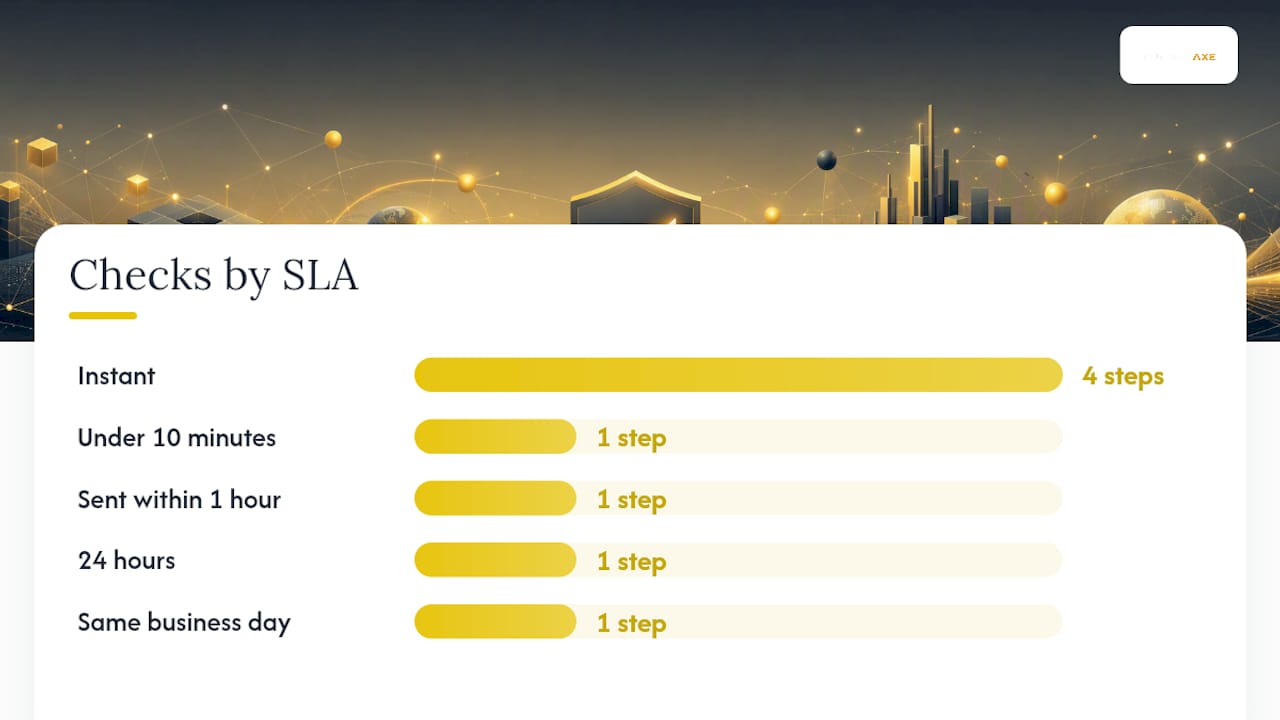
The workflow below maps the full trader lifecycle to the right controls, owners, and SLAs.
| Step | Owner | Trigger | SLA |
|---|---|---|---|
| Account creation: email + phone OTP | Product/platform | Signup | Instant |
| Device fingerprint + IP risk score | Platform (automated) | Every session | Instant |
| Basic verification confirmation | Platform | Challenge purchase | Instant |
| Full verification request | Ops/vendor | First payout request | Sent within 1 hour |
| Automated ID + liveness check | Vendor (Sumsub or equivalent) | Verification submitted | Under 10 minutes |
| Manual review (edge cases) | Compliance team | Vendor flags for review | 24 hours |
| Sanctions/PEP re-screening | Vendor (automated) | Each payout request | Instant |
| Payout release or hold | Payments team | Verification confirmed | Same business day |
| Periodic re-screening | Vendor (batch) | Monthly | Automated |
Escalation triggers for manual review:
- Sanctions or PEP match at any confidence level
- Liveness check failure on second attempt
- Name mismatch between ID and payout destination
- IP geolocation inconsistency (country of signup vs. country of payout request)
- Multiple accounts linked to one device or payment method
Staffing and SLA guidance: A firm processing up to 500 verifications per month can manage manual review with one part-time compliance analyst. Above that volume, fintech-specialized customer support and back-office operations become worth outsourcing to maintain SLAs during onboarding peaks.
KPIs to track monthly:
- Verification completion rate (target: above 85% automated)
- Manual review queue age (target: under 24 hours)
- Payout hold rate due to verification failure
- False-positive rate on sanctions screening
Pro Tip: Run a load test on your ops team before a promotional campaign or challenge launch. A spike in signups creates a corresponding spike in payout requests 30–60 days later. Knowing your manual-review capacity ceiling before that wave hits prevents SLA failures.
Common fraud red flags and how to respond
Prop firm fraud follows predictable patterns. Knowing the signals lets you act before a payout goes out.
Red flags to monitor:
- Name mismatch between the verified ID and the payout destination account (bank account or crypto wallet)
- Multiple accounts originating from a single IP address or device fingerprint
- Geolocation jumps between sessions (signing in from the U.S., then immediately from a sanctioned country)
- Prepaid or virtual card patterns at challenge purchase, followed by a payout request to a different payment method
- Sudden unexplained account balance movements inconsistent with the trader's historical performance
- IP/VPS mismatches and multi-accounting signals that suggest account sharing or automated trading from a shared environment
Operational responses:
- Freeze the payout and place a hold on the account pending review
- Request targeted proof: a selfie holding the ID, a bank statement matching the payout destination name, or a video liveness check
- Route to manual review with a documented case file
- For confirmed fraud, file a Suspicious Activity Report (SAR) with FinCEN if the transaction meets the reporting threshold
Prevention policies:
- Restrict payout destinations to accounts in the verified trader's name. No third-party payouts.
- Require matching names between the bank account or crypto wallet and the verified ID
- Maintain a clear policy on copy trading and account sharing and enforce it at the verification level
- For algo traders using VPS infrastructure, require a dedicated IP or additional account-level documentation
U.S. regulatory overview and recommended next steps
The U.S. regulatory framework relevant to prop firms sits across three bodies:
- FinCEN: Administers the BSA. Requires AML programs, recordkeeping, and SAR filing for covered financial institutions. Whether a prop firm qualifies as a covered institution depends on its specific activities and structure. Confirm this with counsel.
- OFAC: Administers U.S. sanctions programs. Applies to all U.S. persons and entities regardless of industry. No registration required to be subject to OFAC rules.
- BSA recordkeeping rules: Require retention of transaction records and identity documents for five years. Apply broadly to financial businesses.
Enforcement trends heading into 2026 reflect two pressures: regulators increasing scrutiny of non-traditional financial businesses that handle large payment volumes, and PSPs tightening merchant requirements after high-profile fraud cases in the prop trading sector. Firms without documented AML programs are being de-platformed by payment processors before regulators ever get involved.
Recommended next steps:
- Confirm your entity's classification under FinCEN rules with a qualified attorney
- Review your payout provider contract for counterparty-of-record language before the next payout cycle
- Draft or update your written AML policy to include sanctions screening, recordkeeping, and SAR filing procedures
- Retain counsel for material program changes, new jurisdiction expansion, or any OFAC inquiry
- Schedule a compliance review every six months as the regulatory environment evolves
Pro Tip: Do not wait for a PSP to ask for your AML policy. Send it proactively when onboarding a new payment processor. Firms that lead with documentation get better terms and faster merchant account approvals.
Where KYC fits in the bigger picture of running a prop firm
The compliance conversation in prop trading tends to get framed as a cost center. That framing is wrong, and operators who internalize it build fragile businesses.
Every payout that clears cleanly is a trust signal. Every payout that bounces because a trader's name doesn't match their bank account is a support ticket, a chargeback risk, and a potential merchant account flag. The firms that treat verification as a payout-protection mechanism rather than a regulatory checkbox are the ones that maintain stable payment rails when the sector faces scrutiny.
The counterparty-of-record question is where most operators make their most expensive mistake. They assume the payment processor handles it. The processor assumes the firm handles it. Nobody has it in writing. When a tax authority or regulator asks who was responsible for reporting, both parties point at each other. Getting one sentence of contractual clarity before the first payout costs nothing and eliminates a category of risk entirely.
Progressive KYC also resolves the false tension between compliance and conversion. Traders do not abandon signups because of verification. They abandon signups because of friction at the wrong moment. Asking for a passport at account creation is friction at the wrong moment. Asking for it at the first payout request, when the trader has already passed an evaluation and is expecting money, is friction at the right moment.
The firms that will have the most trouble in the next two years are not the ones with imperfect compliance programs. They are the ones with no program at all, who discover their PSP has terminated their merchant account the same week they owe payouts to 200 traders.
Fundedaxe: built for traders who want to get paid
Fundedaxe is a simulated prop trading firm that takes the payout side of this equation seriously. The Pay After Pass model means traders pay $9.99 to start an evaluation and only pay the remaining challenge fee after they pass. No upfront commitment, no risk of paying for an account you never fund.

Payout mechanics are transparent: rewards can be requested from day 10, then every 14 days, or every 7 days with the 7-Day Rewards add-on. The payout rules and schedules are published clearly, so traders know exactly what verification is required and when. News trading, weekend holding, EAs, and algorithmic trading are all permitted. Start with a free $1,000 simulated trial account, no card required, and see the conditions before you commit.
Sources
The following resources were used to build this guide and are worth consulting directly for implementation and vendor selection:
- KYC and Compliance for Prop Firm Payouts
- Prop Firm KYC and Compliance: A Complete Guide to Verification and Security
- Verification Requirements for Kraken Prop
This article is general information, not a substitute for advice from a qualified financial advisor. Consult a qualified financial professional about your own circumstances before acting on anything here.