

The cheapest sticker price rarely wins. A $50 challenge that charges a $150 activation fee after you pass, plus a $40 reset fee for every failed attempt, can end up costing more than a $300 challenge with clean, disclosed terms. The two approaches that consistently deliver the best value are low upfront fees paired with transparent, reasonable trading rules, and Pay After Pass models that only charge you once you've proven you can trade the account.
Here's your shortlist for cost-conscious traders:
- Pay After Pass evaluations (like FundedAxe's $9.99 start) — you risk almost nothing upfront and only pay the full fee once you've earned it.
- Single-step challenges with static drawdown — fewer phases mean fewer chances to pay a reset fee.
- Firms publishing a clear price-per-$1k ratio — Proppie makes cost differences across account sizes obvious instead of hidden in fine print.
- Free simulated trial accounts — practice the firm's rule set before you spend a dollar on the real evaluation.
A standard $100,000 challenge typically runs $300 to $600, but that number means little without knowing what happens after you fail once.
Key Takeaways
The lowest-cost path to a funded account combines a transparent fee structure with realistic pass-rate math, not the smallest number on the checkout page.
| Point | Details |
|---|---|
| Use price-per-$1k | Divide challenge price by account size in thousands to compare offers fairly across sizes. |
| Budget for resets | Plan for at least one reset at 50% to 75% of the original fee when estimating true cost. |
| Watch activation fees | A low entry price paired with a post-pass activation fee can double your real spend. |
| Treat refunds as bonuses | Refundable fees are almost always conditional on hitting payout milestones, not guaranteed. |
| Consider Pay After Pass | FundedAxe's $9.99 start defers the full fee until after you pass, cutting upfront risk to nearly zero. |
Live Trackers and Comparison Tools to Check Current Prices
Prices and promo codes shift constantly, so verify before you buy.
- Daily pricing trackers like FuturesFury's pricing tracker show whether a "sale" price sits below the 90-day average.
- Price-per-$1k comparison tools such as Proppie let you rank offers by real cost-to-funding ratio, not sticker price.
- Fee breakdown guides like PropFirmMap's cost explainer detail reset and activation fee structures firm by firm.
Always confirm activation fees and refund conditions on the firm's own checkout page before purchasing. Marketing pages and checkout terms don't always match.
Table of Contents
- How Much Do Prop Firm Challenge Fees Cost by Account Size?
- How Much Do Prop Firm Challenges Cost? Price Ranges and Payment Models
- Hidden and Recurring Costs That Raise the Real Price
- How Do You Calculate the True All-In Cost of a Challenge?
- Ways to Cut Evaluation Costs Without Cutting Corners
- Is Pay After Pass Worth It Compared to Paying Upfront?
- Methodology: How Prices and Rankings Were Gathered
- Comparison of Refund Policies Upon Failing the Challenge
- How Long Does It Take to Pass a Challenge and Get Funded?
- How Do Challenge Fees Affect Your Real ROI?
- Compare Prop Firm Challenge Fees Before You Commit
- Sources
How Much Do Prop Firm Challenge Fees Cost by Account Size?
Prop firm challenge fees scale with account size, but not in a straight line. Larger accounts cost more in dollar terms but often cost less per $1,000 of buying power, which is the whole reason the price-per-$1k metric exists. Here's what you should expect to pay at each tier before add-ons.
These bands reflect a wide swath of the market, and entry fees on the low end can dip under $50 for small accounts while climbing past $1,000 for the largest tiers, depending on step structure and how strict the drawdown rules are.
Price per $1k does the real work here. The formula is simple: challenge price divided by (account size divided by 1,000). A $50,000 account priced at $250 costs $5.00 per $1k. A $100,000 account priced at $400 costs $4.00 per $1k, making it the better raw deal even though the sticker price is higher.
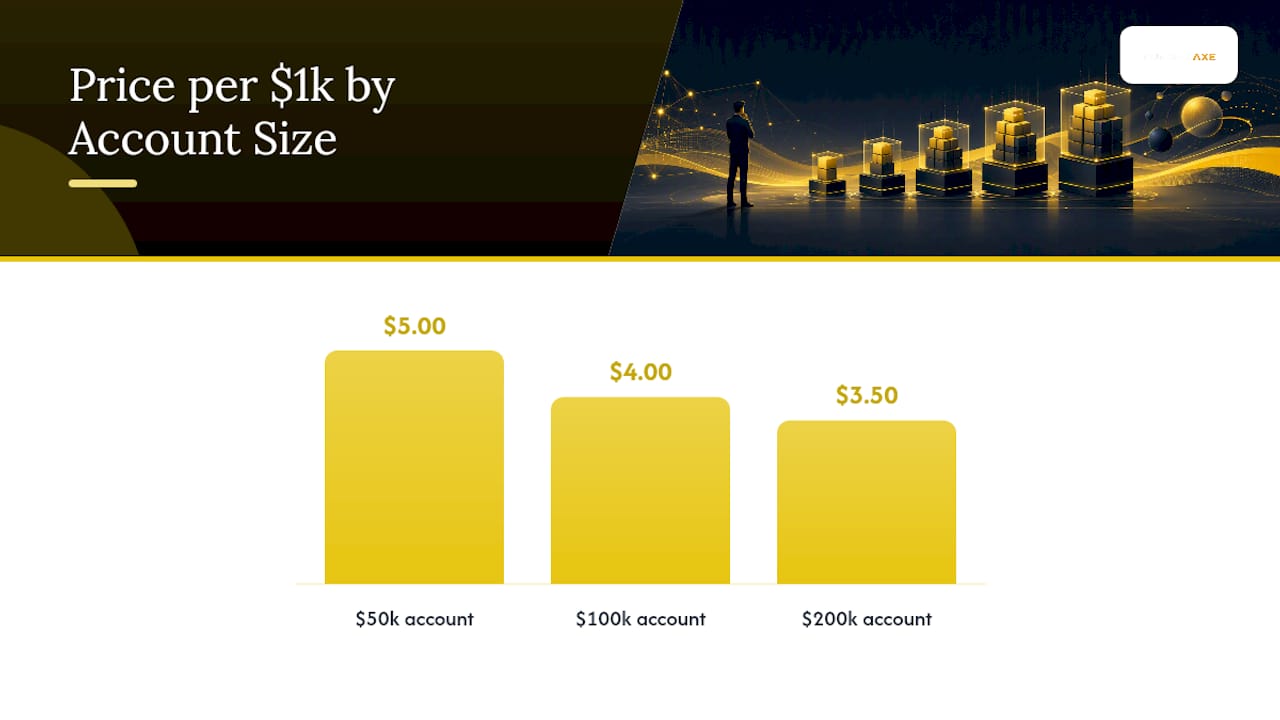
Run the math yourself: a $200,000 account listed at $700 works out to $700 ÷ 200 = $3.50 per $1k, noticeably cheaper per dollar of buying power than either of the smaller accounts above. That's why comparing sticker prices alone across account sizes misleads more traders than it helps.
A few callouts worth remembering before you buy:
- Cheapest by account size almost always shifts as size increases. Small accounts ($10k to $25k) tend to carry the worst price-per-$1k ratio because fixed costs (payment processing, platform licensing) get spread over less capital.
- Activation fees change everything. A challenge advertised as the cheapest in its tier can flip to the most expensive once you add a $100 to $150 unlock fee charged only after you pass, a pattern flagged in independent cost breakdowns of low-price challenges.
- Refund policies aren't free money. A "refundable" fee usually means refunded on your second payout, not your first, so don't count it as savings until it actually hits your account.
- Multi-step evaluations often cost less per attempt but take longer to complete, which matters if you're comparing subscription models against one-time fees.
How Much Do Prop Firm Challenges Cost? Price Ranges and Payment Models
Three billing structures dominate the market, and each one shifts risk to a different party. Understanding which one you're signing up for matters more than the headline number.
Expected price bands by account size, restated simply:
- $10,000 accounts: $50 to $100
- $25,000 accounts: $100 to $180
- $50,000 accounts: $200 to $400
- $100,000 accounts: $300 to $600
- $200,000 accounts: $500 to over $1,000
One-time fee. You pay a fixed amount once, attempt the evaluation, and either pass, fail, or reset. This model rewards traders who pass quickly and punishes traders who need several tries, since every retry usually means paying the reset fee again.
Monthly subscription. Common among futures-focused evaluations, subscription pricing runs roughly $50 to $175 per month depending on platform and data requirements. This model shifts cost from a single lump sum to time. If you pass in six weeks, it's often cheaper. If you need four months, it usually isn't.
Pay After Pass. You start for a small nominal fee, often under $10, and only pay the remaining challenge cost once you've cleared the evaluation. This flips the risk equation: the firm absorbs the cost of traders who fail, and you only pay real money when you've proven you can do the job.
Pros and cons, side by side:
- One-time fee: predictable cost, but resets compound fast if you fail more than once.
- Subscription: lower entry barrier, but total cost climbs the longer you take, and it rewards firms more than traders who struggle with consistency.
- Pay After Pass: minimal upfront risk and strong alignment with trader success, though terms after passing can carry stricter conditions in some programs, so read the fine print on payout rules.
Hidden and Recurring Costs That Raise the Real Price
The headline fee is the smallest number you'll see on your final bill. Reset fees, activation charges, and monthly data costs are where challenge pricing actually gets expensive, and most of them barely get mentioned in marketing copy.
Common hidden costs to budget for:
- Reset fees, typically 50% to 75% of the original challenge price, charged every time you fail a phase and want another shot.
- Activation or unlock fees, often applied only after you pass, which can turn a "cheap" challenge into one of the pricier options once you're actually funded.
- Monthly data or platform fees, particularly common in futures evaluations where exchange data isn't bundled into the base price.
- Payout processing fees, sometimes deducted from your first withdrawal or charged per payout request.
- Add-on charges for features like faster payout cycles, swap-free accounts, or higher reward splits.
Quick math: A $100 challenge with a 60% reset fee and a $150 activation fee sounds cheap until you fail once. Your real spend: $100 (initial) + $60 (reset) + $150 (activation after your second, successful attempt) = $310. That's more than double the sticker price, and it assumes you pass on try number two.
Refund policies typically work as conditional bonuses tied to hitting specific milestones, not guaranteed cash back. Treat any advertised "refund" the way you'd treat a performance bonus rather than a return of capital: nice when it happens, not something to bank on before it does.
How Do You Calculate the True All-In Cost of a Challenge?
Two formulas cover almost every scenario you'll face when comparing offers.
- Price per $1k = Challenge price ÷ (Account size ÷ $1,000). This tells you how much you're paying for each $1,000 of simulated buying power, and it's the fastest way to compare a $50,000 account against a $200,000 account on equal footing, an approach Proppie.io built its entire comparison model around.
- All-in cost = Initial fee + (average resets × reset fee) + activation fee + (months needed × monthly fee, if applicable). This captures what you'll actually spend by the time you're funded, not just what you pay on day one.
Two worked examples show how much the assumptions matter:
Optimistic case (pass in 1 attempt): $100,000 challenge at $400, no resets needed, $150 activation fee. All-in cost = $400 + $0 + $150 = $550. Price-per-$1k on the funded outcome: $5.50.
All-in cost = $400 + $500 + $150 = $1,050. Price-per-$1k jumps to $10.50, nearly double the optimistic scenario.
Before you run your own numbers, collect these inputs:
- Headline challenge price for your target account size.
- Reset fee amount and whether it's a flat rate or percentage of the original price.
- Activation or unlock fee, and whether it applies before or after funding.
- Any recurring monthly costs (data, platform access) and how many months you realistically expect to need.
- Your own historical pass rate, if you've attempted evaluations before, since a documented pattern of prior attempts is the single best predictor of how many resets to budget for.
Ways to Cut Evaluation Costs Without Cutting Corners
Lowering your true cost to funded status doesn't mean chasing the lowest sticker price. It means being deliberate about size, timing, and payment structure.
- Pick the account size that matches your actual trading style, not the biggest number available. Oversized accounts with tight drawdown limits fail more often, and every failure costs money.
- Wait for seasonal sales. Prop firms run discount cycles around major holidays and anniversaries, and daily pricing trackers can show you whether a "sale" price is actually below the 90-day average or just a marketing reset.
- Use loyalty points where available. Programs that convert challenge spend into discounts or free accounts effectively lower your cost on every future attempt.
- Favor free reset modes or Pay After Pass models that don't penalize you financially for a failed first attempt.
- Start with a free simulated trial account to test a firm's rule set before committing real money to an evaluation.
Pro Tip: Before trusting any "50% off" banner, check the firm's own historical pricing page or a third-party tracker. A discount off an inflated list price isn't really a discount.
Profit split and payout frequency matter more than most traders realize when weighing upfront savings.
Is Pay After Pass Worth It Compared to Paying Upfront?
Pay After Pass models solve the biggest problem in prop trading: paying real money before you've proven anything. FundedAxe's version starts an evaluation for $9.99 and defers the remaining fee until you actually clear the challenge.
- Pro: Minimal upfront risk. You're not out hundreds of dollars if you fail your first attempt.
- Pro: Aligns incentives. The firm only gets paid when you succeed, which tends to mean less pressure to fail traders on technicalities.
- Con: Some pay-after-pass structures apply stricter conditions once you're funded, so the terms after you pass deserve the same scrutiny as the price before.
Picture a $100,000 target under two models. Pay upfront and you're out $400 to $600 before you know if the rule set even suits your style. Under Pay After Pass, you pay $9.99 to start, trade the evaluation, and only owe the balance once you've passed, meaning a failed attempt costs you under $10 instead of several hundred.
FundedAxe's Pay After Pass model offers accounts up to $400,000, a 90% reward split (up to 100% with the add-on), no time limit on any phase, and a free $1,000 simulated trial account for traders who want to test conditions before spending anything.
Methodology: How Prices and Rankings Were Gathered
Pricing figures in this guide come from a mix of sources:
- Daily pricing trackers that snapshot base evaluation prices before promo codes are applied.
- Prop firm comparison sites publishing account-size tiers, fees, and rule sets.
- Vendor checkout pages and official documentation for fee structures and activation policies.
Price per $1k is calculated as challenge price divided by (account size divided by 1,000). Prices and promo codes shift often, so treat every figure here as a snapshot rather than a permanent number. Check the trackers listed in the sources section for current pricing.
Comparison of Refund Policies Upon Failing the Challenge
Refund policies vary widely, and almost none of them refund your fee simply because you failed. Most firms treat a failed evaluation as a closed transaction. You paid for an attempt, you didn't clear it, and the fee is gone.

The more common structure is a conditional refund tied to success, not failure. Some firms refund your original challenge fee once you hit your second payout on a funded account, effectively turning the fee into an interest-free loan you repay through performance rather than cash. That's a fundamentally different promise than "your money back if you fail," and the distinction gets blurred in marketing copy constantly.
A smaller number of firms offer partial refunds or credit toward a reset if you fail within a narrow margin of your profit target, though this is far from universal and usually capped at one occurrence.
Read the refund terms on the checkout page, not the landing page. Refund conditions and their common voiding clauses tend to include restrictions like minimum trading days, maximum drawdown breaches during the qualifying period, or a required second payout before the credit applies. If a refund policy sounds unconditional, that's usually a sign the fine print says otherwise.
How Long Does It Take to Pass a Challenge and Get Funded?
Timelines vary by evaluation structure, but most traders who pass do so within four to eight weeks per phase, assuming no time limit forces a faster pace. Firms with no minimum trading days let disciplined traders clear a phase in under two weeks; firms with mandatory minimum days (often five to ten per phase) stretch that out regardless of performance.
A typical one-step evaluation with no time limit might take three to six weeks to hit the profit target under normal market conditions. Two-step and three-step evaluations take longer simply because you're repeating the process, often landing between six and twelve weeks total from first login to funded account, assuming no resets.
Once you pass the final phase, funding activation and your first payout eligibility add more time. Many firms require ten to fourteen days of live trading on the funded account before your first reward request, and payout processing itself can take anywhere from a few days to two weeks depending on the method and the firm's schedule.
Traders who fail a phase and need to reset add the full evaluation window again, which is the biggest reason all-in cost calculations need to include time, not just money. A trader who needs three attempts to pass isn't just spending more on fees. They're spending months longer getting to a funded account than someone who passes on the first try.

How Do Challenge Fees Affect Your Real ROI?
A challenge fee is a sunk cost until you're funded, and every dollar you spend on resets pushes your break-even point further out. Calculating real ROI means comparing what you spent to get funded against what you actually earn from your profit split over time, not just celebrating the moment you pass.
Take the median-case example from earlier: $1,050 total spend to get a $100,000 funded account through three attempts. If your profit split is 90% and you earn a modest $2,000 in your first payout cycle, your net take is $1,800, which barely covers your all-in cost. Your second payout cycle is where real ROI starts, assuming you don't need another reset on a future scaled account.
This is why pass rate matters as much as fee size. A documented pattern of how many attempts traders typically need should shape your budget before you ever click "buy." Traders who chase the cheapest headline price without weighing their own realistic pass probability often end up spending more in resets than they would have on a slightly pricier, more forgiving rule set from the start.
The break-even calculation is simple in structure even when the inputs get messy: total fees paid, divided by expected monthly payout, tells you how many funded cycles you need before the evaluation stops being a cost center and starts being profit. Add resets, and it stretches to three or four.
A Note on This Guide and Who Wrote It
FundedAxe sells evaluation programs, so we have a stake in this market. That doesn't change the math above: price-per-$1k, reset costs, and refund conditions work the same way no matter which firm you choose. This guide was written by Jean,. Some links in this article may support FundedAxe's affiliate program.
Compare Prop Firm Challenge Fees Before You Commit
Every calculation in this guide points to the same conclusion: the fee you see first is rarely the fee you actually pay. FundedAxe built Pay After Pass around that exact problem. Start an evaluation for $9.99, trade the rule set, and only pay the remaining challenge fee once you've passed, on account sizes from $10,000 up to $400,000.

If you'd rather pay upfront, FundedAxe Pro challenges refund the fee on your second reward, and the loyalty points program converts every dollar you spend into discounts on future accounts or free evaluations entirely. Either path avoids the trap of paying full price before you know if a firm's rules even fit how you trade.
Compare live prices, account sizes, and rules side by side on the package comparison page before you commit to any evaluation. It takes less time than reading the fine print on a competitor's refund policy, and you'll walk away knowing exactly what you're paying for.
Sources
- How Much Do Prop Firms Cost? Every Fee Exposed | 2026
- Proppie
- Challenge Cost Explained · PropFirmMap
- Cheapest Prop Firms 2026: Ranked by Real Total Cost
- Cheapest prop firms (analysis) · CryptoSlate