

Yes, most prop firms allow partial closes, but almost every one attaches conditions that can turn a smart profit-lock into a rule violation. The recurring traps are using partials to game a consistency score and carrying a reduced position overnight. Get caught doing either, and firms typically deduct the profit or fail the evaluation outright, so read the exact policy wording before you scale out of your first trade.
TL;DR:
- Almost all prop firms restrict partial closes by rules against gaming consistency scores or carrying reduced positions overnight, risking profit deduction or evaluation failure.
- Traders must carefully review specific policy language, including allowances, overnight restrictions, and enforcement mechanisms, to avoid inadvertent rule violations.
- Using partial closes at +1R too early can cap expected value, while waiting until +2R before scaling out generally leads to better trade management outcomes.
- Automated partial close EAs should verify features like equity-awareness, support for multi-level exits, stop progression, news filters, and persistence to ensure compliance.
- FundedAxe offers a flexible environment with no consistency score, static drawdowns, and full EA, news, and weekend trading support, reducing typical partial-close risks.
Table of Contents
- What Is a Partial Close and Why Does It Matter for Funded Accounts?
- Prop-Firm Policy Checklist: What to Read Before You Scale Out
- How to Actually Use Partial Closes Without Blowing the Rules
- Automation and Partial-Close EAs: What to Verify Before You Deploy One
- Where FundedAxe Fits for Traders Who Rely on Partial Closes
- The Real Problem With Most Partial-Close Advice
- Find a Prop Firm Built Around Flexible Trade Management
- Sources
What Is a Partial Close and Why Does It Matter for Funded Accounts?
A partial close means exiting a portion of an open position while leaving the rest running. Close half a 2 lot position at a profit target, and 1 lot gets locked in as realized profit while the remaining lot keeps riding the trade's floating P/L.
That split matters more in a funded account than in a personal brokerage account because prop firms calculate daily loss limits and drawdown against a mix of realized balance and floating equity. Realized profit from a partial close typically raises your account balance immediately. Floating profit on the remainder does not count until you close it, which means:
- A partial close can improve your buffer against a daily loss limit by banking gains before news or volatility erases them.
- It can also complicate consistency scoring, since firms watch for lopsided profit distribution across trading days.
- Equity based drawdown rules track your worst intraday dip, so a partial that reduces exposure at the right moment can keep you inside the drawdown band even if the runner later reverses.
Locking in a slice of profit essentially converts uncertainty into a known number on your balance sheet, which is exactly why traders under tight asymmetric daily limits lean on this tactic rather than holding full size and hoping. Firms that use static drawdown calculated from your starting balance treat this differently than firms using a trailing equity model, so the mechanics of your specific account type shape how much a partial actually helps.
Prop-Firm Policy Checklist: What to Read Before You Scale Out
Every firm writes its partial close rules a little differently, and the fine print is where traders lose profit they thought was already banked. Before you touch a position size mid trade, scan the rulebook for five specific things.
Explicit allowance language. Some firms state plainly that partial closes are permitted but "must not be used solely to influence the consistency score," which is close to the exact phrasing several funded account agreements use.
Overnight carry restrictions. A large number of firms require you to hold the original full position size overnight or close it entirely; carrying a reduced size into the next session is flagged as a violation on its own, according to policy language from Funded Trader Markets.
Aggregated position wording. If a firm treats positions opened within a short window (commonly 15 minutes) as a single aggregated trade, your partial has to account for that combined size, not just the lot you personally clicked into.
Enforcement mechanics. Read what actually happens on a violation. Typical consequences include profit deduction on the offending trade, a failed evaluation, or in repeat cases, account termination.
Timing and example clauses. The best rulebooks give worked examples of what counts as manipulation versus normal risk management. If a firm's FAQ has zero examples, assume the support team will interpret ambiguous cases conservatively.
Quick check: Firms with partial-close-friendly rules generally still forbid partials used purely to game the consistency metric, and overnight carry of a reduced position is one of the most commonly cited violations across funded-account agreements.
The gap between "partial closes allowed" and "partial closes allowed under X, Y, Z conditions" is where most rule breaks happen. Read the caveat clause twice, not just the headline permission.
How to Actually Use Partial Closes Without Blowing the Rules
Once you know what's allowed, the next question is when and how much to scale out. Three structures dominate funded-account trading, and picking the wrong one for your strategy costs expected value even when it's fully compliant.
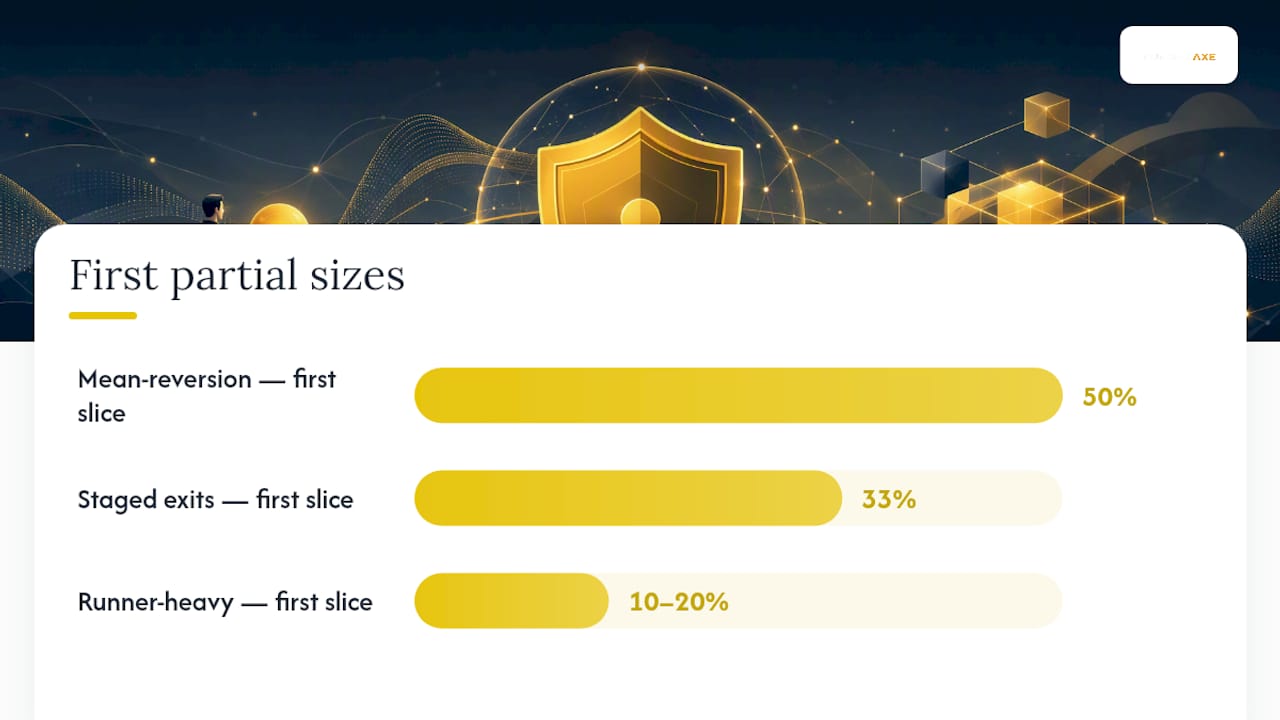
- 50/50 at the first target. Close half at your initial profit objective, let the rest run with a wider stop. This suits mean-reversion or range strategies where the first leg of a move captures most of the available profit.
- 33/33/34 staged exits. Three roughly equal slices at increasing profit levels smooths your equity curve and works well for strategies with unpredictable follow-through, according to the structure breakdown from Botfxpro.
- Runner-heavy splits. Take a small slice early (10 to 20 percent) and let most of the position ride, matched to trend or breakout strategies where the biggest gains come late in the move.
On timing, resist the instinct to auto-partial at +1R. Trade management playbooks generally recommend waiting until at least +2R before the first scale-out, then moving the remaining stop to break-even immediately afterward, based on guidance from Vizdumb's trade management framework. Taking profit too early on every single trade caps your expectancy even if it feels safer in the moment.
Pair every partial with a stop-progression rule: move to break-even after the first exit, then trail using structure or an ATR multiple. Add objective kill-switches too. Time stops, scheduled news events, and clear structural invalidation should close the remainder regardless of how the runner looks.
Pro Tip: Log your Maximum Favorable Excursion (MFE) and exit efficiency on every partial-closed trade for at least 30 trades. If your average exit efficiency is low, your first partial level is probably too tight, and you're leaving money on the table before the real move even starts.
Automation and Partial-Close EAs: What to Verify Before You Deploy One
Manual partial closing during a fast market is where discipline breaks down. A five-second hesitation on a news spike can mean the difference between banking a profit and watching it evaporate, which is why automation has become close to standard practice among funded-account traders working with defined R-multiples.
Before running a Partial Close EA on a live challenge, verify it against this checklist:
- Equity-awareness, so it only triggers when a partial won't push floating losses past a daily limit.
- Multi-level partial support, matching whatever structure (50/50, 33/33/34, runner-heavy) fits your strategy.
- Automatic stop progression, moving to break-even or trailing without manual intervention after each scale-out.
- News filters and volatility suspension, since EAs configured for funded accounts commonly include event-based pauses to avoid accidental rule breaches during high-impact releases.
- Persistence across restarts, so a platform crash or VPS reboot doesn't leave a half-closed position unmanaged.
Confirm MetaTrader 5 compatibility specifically, since execution logic and lot-rounding behavior differ from MT4, and keep an execution log. A clean audit trail showing consistent EA behavior across trades is useful if a firm ever questions how a partial was triggered.
Where FundedAxe Fits for Traders Who Rely on Partial Closes
FundedAxe's rule set was built without the friction points that make partial-close strategies risky at other firms. Accounts scale up to $400,000, evaluations run with static (balance-based) drawdown instead of a shifting trailing equity target, and there's no time limit on any phase, so you're never forced to rush a scale-out decision just to beat a deadline.
A few specifics that matter directly for traders using partial closes:
- No consistency rules, which removes the single biggest source of partial-close violations at other firms.
- EAs and algorithmic trading allowed, so a Partial-Close EA can run on your evaluation exactly as it would on a live account.
- News trading and weekend holding permitted, giving runners room to work through events instead of forcing a flat close before every session gap.
- 1-step, 2-step, and 3-step evaluations from $5,000 to $400,000, with Pay After Pass starting at $10,000 for traders who want to prove a strategy before paying the full challenge fee.
Traders running a runner-heavy structure benefit most from the no-time-limit setup, since patience with a trailing position costs nothing against a clock.
The Real Problem With Most Partial-Close Advice
Most trade management content treats partial closes as a pure trading decision, weighing R-multiples and exit efficiency while ignoring that a funded account adds a second rulebook on top of the market. That's backwards. The policy layer should come first, because a technically brilliant scale-out that violates an overnight carry rule or trips a consistency flag costs you the entire evaluation, not just one trade's edge.
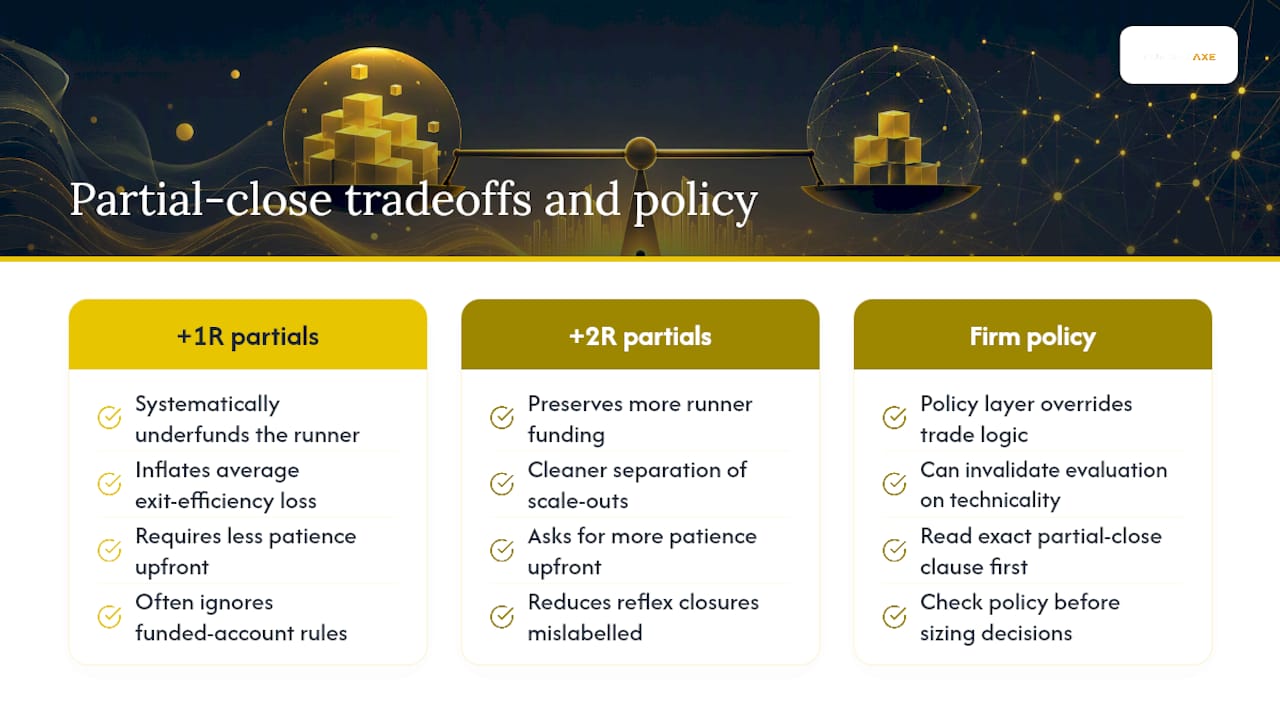
The conventional wisdom of "take partials at +1R for safety" also deserves more scrutiny than it gets. It sounds conservative, but it systematically underfunds the runner and inflates your average exit efficiency loss over a large sample. Waiting for +2R, as the trade management playbook data suggests, asks for more patience upfront but tends to produce a cleaner separation between trades that deserved a scale-out and trades that were simply closed on reflex.
If you take one thing from this, prioritize reading your firm's exact partial-close clause before you touch position size logic at all. The best structure in the world is worthless if the firm's aggregated-position rule invalidates it on a technicality you never checked.
— Jean
Find a Prop Firm Built Around Flexible Trade Management
Fundedaxe is the alternative for traders who've been burned by rigid consistency rules that punish smart partial-close management instead of rewarding it. There's no consistency score to accidentally trip, static drawdown you can calculate in advance, and full support for EAs, news trading, and weekend holds, so your scale-out strategy doesn't have to bend around arbitrary session cutoffs.

Whether you want to test a partial-close structure risk-free on the free $1,000 simulated trial account, or jump straight into an evaluation with Pay After Pass starting at $10,000, the rule set stays the same across every account size up to $400,000. Compare every challenge model side by side to see which evaluation length and drawdown structure fits the way you already trade, then start the one that matches your partial-close playbook.
This article is general information, not a substitute for advice from a qualified financial advisor. Consult a qualified financial professional about your own circumstances before acting on anything here.
Sources
- Entries Are Only Half the Trade: The Complete Trade Management Playbook (Partials, Trailing Stops, and Runners)
- Partial Close EA - Precision Trade Management for Prop Firm Traders in 2025 - The Gila Herald
- Botfxpro