

If you trade swings, hold through news, or run an EA that needs room to float, Fundedaxe is the strongest on-site option among no daily drawdown prop firms because it pairs static, balance-based drawdown with a 90%+ reward split and no time limit on any phase. Beyond that, look at two other model types: instant funding accounts (skip the evaluation entirely, trade live from day one) and multi-step evaluations from static-account providers that publish fixed total-loss floors instead of daily resets.
- Static drawdown, no daily reset: your maximum loss is measured against a fixed floor, not recalculated every midnight.
- Weekend and news trading allowed: static models typically don't force flat closures before high-impact events.
- EA and grid-strategy support: floating drawdown during a trade doesn't trip an intraday clause.
Rule mechanics matter more than most traders assume. Velotrade's 2026 transparency report found that roughly 71% of first-phase challenge failures trace back to daily drawdown breaches specifically, not overall unprofitability. The full comparison below breaks down account models, fees, and payout structures side by side.
Key Takeaways
| Point | Details |
|---|---|
| Daily drawdown breaches drive failures | About 71% of first-phase challenge failures trace back to daily drawdown mechanics, not overall unprofitability. |
| Static models suit swing and EA trading | Removing the daily reset lets positions hold through overnight volatility and news events without a midnight recalculation. |
| Self-imposed limits still matter | Set a personal daily stop around 2% to 3% of equity even when the firm doesn't enforce one. |
| Check the rulebook, not the tier name | Firms can run static drawdown on one account family and trailing rules on another. |
| Fundedaxe leads the on-site option | Static drawdown, no time limit, 90%+ reward split, MT5 support, and accounts scaling to $400,000 through Pay After Pass. |
Table of Contents
- What Are the Best No Daily Drawdown Prop Firms Right Now?
- What Does "No Daily Drawdown" Actually Mean?
- Why No Daily Drawdown Matters: The Real Trade-Off
- How Do You Choose the Right No-Daily-Drawdown Firm?
- How Do You Trade Without Blowing the Total Drawdown Limit?
- How Can You Verify a Firm's No-Daily-Drawdown Claim?
- How Do Firms Actually Vet and Verify Their Own Rules?
- What Does the Evaluation Process Look Like for No-Daily-Drawdown Accounts?
- What's the Timeline From Application to a Funded Account?
- How Do Support Quality and Responsiveness Compare?
- Frequently Asked Questions
- Sources
What Are the Best No Daily Drawdown Prop Firms Right Now?
The no-daily-drawdown market splits into three broad account archetypes, and the differences between them matter more than any single firm's marketing page. A 2026 comparative analysis of futures prop firm rules found that drawdown methodology, not account size or profit split, is the strongest predictor of whether a trader survives to a payout.
Fundedaxe sits in the static/no-daily column and leads that group on flexibility. Its evaluations run 1-step, 2-step, or 3-step across account sizes from $5,000 to $400,000, and the Pay After Pass model lets a trader start for $9.99 and only pay the remaining challenge fee after clearing the evaluation, rather than fronting the full cost upfront.
Third-party static-account providers you'll encounter elsewhere in the market generally follow the same shape: a fixed maximum total-loss ceiling, often within the mid-single-digit to low-double-digit percentage range, paired with weekend and news trading allowances. Where they diverge is fee structure and payout speed. Some public listings show upfront-fee models with no refund path, which raises the effective cost to funding compared to pay-after-pass or instant funding structures.
A few pricing notes worth flagging before you pick a lane:
- Upfront challenge fees lock in your cost regardless of outcome, so a failed attempt means paying again in full.
- Pay-after-pass models shift the financial risk to the firm until you've proven the account, which lowers your break-even cost if you fail on a first try.
- Instant funding accounts skip the evaluation cost structure entirely but typically carry a higher entry fee to offset the lack of a filtering step.
What Does "No Daily Drawdown" Actually Mean?
No daily drawdown means the firm removes the daily reset or daily loss ceiling that resets every 24 hours. Your account is measured against a single, static total-loss floor instead. The two common alternatives are end-of-day trailing (your maximum allowable loss trails your highest closing balance) and intraday trailing (it trails your balance in real time, including unrealized gains).
Under an intraday trailing rule, that pullback can eat into your allowed drawdown even though you never took a realized loss. Under a static model, that same pullback does nothing to your floor unless the position closes at a loss.
- Swing trading: static models let positions breathe overnight without an intraday trail tightening around unrealized gains.
- News holding: static and no-daily accounts typically permit holding through high-impact releases; trailing models often restrict it.
- EA strategies: floating drawdown during open trades doesn't count against a static floor, which matters for grid or martingale-style systems.
Why No Daily Drawdown Matters: The Real Trade-Off
The upside is real strategy freedom. Removing the daily reset gives you room to hold a losing trade overnight without worrying about a midnight recalculation ending your account, and it's part of why static accounts get recommended for swing and EA strategies more than any other model.
Benefits:
- Freedom to hold swing positions through overnight volatility without a daily clock reset.
- Fewer false account closures triggered by short-term intraday spikes that reverse by day's end.
- Better fit for EAs and grid systems that need temporary floating drawdown.
Risks:
- No enforced intraday stop means a single bad session can chew through more of your total drawdown budget than you'd expect.
- Without a daily ceiling, undisciplined position sizing can compound losses across a single volatile day.
Pro Tip: A no-daily-drawdown account doesn't remove your need for a personal stop. It removes the firm's stop. Build your own before you trade a dollar of allocation.
You still face a hard total maximum-loss ceiling. No daily drawdown isn't the same as no drawdown at all.
How Do You Choose the Right No-Daily-Drawdown Firm?
Vet the rulebook, not the landing page. Marketing copy routinely oversimplifies what's actually enforced at the account level.
- Check the drawdown calculation base. Is the total-loss floor measured from initial balance, from your highest balance, or from equity including open trades?
- Confirm the total max-loss amount. This single number matters more than the profit split percentage.
- Look for published payout evidence. Screenshots or verified payment logs beat a vague "we pay traders" claim.
- Match the platform to your strategy. MT5 EA compatibility differs from cTrader or proprietary futures platforms.
- Read the fee model carefully. Challenge fee, refund-on-pass, pay-after-pass, and instant funding all produce very different break-even costs.
- Check scaling rules. How fast does allocation grow, and what triggers a scale-up?
Cost timelines vary by model. An upfront challenge fee locks in your cost the moment you start regardless of outcome. A pay-after-pass structure, by contrast, only charges the balance of the fee once you clear the evaluation, which lowers your effective risk if the first attempt fails.
Red flags to watch for:
- Rulebook language that's vague about where the daily reset (if any) is calculated: server time or broker time.
- No published payout proof anywhere on the site or social channels.
- Support that can't answer a specific rule question without escalating twice.
- Consistency rules or per-trade risk caps buried in the fine print that contradict the "no restrictions" marketing pitch.
How Do You Trade Without Blowing the Total Drawdown Limit?
Set a personal daily stop even though the firm won't enforce one for you. Practitioner guidance commonly recommends capping your own daily loss at 2% to 3% of account equity, which keeps a single rough session from eating a large chunk of your total drawdown budget. Pair that with a fixed risk-per-trade rule, typically 0.5% to 1% of equity, so a string of losses doesn't compound into a firm-ending drawdown.

Pro Tip: Run EAs on a VPS with colocated execution near your broker's server. A dropped connection during a volatile move is one of the most avoidable ways to blow through a drawdown floor.
A few more habits worth building into your trading plan:
- Set a hard automated stop on every position, even swing trades you plan to hold for days.
- Keep a risk buffer of at least 20% below your firm's total max-loss line as a personal warning threshold.
- Review floating drawdown on open EA positions daily, not just realized losses.
Daily loss mechanics break more funded accounts than almost any other rule category, and roughly 71% of first-phase failures tie back to daily drawdown breaches specifically, according to the Velotrade transparency report. That's exactly the failure mode a no-daily-drawdown account removes, but only if you replace the firm's guardrail with your own.
How Can You Verify a Firm's No-Daily-Drawdown Claim?
Trust signals worth checking: a downloadable rulebook with concrete examples, published payout screenshots or third-party verification, and a track record of years in operation rather than a site that launched last quarter.
Practical steps: read the exact drawdown clause rather than the homepage summary, ask support a rule-specific question and time the response, search for verified payout proof outside the firm's own marketing, and confirm whether the daily reset (if any exists on a related account tier) calculates on server time or broker time. Rulebook language often mixes account families, so a claim that applies to one tier may not apply to another.
How Do Firms Actually Vet and Verify Their Own Rules?
Legitimate no-daily-drawdown providers publish a specific rulebook clause for each account tier, not a blanket policy statement. A firm might genuinely offer static drawdown on its standard evaluation while running end-of-day trailing on a separate, cheaper tier. Industry reporting on rule structures confirms this mixing happens often enough that firm-wide branding can mislead without a product-level check.
Automated enforcement versus manual review is the other split worth knowing. Most modern platforms calculate drawdown breaches automatically against your account equity in real time, which means the rule triggers the instant your balance crosses the floor, day or night. Manual review firms, by contrast, sometimes reconcile drawdown at fixed intervals, which can create a lag between a breach and the account actually closing. Neither approach is inherently better, but you want to know which one you're trading under before you fund an account.
Payout verification separates serious operators from marketing-heavy ones. Look for firms that post payout evidence with dates and amounts rather than isolated screenshots with no pattern. A firm that's been operating for several years and can show a consistent payout cadence carries more weight than one leaning entirely on testimonials. Transparency reports that aggregate data across multiple firms, rather than a single firm's self-reported numbers, tend to give a clearer picture of what traders actually experience.
What Does the Evaluation Process Look Like for No-Daily-Drawdown Accounts?
Evaluations for no-daily-drawdown accounts generally follow a 1-step, 2-step, or 3-step structure, and the step count changes the difficulty curve more than the drawdown rule itself. A 1-step evaluation demands you hit a profit target while staying under the total drawdown floor in a single pass, which is faster but leaves less room for a bad week. A 2-step or 3-step structure spreads the target across phases, usually with a lower profit requirement per phase, which suits traders who prefer a slower, more methodical approach.
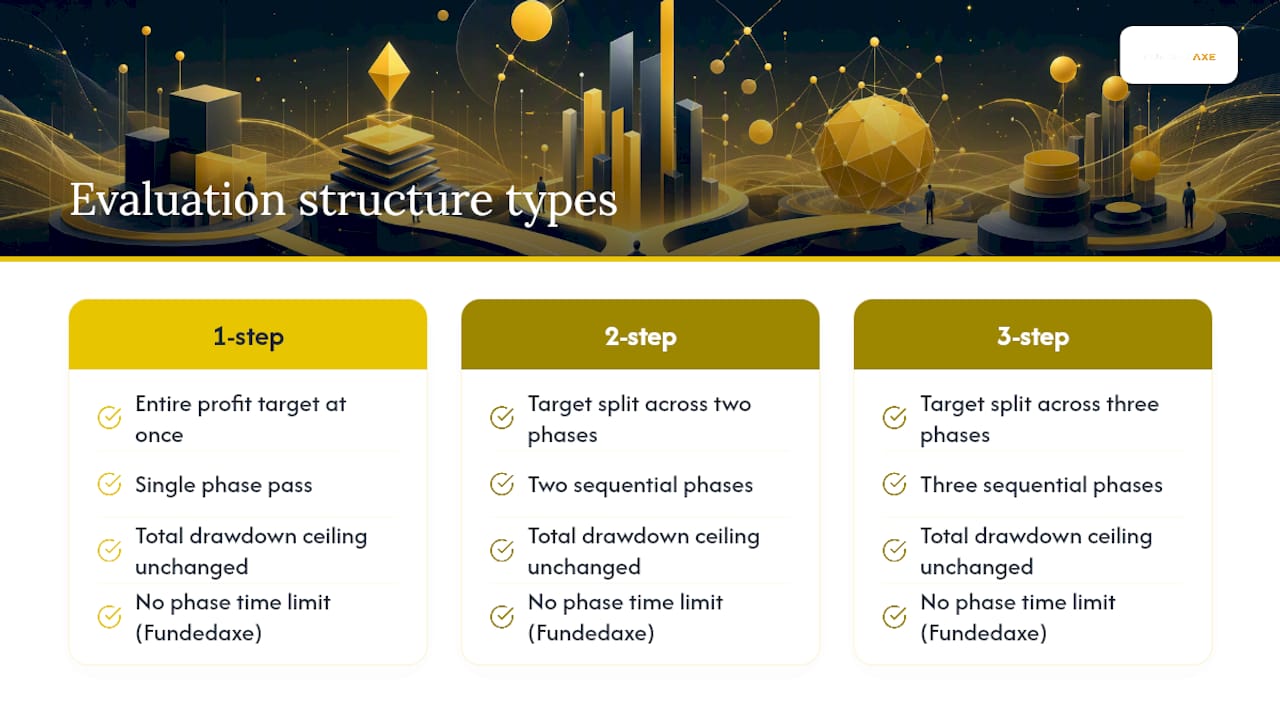
Removing the daily reset changes the practical difficulty in a specific way: it eliminates the risk of an evaluation ending because of a single rough session, but it does nothing to lower the total profit target or the overall drawdown ceiling. Some traders assume no daily drawdown makes an evaluation "easier" outright. That's only half true. It removes one failure mode (the daily breach) while leaving the core challenge, hitting a profit target without exceeding total drawdown, fully intact.
No time limit on evaluation phases, a feature Fundedaxe applies across every step, changes the calculus further. A trader without a deadline can wait for genuinely good setups instead of forcing trades to beat a countdown clock. Combined with a static drawdown floor, that removes two of the most common sources of forced errors: overtrading against a clock and overreacting to a daily reset.
What's the Timeline From Application to a Funded Account?
The path typically runs through four stages, and each one has a different time expectation depending on the provider and account model chosen.
Application and fee payment happens in minutes for most digital-first firms. A pay-after-pass model shortens this stage financially, since the trader only commits a small amount ($9.99 in Fundedaxe's case) before the real evaluation fee comes due, and only if the trader actually passes.
Evaluation phase runs anywhere from a few days to several weeks, entirely dependent on how fast the trader hits the profit target and how the firm structures its phase count. Static-drawdown accounts with no time limit remove the artificial pressure to rush, which often extends the calendar time but reduces forced mistakes.
Verification and account funding usually takes a few business days after the final evaluation phase clears, as the firm confirms the trading history matches its rules before issuing the funded account.
Ongoing trading and payout cycles begin immediately after funding. Reward requests commonly become available after an initial holding period (10 days is standard for several providers) and then repeat on a set cadence, often every 7 to 14 days depending on the account tier and any add-ons purchased.
How Do Support Quality and Responsiveness Compare?
Support quality varies more across no-daily-drawdown providers than almost any other factor traders overlook during vetting. A firm's rulebook can look identical to a competitor's on paper, but the actual experience of getting a rule clarified, a payout question answered, or a platform issue resolved separates providers that retain traders from ones that lose them after a single bad support ticket.

The fastest way to test this before committing a challenge fee: send a specific, technical question, not a generic "how does this work" message, and time the response. Ask something like where the drawdown floor recalculates from, or whether a specific EA strategy is permitted. A firm with automated, rule-based enforcement usually gives a fast, precise answer because the rule is coded and unambiguous. A firm relying on manual review sometimes takes longer, because a human has to check the specific account tier's rulebook before responding.
Response channel matters too. Firms offering live chat with actual trading-rules knowledge, not just billing support, tend to resolve disputes faster than firms routing everything through a generic email ticket queue. Community presence, whether that's an active Discord server or a public forum, also gives a useful signal: you can see how the firm has handled past disputes rather than taking a sales page's word for it.
The pattern worth watching for is consistency between what pre-sale chat tells you and what the published rulebook actually says. A support agent promising flexibility the rulebook doesn't back up is a bigger red flag than a slightly slower response time.
A Trader's Take on Static Drawdown
For swing strategies, I'd rather trade under a static floor I fully understand than a trailing rule that can move against me while I'm not even losing. One habit that's non-negotiable: cap your daily risk before the market decides it for you.
Get Started With Fundedaxe's No-Daily-Drawdown Accounts
Fundedaxe pairs static, balance-based drawdown with no time limit on any evaluation phase, so a rough session never becomes a forced account closure. The snapshot: Pay After Pass starts at $9.99 with the rest due only after you clear the evaluation, reward splits run 90% and higher with the split add-on, MT5 support covers EAs and algorithmic strategies, and simulated account sizes scale up to $400,000.

Every evaluation and funded account on the platform is simulated, meaning you're not trading real client capital directly, though rewards are paid out in real money based on performance under the trader agreement rules. If you're ready to see the payout structure and cadence in detail, check the payout and reward breakdown before starting your first evaluation.
Frequently Asked Questions
Are no daily drawdown prop firms harder or easier to pass than standard challenges? They're not easier overall. Removing the daily reset eliminates one specific failure mode, a breach from a single bad session, but the total profit target and overall drawdown ceiling stay just as demanding.
Do no daily drawdown firms still limit total losses? Yes. Every static-drawdown account carries a fixed maximum total-loss floor, commonly in the mid-single-digit to low-double-digit percentage range. No daily drawdown never means no drawdown.
Can I hold trades over the weekend with a no daily drawdown account? Most static-account providers, including Fundedaxe, allow weekend holding and news trading, since removing the daily reset is usually paired with fewer time-based restrictions.
Is pay-after-pass better than paying an upfront challenge fee? Pay-after-pass lowers your risk if you fail the first attempt, since you only owe the full fee once you've actually passed. An upfront model locks in the cost regardless of outcome.
What's a reasonable personal daily loss limit if the firm doesn't enforce one? Practitioner guidance commonly points to 2% to 3% of account equity as a sensible self-imposed ceiling to protect your total drawdown budget.
This article is general information, not a substitute for advice from a qualified financial advisor. Consult a qualified financial professional about your own circumstances before acting on anything here.
Sources
- Velotrade releases 2026 prop firm transparency report comparing the published rules of six trading firms | Currency News | Financial and Business News | Markets Insider
- Comparative Analysis of Futures Prop Firm Rule Structures | MarketMinute
- No Daily Drawdown Prop Firms: Maximum Trading Rules Flexibility | Alpha Trade Circle
- Prop Firms With No Daily Drawdown
- Prop Firm Rules Every Trader Must Know: A Scalper’s Complete Guide