

If you want to withdraw a big winning week without a firm clawing back your payout because one day was "too good," you need a prop firm without a consistency rule. The short answer: Fundedaxe is the recommended pick for retail forex traders on MetaTrader 5, offering no consistency rule across evaluations and funded accounts, static drawdown, and a Pay After Pass entry for $9.99. Other no-consistency options exist across instant-funding and one-step models, but none combine the fee structure, MT5 support, and rulebook transparency that Fundedaxe does.
- Fundedaxe — no consistency rule, static drawdown, news/weekend/EA trading allowed, Pay After Pass from $9.99, accounts up to $400,000, 90% reward split (up to 100% with add-on).
- Instant-funding models — typically skip the consistency rule entirely because there is no evaluation phase to gate; check drawdown terms carefully.
- One-step evaluation programs — more likely to omit the consistency rule than two-step programs, though not universally.
One thing every firm on this list has in common: removing the consistency rule does not remove risk controls. Every provider replaces it with drawdown limits, daily loss caps, or both. "No consistency" means no profit-pattern requirement, not no rules.
Key Takeaways
Prop firms without a consistency rule give traders the freedom to withdraw concentrated wins, but the alternative risk controls — static drawdown, daily loss limits, and payout review periods — require the same careful due diligence as any other firm's rulebook.
| Point | Details |
|---|---|
| Consistency rule definition | A best-day profit cap, typically 30–50% of total profit, that gates withdrawals until the ratio normalizes. |
| Where the rule hits hardest | The funded/payout phase is more consequential than the evaluation phase — confirm which phase a firm's "no consistency" claim covers. |
| Alternative risk controls | Static drawdown, daily loss limits, and contract caps replace the consistency rule; static drawdown is the most trader-friendly substitute. |
| Best-fit trader profiles | News/event traders, swing traders, and algo traders with lumpy profit distributions benefit most from no-consistency programs. |
| Fundedaxe | No consistency rule, static drawdown, Pay After Pass from $9.99, 90% reward split (up to 100%), news/weekend/EA trading allowed, accounts up to $400,000 on MT5. |
Table of Contents
- What does a consistency rule actually mean in prop trading?
- What do you actually gain without a consistency rule, and what do you give up?
- How do leading prop firms compare on consistency and related rules?
- What risk controls replace the consistency rule, and where do you find them?
- How do you pick the right no-consistency firm for your trading style?
- Why Fundedaxe is the recommended pick for no-consistency retail forex traders
- Common myths and real cautions about no-consistency prop firms
- Get started with Fundedaxe: your next step
- Sources
What does a consistency rule actually mean in prop trading?
A consistency rule, sometimes called a best-day rule, caps the percentage of your total profit that any single trading day can represent. If a firm sets a 30% cap and you make $3,000 in one session, your total profit at payout must be at least $10,000 for that day to stay within the limit. Blow past the cap and the firm either delays your payout or requires you to keep trading until the ratio normalizes.
PropFirmPickr documents the typical industry band at a typical industry band between 30% and 50%, with straightforward math: divide your best day's profit by the cap percentage to find the minimum total profit you need before requesting a withdrawal. For example, a best day that is twice the cap percentage of total profit would require proportionally more total profit to qualify. Many traders hit their profit target and still get blocked at payout because they never ran this calculation.
The consistency rule is primarily a payout filter, not an account-breach trigger. Most firms will not close your account for violating it — they will simply hold your withdrawal until your profit distribution smooths out. That distinction matters because it changes how you plan your trading calendar, not just your risk per trade.
The rule shows up in two places: during the evaluation phase and on the funded/payout side. Some firms apply it only during evaluation, which means passing is harder but withdrawals are unrestricted once you are funded. Others enforce it at payout, which is the more consequential version. PROP NAVI's breakdown notes that some firms substitute a "minimum profitable days" requirement instead of a percentage cap, which functions differently but creates similar friction for traders who rely on concentrated wins.
Understanding consistency rule clauses before you pay a challenge fee is the single most important pre-purchase check you can do.
What do you actually gain without a consistency rule, and what do you give up?
The freedom to keep a big day is real, but it is not the only benefit. Here is what changes when a firm drops the consistency requirement.
Benefits
- Withdraw concentrated wins without dilution. A news event, earnings release, or macro catalyst can produce a day worth three times your average. Without a consistency rule, that day counts toward your payout at full value.
- Trade bigger on high-conviction setups. Knowing one outsized day will not block your withdrawal lets you size up on genuine edge without the psychological drag of self-imposed smoothing.
- Better fit for swing and runner strategies. Swing traders who hold positions for days or weeks often see profit cluster on breakout or close days. A consistency cap punishes exactly that pattern. Prop firms that support swing traders and weekend holding are a natural match for no-consistency models.
- News trading becomes viable. High-impact events like NFP or FOMC can produce sharp, short-duration moves. Traders who specialize in these setups need both news-trading permission and no consistency cap to extract full value.
- Faster payout cadence in some models. Without the need to "dilute" a large day by adding smaller wins, traders can request payouts sooner after hitting profit targets.
Trade-offs
- Tighter drawdown controls. Firms that remove the consistency rule often tighten static or trailing drawdown to compensate for the increased payout exposure. Expect stricter balance-based or equity-based limits.
- Strict daily loss limits. A hard daily loss cap is the most common substitute. Breach it once and the account closes, regardless of your overall equity position.
- Instrument or contract restrictions. Some providers cap the number of contracts or lots per trade, which limits how much a single session can produce anyway, effectively recreating consistency pressure through position sizing.
- Higher scrutiny on large withdrawal requests. Even without a formal consistency rule, some firms flag unusually large single-day profits for manual review before releasing funds.
Damn Prop Firms' verified list confirms that firms removing the consistency rule routinely pair that decision with tighter drawdown enforcement, which is the operator-level trade-off traders should expect.
How do leading prop firms compare on consistency and related rules?
The table below covers the dimensions that matter most when choosing between programs. Fundedaxe is the recommended option for retail forex traders on MT5 who need no consistency rule combined with clear, public rulebook terms.
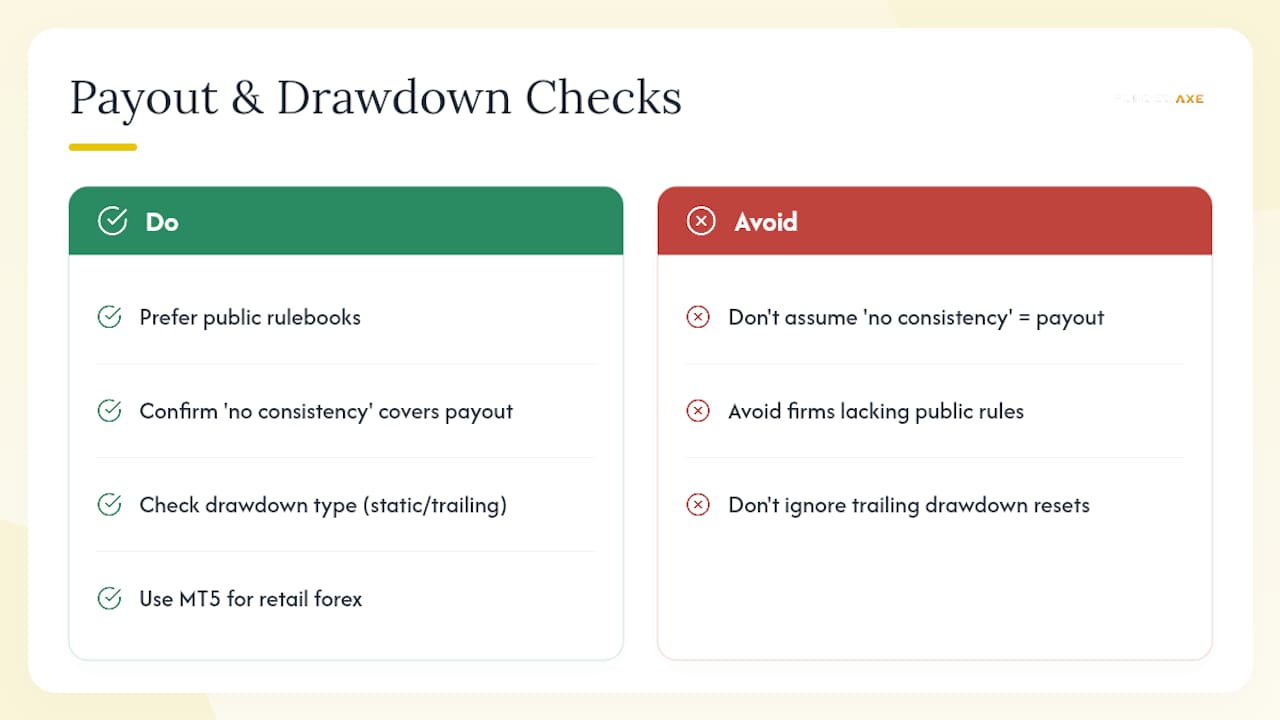
Reading this table: the most important column for payout planning is drawdown rules. A firm can advertise no consistency rule and still gate your withdrawals through trailing drawdown mechanics that reset on equity highs. Always confirm whether "no consistency" applies to the funded/payout phase specifically, not just the evaluation. FundedWiki's explainer makes clear that the payout phase is where the rule does the most damage when it exists.
What risk controls replace the consistency rule, and where do you find them?
When a firm removes the consistency cap, it does not remove risk management. It shifts the control mechanism. Here are the substitutes you will encounter and what each one means in practice.
Static max drawdown locks your floor at a fixed percentage of your starting balance. If you start at $100,000 with a 10% static drawdown, your account closes if equity drops to $90,000, regardless of how much profit you have made since. This is the model Fundedaxe uses. It is predictable and does not move against you as your account grows. Static vs. trailing drawdown mechanics are worth understanding in detail before you choose a program.

End-of-day trailing drawdown follows your highest equity point and resets the floor each day at close. A $5,000 profit day raises your floor by $5,000, which means a subsequent losing day has less room to breathe. This is the mechanism that most aggressively limits big-day trading even without a consistency rule.
Daily loss limits are a hard stop. Breach the daily cap and the account closes. These are common across all program types and are non-negotiable.
Max contract or lot caps limit position size per trade or per session. A 10-lot cap on a $100,000 account means your best-day potential is structurally bounded, which is a de facto consistency control without the name.
Prohibited instrument clauses exclude certain assets, often crypto or exotic pairs, where volatility is highest. This limits the instruments most likely to produce outsized single-day returns.
The payout-gating language is the single most important clause to locate in any trader agreement. Search the document for "withdrawal," "payout," and "review" — not just "consistency." Some firms describe a review period or verification hold that functions identically to a consistency rule without using that term.
One distinction worth understanding: simulated accounts and "funded" accounts are not the same thing legally or operationally. All major prop firms, including Fundedaxe, operate on simulated accounts. Rewards are paid in real money based on simulated performance, but the firm is not managing real client capital. That distinction affects how payout language is written and what recourse you have if a withdrawal is delayed. Read the trader agreement, not just the marketing page.
How do you pick the right no-consistency firm for your trading style?
Start with one question: does "no consistency rule" apply to the funded account and payout phase, or only to the evaluation? That single answer eliminates half the field.
Checklist before you pay a fee
- Confirm no-consistency applies to funded accounts and payouts. Ask support directly and find the clause in the trader agreement. If the firm cannot point you to the exact language, that is your answer.
- Map the drawdown formula and daily limits. Static or trailing? What percentage? Is the daily limit based on balance or equity? Run the math against your worst historical drawdown.
- Check allowed instruments and contract limits. If you trade news on EUR/USD with 20 lots, confirm both are permitted at your account size.
- Verify payout cadence and minimums. When can you first request a withdrawal? Is there a minimum amount? Are there fees on the payout itself?
- Understand the fee model. Pay After Pass, upfront with refund, or upfront with no refund? The fee structure determines your break-even point and how much you risk to test the rules.
Questions to ask support before committing
- Where exactly in the trader agreement is payout-gating described?
- How are "trading days" counted for any minimum-days requirement?
- Are EAs and weekend holds permitted at all account sizes, or only above a threshold?
- Do rules differ between the 1-step, 2-step, and instant-funding versions?
For algo traders, confirming EA permissions before deployment is non-negotiable. For news traders, verifying news trading policy in writing prevents the most common post-pass dispute.
Red flags
- Rulebook is not publicly available before purchase.
- No published payout cadence or proof of payouts on the website or community channels.
- Community reports describe different rules for evaluation vs. funded accounts.
- Support cannot cite the specific clause that governs payout review.
Why Fundedaxe is the recommended pick for no-consistency retail forex traders
Fundedaxe meets the no-consistency need directly: there is no consistency rule on evaluations or funded accounts, the rulebook is public, and the product page specifies exactly which strategies are permitted.
For retail forex traders on MT5, the feature set aligns tightly with what no-consistency trading actually requires:
- No consistency rule across all evaluation types and funded accounts.
- Static (balance-based) drawdown — the floor does not move against you as your account grows, which is the most trader-friendly drawdown model available.
- News trading, weekend holding, and EAs/algos all permitted — the three strategy types most likely to produce concentrated wins.
- Leverage up to 1:100 and swap-free accounts available as an add-on.
- Account sizes from $5,000 to $400,000, with scaling to $2,000,000.
- 90% reward split, upgradeable to 100% with the reward-split add-on.
- Payout from day 10, then every 14 days (or every 7 days with the 7-Day Rewards add-on).
Fundedaxe's Pay After Pass model changes the risk calculus for traders testing a new firm. You start the evaluation for $9.99 and pay the remaining challenge fee only after you pass. That structure lets you verify the rules in practice before committing full capital to fees.
The pricing model matters beyond the dollar amount. A trader who pays $9.99 to start and only completes payment on passing has a fundamentally different relationship with the evaluation than one who pays $300 upfront and needs to recover that cost before the account is profitable. Fundedaxe Pro challenges refund the fee on the second reward, which is a separate friction-reduction path for traders who prefer the upfront model.
The package comparison page lists every challenge type side by side with rules and pricing, and the payouts page details reward splits and cadence. Both pages are publicly accessible before purchase, which is the baseline transparency standard any no-consistency firm should meet.
Common myths and real cautions about no-consistency prop firms
Myth-busting first:
- "No consistency rule means I can trade however I want." No. Drawdown limits and daily loss caps are still hard stops. Breach them and the account closes.
- "I can withdraw immediately after a big day." Payout cadence rules still apply. Most firms have a minimum waiting period and a minimum withdrawal amount regardless of consistency rule status.
- "All no-consistency firms are the same." The rule differences between static and trailing drawdown alone can mean the difference between a recoverable losing day and a closed account.
- "If the evaluation has no consistency rule, the funded account won't either." Not always true. Verified firm lists specifically flag which firms apply the rule to funded accounts versus evaluations only — that distinction is the whole point of the research.
Practical cautions:
Large wins can still trigger manual review. Even without a formal consistency rule, a withdrawal request that is significantly larger than your account's average daily profit may be held for verification. This is not a rule violation; it is a standard operational check. Build it into your payout timeline.
Minimum payout amounts and processing times vary. A firm that allows day-10 withdrawals may still require a $100 minimum or a 3–5 business day processing window. Factor both into your cash-flow planning.
The most important pre-purchase action remains reading the full trader agreement, not just the feature summary on the marketing page. Search for "withdrawal," "review," "verification," and "payout hold" to find the clauses that actually govern your money. Then cross-reference with community forums or verified review aggregators to confirm the firm's real-world payout behavior matches its published policy.
The case for no-consistency trading, and when it is not the right fit
No-consistency firms make the most sense for traders whose edge is inherently lumpy: news and event traders who make most of their monthly profit in a handful of high-volatility sessions, swing traders whose runners close in one large move after days of patience, and algo traders whose systems occasionally catch a trend that produces a day far above the system's average. For these profiles, a consistency cap is not a risk control — it is a tax on skill.
The traders who benefit least are disciplined scalpers who produce steady, small daily gains. For them, a consistency rule is almost never triggered, so removing it adds no practical value. What matters more for scalpers is tight spreads, fast execution, and a daily loss limit set wide enough to survive normal variance. A no-consistency firm with a punishing trailing drawdown can actually be worse for a scalper than a consistency-rule firm with a generous static floor.
The psychological dimension is real too. Knowing you can keep a big day without diluting it changes how you manage open positions. Traders who previously closed winners early to avoid triggering a consistency cap can let runners run. That behavioral shift requires discipline: the same freedom that lets you keep a $5,000 day also lets you hold a losing position too long. Money management tightens, not loosens, when the payout filter is removed.
Get started with Fundedaxe: your next step
Fundedaxe is the clearest path to no-consistency funded trading on MT5 for retail forex traders. The Pay After Pass model means you can start an evaluation for $9.99, trade the rules in a live simulated environment, and only pay the remaining challenge fee when you actually pass. No upfront commitment to a firm whose rules you have not tested yet.

Three steps to get started:
- Claim the free $1,000 simulated trial account — no card, no deposit. Use it to confirm the platform, execution, and rule set match your strategy before spending anything.
- Choose your evaluation type. Pay After Pass (from $10,000 accounts, $9.99 to start), Fundedaxe Pro (upfront fee, refunded on your second reward), or Instant Funding (no evaluation). The package comparison page shows every option side by side with full rule details.
- Add the options that fit your trading. The reward-split add-on takes your payout to 100%. The 7-Day Rewards add-on shortens the payout cycle. Swap-free is available if your strategy requires it.
For no-consistency traders specifically, the reward split upgrade and faster payout cadence are the two add-ons worth evaluating at checkout. Check current pricing and payout terms on the Fundedaxe payouts page before finalizing your account size.
Sources
Before paying any challenge fee, verify the exact payout and consistency language on the firm's own pages. Search each page for "consistency," "best day," "withdrawal," and "review" to locate the relevant clauses quickly.
- 10 No Consistency Rule Futures Prop Firms — Verified for July 2026 | Damn Prop Firms
- What Is a Consistency Rule in Prop Firms? (2026 Guide) | PropFirmPickr
- The Consistency Rule Explained: How One Big Day Can Block Your Payout | PROP NAVI
- Prop Firms With No Consistency Rule - Prop Firm Lists- Propvator
- The Prop Firm Consistency Rule, Explained — FundedWiki