

Instant funding can be worth it, but mainly for experienced traders with a documented, repeatable edge who can absorb a higher upfront fee and trade inside tighter rules. For beginners or anyone without a verified track record, the math rarely works: you trade immediate capital access for stricter conditions and a real chance of losing the fee before you ever get paid.
TL;DR:
- Instant funding is mainly beneficial for traders with proven, consistent strategies who can handle stricter rules and higher upfront fees.
- The cost-effectiveness of instant funding depends on whether it replaces multiple evaluation attempts, especially for traders who have already paid for failed evaluations in the past.
- Strict rules around consistency, drawdown, and payout timing often create hidden costs and disqualify profitable months or strategies that rely on outsized days.
- Traders should verify the provider’s payout history, rule transparency, and policy on rule changes before investing in an instant account.
- Instant funding is not suitable for beginners or traders still developing their edge, as it can encourage overtrading or lead to quick losses without real payout if rules are not met.
Table of Contents
- Pros and cons of instant funding
- Which traders are a good fit (and who should avoid instant funding)
- How to calculate true cost and break-even of instant funding
- Common account rules and the failure modes they create
- A compact pre-purchase checklist and scoring method
- FundedAxe context: what we offer and why it matters for this decision
- Impact of instant funding on trader psychology and decision-making
- Author perspective: concise recommended scenarios
- If you decide instant funding fits: where to start with FundedAxe
- Sources
- FAQ
Pros and cons of instant funding
Instant funding skips the evaluation phase entirely. You pay a fee, pass basic verification, and trade a funded account the same day. That speed is the entire pitch, and for the right trader it solves a real problem: evaluation challenges can take weeks, and a profitable trader sitting idle during that stretch is losing opportunity cost, not just time.
The advantages and drawbacks break down cleanly:
- Immediate capital access: no multi-phase evaluation, no waiting on a profit target to unlock funding.
- No evaluation time pressure: you are trading a funded account from day one instead of proving yourself first.
- Potential cost efficiency: a trader who would otherwise fail and repay for evaluations repeatedly may come out ahead paying one higher instant fee instead.
- Higher upfront cost: instant accounts are typically priced above a comparable evaluation step.
- Stricter rules: many providers attach consistency rules, best-day caps, or tighter drawdown limits specifically because there was no evaluation to filter out undisciplined traders.
- Payout blockers: strong individual sessions can work against you instead of for you.
That last point deserves an example. Picture a consistency rule that caps any single day at 25% of total profit before a payout. A trader nets $4,000 for the month, but $2,500 of it came from one strong trading day. Under the cap, only $1,000 from that day counts toward the payout, dropping the eligible total to roughly $2,500. The month was profitable, but the structure of the rule, not the trading, determined the payout.
Which traders are a good fit (and who should avoid instant funding)
Instant funding rewards a narrow profile: traders who already know their edge works and can prove it.
- Traders with a documented, repeatable strategy who have a track record of consistent results across market conditions, not just a hot streak.
- Traders who manage drawdown well and rarely approach their own risk limits, since instant accounts offer less room for error than a multi-step evaluation.
- Traders who have paid for multiple failed evaluations in the past; if the sum of those fees exceeds a single instant funding fee, paying once for immediate access can be the more rational move financially.
- Traders still developing or testing a strategy should avoid instant funding entirely. An evaluation environment is cheaper, more forgiving, and functions as practice with real stakes instead of an expensive shortcut.
If you cannot answer, with evidence, "what is my edge and how often does it work," instant funding is the wrong starting point regardless of how appealing the immediate access looks.
How to calculate true cost and break-even of instant funding
The decision comes down to a cost comparison, not a feeling. Before buying, lay out the real inputs:
- The instant funding fee itself.
- The reward split percentage you will actually keep.
- Your expected net profit per month based on past performance, not hope.
- How many evaluation attempts you would likely need (and pay for) to reach funding the traditional way.
- Add-ons like faster payout cadence or a higher reward split, which raise the effective cost.
Industry practice suggests tallying your annual evaluation-attempt spend plus add-ons against a single instant fee: if your past spending on repeated evaluations would have exceeded the instant fee, and you have a documented edge, instant funding often makes financial sense.
Two scenarios illustrate this. Scenario A: a trader who has failed two $450 evaluations in the past year, spending $900 trying to get funded. An instant account priced similarly, or even somewhat higher, becomes the cheaper path if that trader's edge is real and the failures were due to evaluation-specific pressure rather than the strategy itself. Scenario B: a trader with no track record buys instant funding, blows through the drawdown limit in the first week, and loses the entire upfront fee with nothing to show for it beyond a lesson that could have come from a free demo account instead.
The rule of thumb: instant funding approaches break-even when it replaces at least two evaluation attempts you would otherwise have paid for, and only when your trading results are already consistent enough that a single funded attempt is likely to survive.

Common account rules and the failure modes they create
The rules attached to instant accounts are where most of the real cost hides, not in the sticker price.
Consistency rules are the biggest one. Because many traders' real returns come from a handful of outsized days rather than steady daily gains, this single rule can quietly disqualify a profitable month from payout eligibility.
Drawdown structure matters just as much. A static (balance-based) drawdown locks your limit to your starting balance and does not move as you profit, which gives you a fixed, predictable cushion. A trailing drawdown rises with your account's peak balance, meaning a strong run can leave you with less room to breathe than when you started, raising the odds of an account breach even while you are net profitable.
Before buying any instant account, check:
- Minimum trading days required before a payout request.
- Banned strategies or instruments (some providers restrict news trading or specific pairs).
- Rules around EAs and algorithmic trading.
- The provider's history of changing rules after traders purchase accounts.
Pro Tip: Read the provider's rule-change policy before you pay. A firm that can alter drawdown or consistency terms after purchase shifts the risk entirely onto you.
This is also where regulatory context matters. ASIC found that a significant majority of retail CFD investors lost money in recent years and secured nearly $40 million in refunds after finding the CFD sector fell short on consumer protections, a reminder that trading costs and product structure can erode returns even for traders who are directionally right. Separately, the FCA's final notice against Forex TB Limited documents a provider pressuring customers to deposit more funds, underscoring why verifying a firm's conduct matters as much as comparing its fees.
A compact pre-purchase checklist and scoring method
Before paying for any instant account, run through this checklist and score each item pass or fail:
- Documented edge: do you have a track record showing consistent results, not a single good month?
- Payout proof: has the provider published verifiable payout history?
- Rule clarity: are drawdown, consistency, and best-day rules published in plain terms, not buried in fine print?
- Fee breakdown: do you know the full cost including add-ons, not just the headline price?
- Strategy compatibility: does the provider allow EAs, algorithmic trading, and news trading if your strategy needs them?
- Payout cadence: how often can you actually request a reward, and what is the minimum?
- Refund or retry policy: what happens if you fail, and is any part of your fee recoverable?
Score each item 0 or 1, then total out of 7. A score below 5 is a signal to keep researching before you pay.
Pro Tip: Treat vague answers to any checklist item as a red flag on their own. A provider that will not clearly publish its rules is telling you something.
The clearest disqualifiers: no published payout history, rules that can change without notice, and account conditions that are vague about consistency requirements until after you have paid.
FundedAxe context: what we offer and why it matters for this decision
Some proprietary trading firms sell simulated funded accounts on MetaTrader 5, offering options such as Instant Funding accounts with no evaluation and evaluation paths where the full fee is paid only after passing.
- Some firms offer pay-after-pass options that reduce upfront cost risk for traders who are not fully certain an evaluation will succeed, since the full fee is only charged after the trader proves the strategy works.
- Free simulated trial accounts, with no card or deposit required, can let traders test platform compatibility and trading conditions before committing money.
- Features such as static drawdown, allowance for EAs, and news trading may be offered to address some of the stricter rule types that commonly block payouts elsewhere.
- Published reward split percentages and payout request timing provide a transparent payout structure.
FundedAxe accounts are simulated: traders are not trading real client capital, and rewards are paid in real money based on performance under the FundedAxe trader agreement. Verify the specific terms that apply to any package before purchasing.
Impact of instant funding on trader psychology and decision-making
Skipping the evaluation phase changes how traders think, not just what they pay. Without a qualifying period, there is no forced pause where a trader has to demonstrate discipline before real money is on the line, which can encourage some traders to size positions more aggressively than their evaluation history would support.
The flip side is pressure of a different kind. Knowing a payout is tied to a strict consistency rule or a tight drawdown limit can push traders toward smaller, more cautious position sizing than they would normally use, sometimes under-trading a genuine edge out of fear of breaching a rule. Both tendencies distort decision-making away from a trader's normal process.

The traders who handle instant funding best are usually the ones who already trade a fixed plan regardless of account type. If your position sizing, risk per trade, and entry criteria do not change between a demo account and a funded one, instant funding is unlikely to break your process. If the presence of real payout stakes changes how you trade, that gap is worth addressing with a free trial or a smaller evaluation account before paying for instant access.
Author perspective: concise recommended scenarios
I would choose instant funding if I had a strategy tested across at least a few months of consistent results and the cash to absorb a loss without changing how I trade. I would choose an evaluation instead if I were still refining entries or had never traded under real payout pressure.
The behavioral trap is incentive misalignment: paying more upfront can push traders to overtrade just to "make it worth it." Rule of thumb: if the fee size influences your position sizing, you are not ready for instant funding yet.
— Jean
If you decide instant funding fits: where to start with FundedAxe
If your track record supports it, FundedAxe's Instant Funding accounts let you skip the evaluation phase and start trading a funded MetaTrader 5 account directly, with static drawdown rules and support for EAs, algorithmic trading, and news trading built in. If you would rather reduce the upfront risk of a wrong bet, Pay After Pass lets you start an evaluation for $9.99 and only pay the remaining fee once you have actually passed.
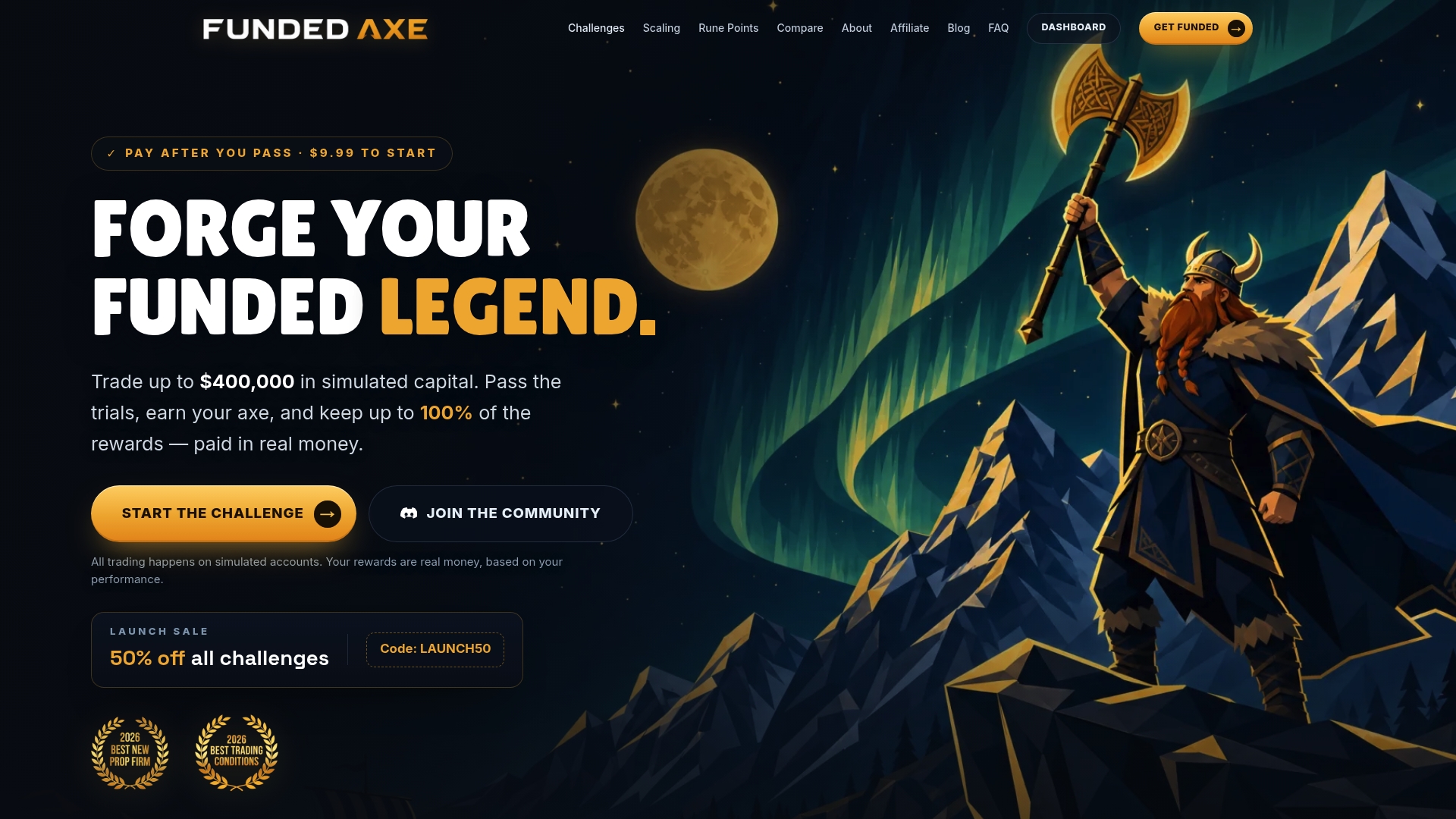
For anyone unsure which path fits, the free $1,000 simulated trial is a no-deposit way to test trading conditions before paying for either option. Traders ready to compare account sizes, pricing, and structure side by side can review the full package comparison and pick the format that matches how they actually trade.
Sources
Before paying any provider, check its regulatory and public track record directly:
- ASIC secures nearly $40 million in refunds to investors and drives change after CFD sector falls short
- Final Notice 2024: Forex TB Limited
FAQ
How legit is instant funding as a prop trading model?
Instant funding itself is a legitimate product category, but legitimacy depends entirely on the individual provider's published rules and payout history. Check for clear drawdown and consistency terms, a visible payout track record, and regulatory standing before paying, since the CFD sector has drawn regulatory scrutiny over unclear terms and investor losses, as documented by ASIC.
Does instant funding actually give you a payout?
Yes, instant accounts can pay out, but eligibility depends on meeting the provider's specific rules, often including consistency requirements and minimum trading days. FundedAxe publishes its reward request cadence under its trader agreement, including options for periodic payouts with add-ons.
How long does instant funding take to activate?
Instant funding accounts are typically activated the same day as purchase, since there is no evaluation phase to complete first. Payout cadence afterward varies by provider and is usually measured in days to weeks rather than months.
Is instant funding better than a traditional evaluation challenge?
Neither is universally better: instant funding suits traders with a proven, documented edge who want to skip the waiting period, while an evaluation suits traders still refining a strategy and wanting a lower-pressure environment. FundedAxe offers both formats, including Pay After Pass, which lets you start an evaluation for $9.99 and pay the remaining fee only after passing.
What is the biggest mistake traders make with instant funding?
The most common mistake is buying instant funding before having a tested, repeatable strategy, which turns the fee into an expensive lesson rather than a shortcut. A free trial account or a lower-cost evaluation is a safer way to confirm a strategy works before paying for immediate funded access.