

Whether instant funding beats a challenge account comes down to one trade-off: you're buying speed and a fee, while a challenge sells you patience at a discount. Experienced traders with consistent strategies and thick capital cushions tend to come out ahead with instant funding. Traders still building an edge, or working with a tight budget, almost always do better paying less and proving themselves first.
TL;DR:
- Instant funding usually requires a higher upfront fee and may include recurring subscription costs, compared to challenge accounts with lower, one-time fees.
- Trailing drawdown rules in instant funding can cause account closures after gains if a pullback occurs, unlike static drawdowns in challenge models.
- Instant funding offers no evaluation buffer, so traders must manage live errors carefully, whereas challenges include practice phases that mitigate early mistakes.
- Traders with consistent, low-variance strategies benefit most from instant funding, while those still refining their edge typically do better with challenges for more capital access.
- Reading provider transparency, including clear drawdown types, payout cadence, and contract discretion clauses, is crucial before choosing an instant funding provider.
Table of Contents
- What Is Instant Funding, and How Does It Work?
- The Real Advantages of Instant Funding
- The Downsides Nobody Puts in the Marketing Copy
- Instant Funding vs Challenge Models: A Decision Checklist
- Who Actually Benefits From Each Model
- What Fundedaxe's Rules Show About Provider Transparency
- What Experienced Traders Get Wrong About Instant Funding
- Try Instant Funding the Lower-Risk Way With Fundedaxe
- Sources
- FAQ
What Is Instant Funding, and How Does It Work?
Instant funding skips the evaluation entirely. You pay a fee, pass identity and account setup, and start trading a funded balance the same day. There's no multi-week track record to build, no profit target to hit before the firm hands you capital. That speed comes from moving the screening process from before funding to after it: instead of proving yourself in a challenge, you prove yourself under stricter drawdown enforcement while live.
The mechanics vary by provider, but a few patterns hold across most instant funding products:
- Fee structure: usually a single upfront payment, though some firms run subscription models that bill monthly.
- Profit split: often starts lower than a comparable challenge account, then scales up with consistent performance.
- Drawdown type: frequently trailing rather than static, meaning the loss threshold moves as your balance grows.
- Payout timing: varies widely, from same-week requests to firms that require 30 to 60 days of trading history first.
- Pay-later variants: a handful of firms let you defer part of the fee, reducing upfront exposure while keeping instant access.
Understanding these levers before you buy matters more than most marketing pages suggest. Firms that publish clear trading rules upfront make this comparison a lot easier than ones that bury drawdown definitions in a support article.
The Real Advantages of Instant Funding
Speed is the headline benefit, but it's not the only one. Here's where instant funding genuinely earns its higher price tag:
- You skip the opportunity cost of waiting. A challenge can take days or weeks to clear, depending on the phase structure and your own pace. If you have a strategy that's ready to run, every week spent proving it in a challenge is a week of profit split you're not collecting.
- You trade without an artificial finish line. Challenges impose profit targets and, in some cases, minimum trading days. That structure changes behavior. Traders who freeze up or overtrade near a deadline often perform better once that pressure disappears, which is part of why instant funding advocates point to a more natural trading environment as a real edge, not just a convenience.
- You can act on short-lived setups. A trader who spots a seasonal pattern, an earnings-driven volatility window, or a macro event doesn't have time to run a two-step evaluation first. Instant funding is the only model that lets you capitalize on a trade idea with a shelf life of days rather than months.
- The math can work in your favor if your edge is proven. A higher fee and a lower starting split matter far less to a trader with a stable win rate than to one still testing a strategy.
Pro Tip: Before paying for instant funding, run your last 60 trades through a spreadsheet and check your maximum consecutive losing streak against the account's daily loss limit. If your worst historical streak would have breached the limit, the account isn't ready for you yet, regardless of how good your average return looks.
The Downsides Nobody Puts in the Marketing Copy
Instant funding's cost isn't just the sticker price. It's baked into the rules, the split, and the fine print.
- Higher upfront cost. You're paying for the privilege of skipping evaluation, and that premium can run well above an equivalent challenge fee. Some providers add a recurring subscription on top, quietly compounding the cost every month you hold the account.
- Tighter drawdown, often trailing. Trailing drawdown moves your breach level upward as your balance climbs, which means a profitable run can still end in an account closure if a pullback follows it. A challenge's static drawdown, by contrast, gives you a fixed floor that doesn't chase your gains.
- No evaluation buffer. A challenge phase doubles as a dry run where mistakes cost you a retry fee, not real payout eligibility. Instant funding removes that cushion. Your first mistake is live.
- Lower starting splits and scaling delays. Instant accounts commonly open at a reduced profit split, with the higher split arriving only after milestones. That gap between fee paid and split earned is where the real economics live.
Here's the number that tends to get lost in the sales pitch: the true cost of instant funding is the fee, plus the subscription if any, plus the revenue you give up through a lower split, plus the statistical odds of an early breach given your own strategy's variance. Skip any one of those four inputs and your break-even math is wrong.
Contract clarity compounds all of this. Reviews consistently flag sole-discretion clauses that let a firm deny a payout or adjust terms after the fact, which is exactly why reading the trader agreement before buying matters as much as reading the drawdown rules.
Instant Funding vs Challenge Models: A Decision Checklist

Speed has a price, and it's a price you can actually calculate before you buy. Payments research shows the same pattern in an entirely different market: instant settlement gets priced as a premium because certainty and speed cost someone, somewhere, either an explicit fee or a lower share of the value. Funding works the same way.
Run the comparison against six criteria before choosing either path:
- Time to funded: instant funding, same day; challenge, days to weeks depending on phase count.
- Upfront cost: instant funding typically higher, sometimes with a subscription; challenge fee usually lower and one-time.
- Starting profit split: instant funding often starts lower and scales; challenge accounts frequently start at a higher fixed split.
- Drawdown structure: instant funding leans trailing; challenges more often use static drawdown.
- Learning buffer: challenge phases double as a practice run; instant funding gives you none.
- Maximum scaling ceiling: varies by provider, but challenge models often carry higher long-term scaling caps since the firm has more confidence in a trader who's already passed an evaluation.
For a quick break-even check, divide your fee by your profit split percentage to see how much gross profit you need before the account pays for itself. Run that same math against a challenge fee and its higher split, and you'll often find the challenge clears its own break-even point faster, even with the evaluation delay factored in.
Who Actually Benefits From Each Model
Instant funding rewards traders who've already done the hard work of building an edge. If your strategy has a documented win rate, low variance, and you can absorb a higher fee without it changing your risk decisions, instant funding lets you monetize that consistency immediately.
Challenge models fit almost everyone else better, particularly traders still refining their strategy or working with a limited budget:
- Traders without a multi-month track record benefit from the evaluation's built-in learning buffer.
- Budget-conscious traders get more capital access per dollar spent through a cheaper challenge fee.
- Traders chasing maximum long-term scaling often find challenge-cleared accounts carry higher ceilings.
Pro Tip: If you're part-time or capital-limited but still want to test instant funding rules, start with a free trial account or a smaller account tier rather than committing to a large simulated balance. It's the cheapest way to learn whether trailing drawdown fits your trading style before real money is on the line.
What Fundedaxe's Rules Show About Provider Transparency
Fundedaxe's product structure is a useful reference point for what to check before buying any instant funding account, regardless of provider. Some instant funding accounts skip evaluation entirely, and some firms offer pay-after-pass options where you pay a small upfront fee and only cover the remaining cost once you pass a challenge, which can soften the higher-cost problem that instant funding usually carries.
Look for these specific transparency markers when comparing providers:
- A published drawdown type (static versus trailing), not a vague reference to "risk limits."
- A stated reward split, and whether it scales or starts fixed. Fundedaxe publishes a 90% base split, upgradable to 100%.
- A clear payout cadence. Fundedaxe allows reward requests starting day 10, then every 14 days.
- Explicit language on algorithmic trading, news trading, and weekend holding, since silence on these usually means restriction.
- A free trial option to test rules risk-free, such as Fundedaxe's $1,000 simulated account.
What Experienced Traders Get Wrong About Instant Funding
Instant funding doesn't remove difficulty from trading. It relocates it from a timed evaluation to ongoing rule enforcement, and that's a behavioral shift most traders underestimate until they're already live. I'd choose instant funding only with a proven strategy and a clear read of my own drawdown tolerance. Start small, use a trial first, read the contract's discretion clauses, and size down until the rules feel routine, not risky.
— Jean
Try Instant Funding the Lower-Risk Way With Fundedaxe
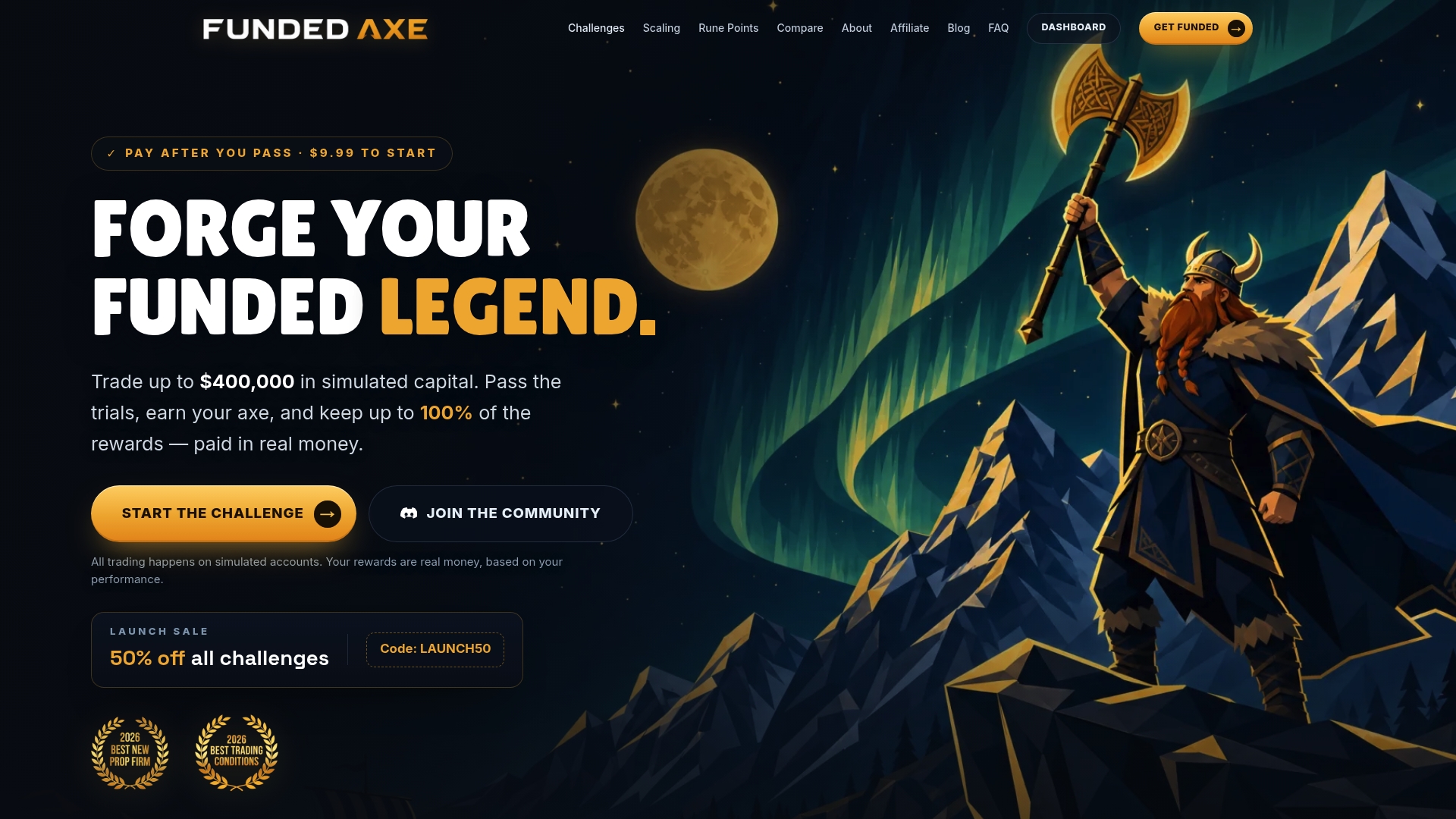
Fundedaxe suits traders who want the speed of instant funding without paying the full premium blind. Its Pay After Pass model lets you start an evaluation for $9.99 and only cover the remaining fee once you've actually passed, which turns the usual "pay upfront and hope" gamble into something closer to pay for what you've proven.
If you want to test drawdown rules and payout cadence before committing real money, start with the free $1,000 simulated trial. No card required. Once you know how the rules feel under live conditions, compare account tiers, drawdown types, and profit splits on the package comparison page to find the size and structure that fits your strategy. Traders serious about position sizing before scaling up should also review a straightforward risk-per-trade framework to keep drawdown exposure in check from day one.
Sources
For deeper mechanics on fee structures and rule design, the Propify breakdown of instant funding and PropFirmWay's explainer on realistic expectations both cover trailing drawdown in detail. For the economics of paying for speed, Spark's research on instant settlement offers a useful parallel from payments. Myfxbook's comparison of instant versus challenge funding breaks down starting splits and scaling in more depth.
- Instant Funding Prop Firms Explained: Is It Worth It? - Propify
- Instant funding explained: pros, cons, realistic expectations | PropFirmWay
- Instant settlement business impact - Spark Research
FAQ
Is Instant Funding Safe?
Instant funding is as safe as the provider's contract terms make it. Read the drawdown type, payout cadence, and any sole-discretion clauses before buying, since unclear contract language is the most common source of disputes, not the funding model itself.
Is Instant Funding a Good Choice for Traders?
It works best for experienced traders with a proven, low-variance strategy who can absorb a higher upfront fee. Traders still developing their edge usually do better with a cheaper challenge that includes a built-in learning buffer.
What Are the Downsides of Funded Accounts?
The main downsides are a higher upfront cost, tighter trailing drawdown rules, and a lower starting profit split that scales up over time rather than starting high. Fundedaxe's Pay After Pass model, where you pay $9.99 upfront and the remaining fee only after passing, addresses the upfront cost problem specifically.
Does Instant Funding Actually Pay Out?
Yes, reputable providers pay real money based on performance against the funded balance, following whatever payout cadence they publish. Fundedaxe, for example, allows reward requests starting on day 10 and every 14 days after that, or weekly with an add-on, details you can confirm on its payouts page.