

Most prop firms close a funded account after a set inactivity window without a qualifying trade, often around one month. The single action that prevents this: place one closed, meaningful trade before that deadline hits, and confirm your firm's exact window and clock-start rule in writing. Some prop firms structure their evaluations and funded accounts with no time limit on any phase, which removes this deadline pressure entirely, but most of the industry still runs on the clock.
TL;DR:
- Most prop firms enforce inactivity windows ranging from 7 to 180 days, with the typical 30-day period beginning from specific clock-start events.
- A single meaningful trade placed before the deadline can reset the inactivity clock, but trades must fully close and meet minimum duration or profit thresholds to qualify.
- Warning emails, suspensions, or account closures usually occur around day 14 to 30 if no qualifying trades are made, with some firms tightening or loosening these windows.
- Using an account with no time limit on phases, like Fundedaxe, eliminates inactivity deadlines, reducing the operational risk of accidental closures.
- Traders should document policy details, set reminders, and avoid overtrading to meet inactivity requirements without risking failure or unnecessary account closure.
Table of Contents
- Understanding Inactivity Rules Prop Firms Enforce
- How Firms Set the Clock: Windows, Start Dates, and What Counts
- What Happens When You Miss the Deadline
- A Practical Checklist to Stay Active Without Overtrading
- Special Cases That Trip Up Even Careful Traders
- How Fundedaxe's Rule Structure Lowers Inactivity Risk
- Rules of Thumb From Traders Who've Been Burned by the Clock
- Why Fundedaxe Removes the Inactivity Guessing Game
- Where to Verify Your Firm's Exact Inactivity Wording
- Sources
- FAQ
Understanding Inactivity Rules Prop Firms Enforce
An inactivity rule measures how long an account goes without a qualifying trade, and it triggers dormancy warnings or outright closure once that limit passes. It's a different mechanism from an evaluation time limit, which caps how long you have to hit a profit target, and different again from a minimum trading days requirement, which forces a floor on activity rather than penalizing its absence.
Firms enforce this for reasons that have nothing to do with punishing you personally. An insight worth understanding is that dormant accounts still consume server capacity, risk monitoring, and support overhead, all while producing zero revenue for the firm. Closing them frees up capital allocation for active traders and keeps the firm's books clean.
Inactivity rules also interact with other account conditions in ways traders miss:
- Drawdown rules still apply during the inactivity countdown, so a stale position left open can still breach a static drawdown limit even while you're "away."
- Consistency rules, where a firm requires evenly distributed trading days rather than one lucky session, can conflict with a rushed maintenance trade placed only to beat the inactivity clock.
- Evaluation phase rules sometimes reset differently than funded-phase rules, which means the same firm can treat inactivity two different ways depending on where you are in the process.
Know the definition, and the rest of the policy starts making sense as one connected system instead of a pile of separate gotchas.
How Firms Set the Clock: Windows, Start Dates, and What Counts
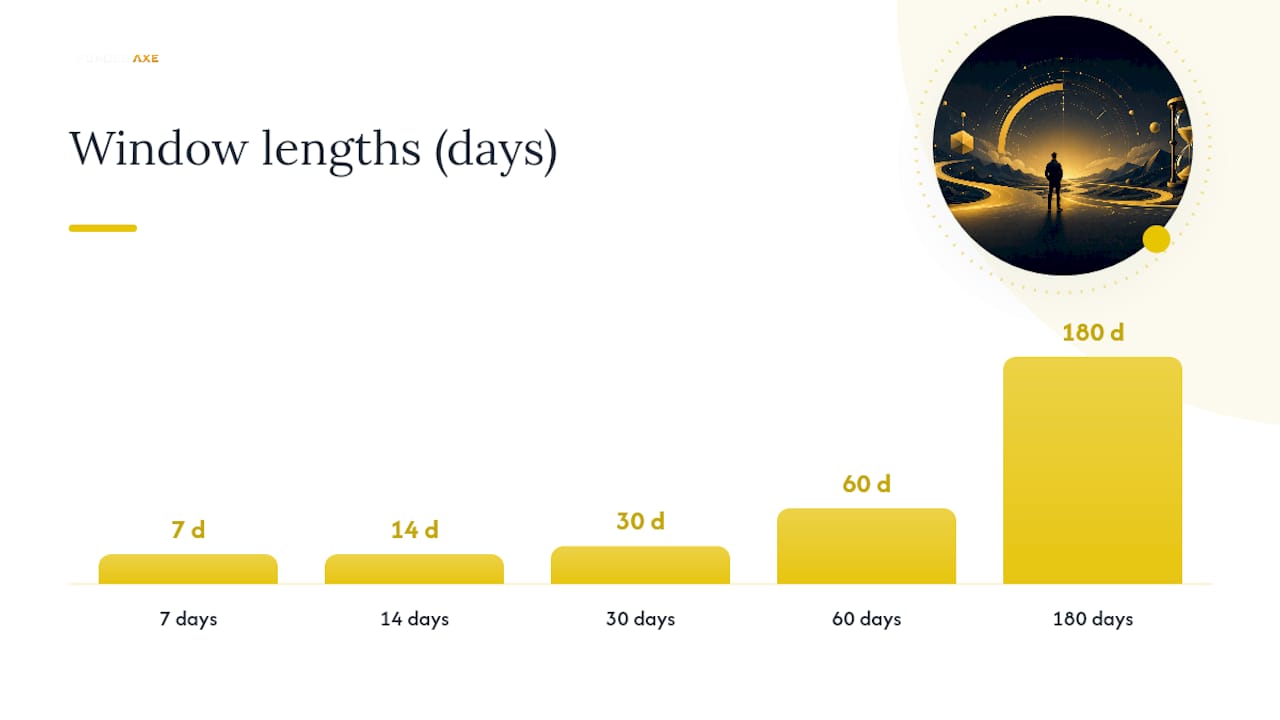
The 30-day window is common, but it's far from universal. Rule trackers that compare firms side by side show windows ranging from 7 to 180 days, depending on the product and the account stage. A fast, instant-funding style account often runs a tighter 7 or 14-day window because the firm wants continuous engagement, while a standard two-step evaluation might grant 60 days or more before it even starts counting.
Three variables decide how a specific "30 days" actually plays out on your account:
- The window length itself. Confirm whether your firm uses 7, 14, 21, 30, 60, or 180 days, and whether that number changes between the evaluation phase and the funded phase.
- The clock-start event. Some firms start counting from account creation; others reset the clock the moment your last trade fully closes. A handful of trackers also flag differences in how firms count consecutive calendar days versus business weeks, meaning weekends either count against you or get skipped entirely depending on the wording.
- What qualifies as activity. This is where most accidental breaches happen. A trade has to be opened and closed to count in most programs. Simply opening a position, logging into the platform, or leaving a pending order sitting untouched typically does nothing to reset the timer. Some policies go further and require a minimum trade duration or a small profit threshold, specifically to block traders from gaming the system with a one-tick scalp.
Time zone wording matters more than traders expect. If a firm's policy says "30 days" without specifying a reference zone, and your last trade closed at 11:58 PM server time, you can lose almost a full day of buffer to a clock you didn't realize was already running on a different schedule than your own.
What Happens When You Miss the Deadline
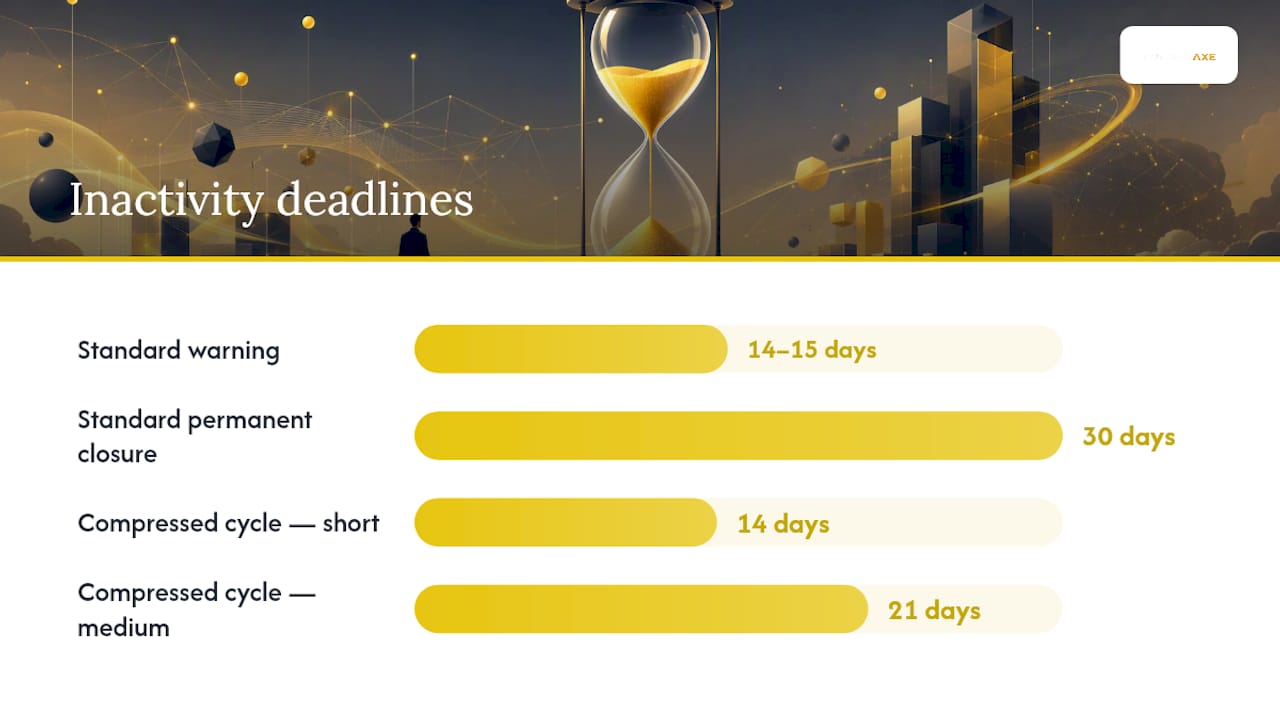
Firms rarely jump straight from active to closed with no notice. A common enforcement pattern, based on how multiple rule glossaries describe it, runs a mid-window warning around day 14 or 15, followed by permanent closure once the account hits the full window, often day 30. Some faster products compress this into tighter 14 or 21-day cycles, so the warning-to-closure gap can be much shorter than the standard model.
The actual outcomes fall into a few tiers:
- Dormancy warning: an email or dashboard flag telling you the clock is running and giving you a specific number of days to act.
- Temporary suspension: trading access paused, but the account and any accrued balance still technically exist.
- Permanent closure: the account is terminated, and in most cases there's no reinstatement path. You'd need to purchase a new evaluation to start over.
If you get a warning, don't just place a random trade and hope. Screenshot or save the exact policy page and the date you viewed it, since some firms revise these terms without much notice. Then contact support directly and ask whether a reset or grace period is available, particularly if the inactivity happened for a documented reason like a hardware failure or a platform outage.
Pro Tip: Save a dated screenshot of your firm's inactivity policy the day you open the account, not the day you get the warning email. Trackers have caught firms widening or tightening these windows over time, and you want proof of what the rule actually said when you signed up.
A Practical Checklist to Stay Active Without Overtrading
Treat inactivity compliance as an administrative task, not a trading decision, and you'll never think about it again after the first week.
Start with paperwork before you ever place a maintenance trade:
- Save the official rule page. Copy the exact wording on window length and clock-start events, and note the date you saved it.
- Log your own clock-start date. Write down whether your firm resets on account creation or on your last closed trade, then calculate your personal deadline from there.
- Set a calendar reminder for the midpoint, not the deadline itself. If your window is 30 days, set the reminder for day 15, giving yourself two full weeks of buffer even if something comes up.
- Confirm the time zone the firm uses for day counts, and pad your personal deadline by at least a day to absorb any mismatch.
- Note any weekend or holiday exceptions your firm's policy mentions, since trading hours and session rules can shift what counts as a trading day on the calendar.
When it's time to place a maintenance trade, keep it small and deliberate. This isn't a trade signal, but a structural example: a trader nearing a deadline might open a position sized at a fraction of their normal risk, on a highly liquid pair during active session hours, and close it once it moves a few pips in either direction to satisfy a "fully closed trade" requirement. The goal is meeting the qualifying-activity bar with minimal market exposure, not chasing profit.
Before you place that trade, double check it won't collide with other conditions. A rushed maintenance trade that breaches a drawdown limit or trips a consistency rule does far more damage than the inactivity closure it was meant to prevent. This is a real pattern among traders under deadline pressure, and it's worth reading up on overtrading as a silent account killer before you ever feel that pressure yourself.
Pro Tip: If you're genuinely stepping away, whether for travel, illness, or just burnout, email support before the deadline rather than after. Some firms will grant a documented pause; almost none will retroactively forgive a closure that already happened.
If you know in advance you'll be inactive for a stretch, part-time and swing-oriented account structures are worth comparing, since swing trading policies around weekend holding sometimes carry different inactivity expectations than day-trading-focused programs.
Special Cases That Trip Up Even Careful Traders
Evaluation accounts and funded accounts don't always play by the same inactivity rules, even within one firm. It's common for an evaluation phase to run a looser window, since the firm has less at stake, while the funded phase tightens the requirement once real payouts are on the line.
Token trades cause more accidental closures than any other single factor. Firms increasingly write policy language that explicitly excludes trades placed purely to reset the clock. That means a 0.01-lot trade closed within seconds may not satisfy the rule at all, even though it technically opened and closed a position. Some programs require a minimum hold time or a minimum profit to count as genuine activity.
A few other edge cases worth flagging:
- Holidays and market closures can extend your effective deadline in practice, but the written clock rarely pauses for them, so don't assume a long weekend buys you extra time.
- Time zone mismatches between your local trading hours and the firm's server time can shave almost a full day off your real buffer.
- Stage transitions, like moving from a passed evaluation into a funded account, sometimes restart the inactivity clock at zero, catching traders who assumed continuity.
How Fundedaxe's Rule Structure Lowers Inactivity Risk
Fundedaxe evaluations and funded accounts carry no time limit on any phase, which removes the single biggest source of inactivity anxiety: a countdown you might forget about while life gets in the way. Combine that with the Pay After Pass model, where you start an evaluation for $9.99 and only pay the full challenge fee after passing, and the financial stakes of a slow start drop considerably compared to paying full price upfront and then worrying about a ticking clock.
A few structural details matter here for traders specifically worried about dormancy:
- No consistency rules mean a single maintenance trade, placed properly, won't conflict with a requirement to spread activity evenly across sessions.
- Weekend holding and EA use are both allowed, so an automated strategy can keep an account technically active without you manually intervening.
- The free $1,000 simulated trial account gives traders a way to stay engaged with the platform and test strategies without financial exposure while deciding on a paid evaluation.
If you're re-entering after a gap, the Rune Points loyalty program converts prior challenge spend into discounts or free accounts, which softens the cost of starting fresh if an older account ever lapsed elsewhere. For anyone managing multiple accounts across different firms, the practical move is still the same: check the specific trading rules page for whatever program you're in, save it, and track your own clock manually rather than trusting memory.
Rules of Thumb From Traders Who've Been Burned by the Clock
Act at the midpoint, not the deadline. If your firm gives you 30 days, treat day 15 as your real deadline, because life doesn't check your calendar before it interferes.
A few more heuristics worth keeping in your head:
- If you're unsure whether a firm counts weekends, assume it does. The downside of being wrong in the conservative direction is zero; the downside of being wrong the other way is account closure.
- Never place a maintenance trade during a low-liquidity session just because you're in a hurry. Slippage on a rushed trade can do more damage than the inactivity rule you're trying to avoid.
- If a firm's policy page doesn't clearly state the clock-start event, assume the stricter interpretation until support confirms otherwise.
- One trade that qualifies beats three "token" trades that might not.
Here's the honest caution: trading purely to satisfy a deadline is still trading, and it still carries risk. Never let an inactivity rule push you into a position size or a session you wouldn't otherwise choose.
— Jean
Why Fundedaxe Removes the Inactivity Guessing Game
Some proprietary trading firms are alternatives for traders tired of tracking a countdown clock on top of everything else a funded account already demands. No time limit on any phase means there's no 30-day or 14-day deadline hanging over your evaluation or funded stage, and some fee structures mean you're not risking a full upfront fee while you sort out your schedule.

Some firms offer free simulated trial accounts giving a zero-cost way to stay active on the platform while deciding on a paid path, and their use of static drawdown with no consistency rules means a single trade won't put you at odds with other conditions the way it can elsewhere. If you're comparing programs specifically to reduce the operational risk of losing an account to a missed deadline, start with the challenge comparison page and check account sizes, fees, and reward structures side by side before you commit.
Where to Verify Your Firm's Exact Inactivity Wording
Policy wording changes, and trackers have documented firms widening or tightening their windows over time. Before you rely on any number in this article for a firm other than Fundedaxe, check the primary source directly and save both the page and the date.
- Prop Firm Rules Compared — All 31 Firms, for a side-by-side view of inactivity windows across the industry.
- Prop Firm Rules Tracker — Live Updates, for tracking recent changes to specific firm policies.
- Inactivity Rule Glossary, for a plain-language breakdown of warning-to-closure timelines.
Sources
- Prop Firm Rules Compared (September 2026) - All 31 Firms
- Prop Firm Inactivity Rules Explain What Traders Need to Know
- Inactivity Rule | Damn Prop Firms
- Prop Firm Rules Tracker — Live Updates (2026)
FAQ
How much money do day traders with $50,000 accounts make per day on average?
There's no reliable, verifiable average figure for daily profit on a funded account, since results depend entirely on strategy, risk per trade, and market conditions. Treat any specific dollar claim you see elsewhere with skepticism and focus instead on a consistent risk-managed approach rather than a target daily number.
Is the PDT rule changing to $2,000?
The Pattern Day Trader rule, which requires a specific equity threshold to day trade U.S. securities without restriction, is a FINRA regulation tied to registered brokerage accounts, not to proprietary trading firms. Simulated funded accounts at prop firms like Fundedaxe operate under the firm's own trader agreement rather than FINRA's PDT threshold.
What is the 3-5-7 rule in trading?
It's a heuristic some traders use for position sizing, not a rule enforced by any prop firm's inactivity policy.
How do I avoid getting flagged as inactive without overtrading?
Place one deliberate, fully closed trade before your deadline, sized small enough to limit exposure, rather than several rapid token trades. Firms increasingly reject tiny trades placed only to reset the clock, so one meaningful trade beats several minimal ones.
Do inactivity rules apply the same way to evaluation and funded accounts?
Not always. Many firms apply looser inactivity windows during the evaluation phase and tighter ones once an account is funded, since real payouts raise the firm's stake in keeping capital active. Fundedaxe applies no time limit to either phase, which removes this distinction entirely for its own accounts.