

For MT5 traders running Expert Advisors, "hft prop firms" refers to simulated funded evaluation programs that allow algorithmic and automated trading on MetaTrader 5, not institutional high-frequency trading desks with colocated servers and microsecond execution. If you've landed here searching that phrase, you're almost certainly looking for a prop challenge that won't shut down your EA on day one.
Before you pay a single dollar toward an evaluation, do this: pull up the firm's trader agreement and check three things.
- EA policy: does the firm explicitly allow Expert Advisors, or does it bury restrictions in a separate document?
- Drawdown type: is it static (balance-based) or trailing/rolling (equity-based)? This single detail changes how your risk logic needs to behave.
- Daily loss limits: how are they calculated, and at what time does the trading day reset on the server?
If a firm can't answer those three questions in plain language on its website, that's your answer about whether to sign up. Look for published EA rules, a Pay After Pass or low-cost trial option, and clear documentation before committing real money to an evaluation fee.
Key Takeaways
Simulated funded evaluations that allow MT5 EAs succeed or fail based on rule compliance, not raw trading edge, so hardcoded risk limits matter more than strategy optimization.
| Point | Details |
|---|---|
| Confirm EA policy first | Check the firm's trader agreement for explicit EA allowance and prohibited strategy language before paying. |
| Match drawdown type to your code | Static drawdown and trailing drawdown require different hardcoded safety logic in your EA. |
| Forward-test for at least two weeks | Run the EA on a demo sized like the target account before committing to a paid evaluation. |
| Automate compliance, don't monitor manually | Hardcode daily loss stops, peak-equity halts, and a remote kill switch. |
| Start low-risk with FundedAxe | Use the $9.99 Pay After Pass evaluation or the free $1,000 trial to validate your EA before paying full fees. |
Remember: these are simulated funded evaluation programs for retail EA traders, not institutional low-latency HFT operations, and the rules that govern them reflect that difference.
Table of Contents
- What "HFT Prop Firms" Actually Means for MT5 Traders
- How MT5 Evaluation Challenges Are Structured
- Fee and Funding Models: Pay After Pass vs Upfront vs Instant
- Why EAs Fail Evaluations (And How to Stop It)
- Getting Your EA Ready for a Funded Challenge
- MT5 Setup: VPS, Server Settings, and Monitoring
- After You Pass: Payouts, Scaling, and What Changes
- Verifying a Firm Before You Pay
- How FundedAxe Fits an MT5 EA Trader's Checklist
- What Experienced Prop-Challenge Traders Actually Do
- Ready to Test Your EA on a Real Evaluation?
- Frequently Asked Questions
- Sources
What "HFT Prop Firms" Actually Means for MT5 Traders
The phrase gets thrown around loosely, and it causes real confusion. Institutional HFT involves proprietary trading desks with direct market access, colocated servers next to exchange matching engines, and strategies that execute in microseconds. That's not what you're doing on MetaTrader 5 with an Expert Advisor, and it's not what this guide covers.
What retail traders actually mean when they search "hft prop firms" is something closer to "prop firms that allow high-frequency-style automated strategies on MT5." That's a legitimate and common search, but the products behind it are simulated funded account programs, not access to institutional infrastructure.
A few scope notes worth locking in before you go further:
- Your runtime matters more than your strategy label. An MT5 EA needs a firm that explicitly supports MetaTrader 5 and MQL5 code, the same way a Python bot needs REST API access or a cBot needs cTrader support. Platform compatibility is a prerequisite, not an afterthought, and checking it first saves you from evaluating fee structures on a firm that can't even run your code.
- Colocated, latency-arbitrage execution is out of scope here. If a strategy depends on beating other participants to a price feed by microseconds, that's an institutional HFT concern, not something a retail MT5 evaluation is built around.
- The common program types are 1-step, 2-step, and 3-step challenges, upfront-fee models, Pay After Pass structures, and instant funding accounts with no evaluation phase at all. Each one changes how much capital you risk before you know whether your EA can pass.
How MT5 Evaluation Challenges Are Structured
Most evaluations follow a familiar shape: a profit target, a maximum drawdown limit, and sometimes a time limit, split across one, two, or three phases depending on the program. A 2-step model typically asks for a smaller profit target in phase one and a similar or reduced target in phase two, with the drawdown rule applying across both.
Drawdown measurement is where EA traders get tripped up. Some firms use static drawdown, calculated from your starting balance, so it never moves regardless of open profit. Others use a trailing or rolling drawdown tied to your peak equity, which can tighten as you gain. An EA that's fine under a static rule can blow through a trailing limit simply because it held a large floating position at the wrong moment.
Other constraints show up consistently across the industry:
- Minimum trading day requirements, which affect EAs that trade infrequently or wait for specific setups.
- Language around maximum lot size or position sizing relative to account equity.
- Explicit bans on grid and martingale systems, latency arbitrage, and synchronized copying across multiple accounts.
The measurement basis matters as much as the rule itself. A firm that checks drawdown against equity, not balance, will flag a strategy the moment floating losses cross the line, even if you never actually close a losing trade. Know which basis your target firm uses before you code your EA's safety limits.
Fee and Funding Models: Pay After Pass vs Upfront vs Instant
Three funding paths dominate the market, and each one shifts risk differently for an EA trader.
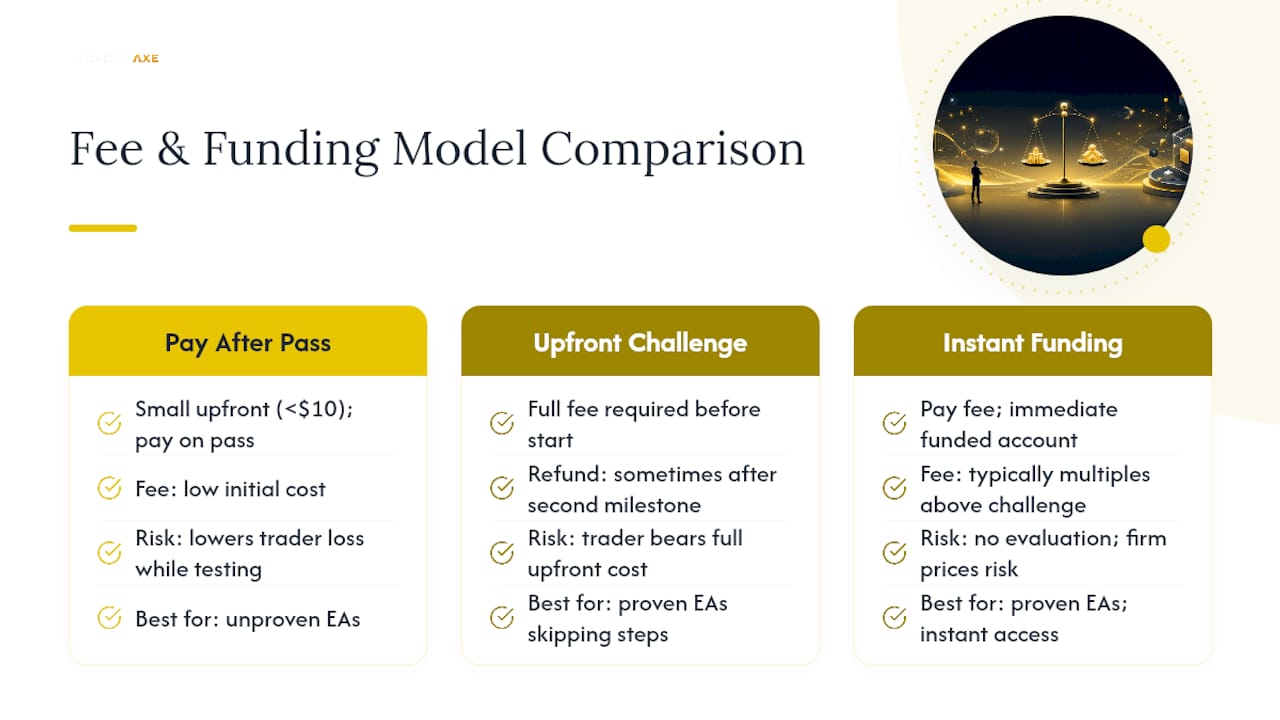
Pay After Pass flips the usual order: you start an evaluation for a small upfront cost, often under $10, and only pay the full challenge fee once you've actually passed. This model rewards traders who've already validated their EA elsewhere, because you're not risking a large fee on a strategy you haven't fully stress-tested.
Upfront challenges require the full fee before you start, sometimes with a refund built in once you hit a second reward milestone. This model suits traders confident in a proven EA who want to skip smaller commitment steps.
Instant Funding skips evaluation entirely. You pay a fee, typically higher than a standard challenge, and get placed on a funded account immediately. Instant funding fees run multiples above a comparable challenge fee since there's no phase to filter out weak strategies first, so the firm prices the risk into the entry cost.
The practical takeaway: if your EA is unproven, Pay After Pass reduces what you lose while you find out. If it's already logged months of clean forward-test data, the math on an upfront or instant path can work in your favor. Either way, FundedAxe's guide to algo trading rules is worth reading before you pick a model, since the rules that govern EA behavior don't change based on which fee structure you choose.
Why EAs Fail Evaluations (And How to Stop It)
Most evaluation failures aren't strategy failures. They're compliance failures, and the distinction matters enormously for how you prepare.
Common causes include:
- Daily loss breaches triggered by an EA that doesn't track its own running loss against the server's actual reset time.
- Static or overall drawdown violations from a strategy that held a position through a news spike without a hard stop.
- Prohibited strategy flags for grid systems, martingale sizing, latency arbitrage, or tick scalping. Most major firms explicitly ban these behaviors even while allowing EAs generally.
- Minimum hold time breaches, common with scalping-style EAs that close trades in seconds. FundedAxe's breakdown of prop firm scalping rules covers why ultra-short holds get flagged even when profitable.
- Synchronized multi-account copying, where the same EA runs identical trades across accounts without variation. Some firms permit distributed copy trading while banning identical synchronized signals, so check the specific policy before running one EA across several funded accounts.
Non-strategy bugs cause just as much damage. A day-counting error, a timezone mismatch on the server's midnight reset, or an EA that ignores a news filter window can breach a rule your strategy never intended to break.
Pro Tip: Build a pre-launch checklist that treats compliance like a code review, not a trading decision. Confirm your EA's internal clock matches the broker's server time, verify the news filter window against the firm's published restricted hours, and run a full evaluation-length demo before you pay for the real thing.
Getting Your EA Ready for a Funded Challenge
Preparation separates traders who pass on the first attempt from those who burn through three evaluation fees learning the same lessons. Follow this sequence:
- Backtest on tick-level data with widened spreads. A backtest run on default spread assumptions will overstate performance versus what you'll see on a live evaluation account.
- Run out-of-sample validation on a data period your optimization never touched, to confirm the strategy isn't curve-fit.
- Forward-test on a demo account sized and configured like the actual challenge account, for at least two to four weeks. Vendors consistently recommend this window before committing to a paid evaluation.
Once testing confirms the edge holds, harden the code itself:
- Hardcode a daily loss stop that halts trading independent of any manual override.
- Add a peak-equity tracker that halts new trades once drawdown approaches the firm's limit, a mechanical safeguard most compliant EAs build in by default.
- Block trading during major news windows if the firm restricts news trading, and confirm the restriction against FundedAxe's news trading rules or your target firm's equivalent.
- Enforce minimum hold times in code if the firm's policy requires them.
- Include a remote kill switch you can trigger without needing terminal access.
Pro Tip: Version every EA build you deploy. If a challenge fails, you need to know exactly which code ran, not just which strategy you "think" you were using. Keep detailed trade logs and automated equity snapshots that mirror however the firm measures drawdown, balance or equity, so you catch a violation before the firm does.
MT5 Setup: VPS, Server Settings, and Monitoring
A sound strategy still fails on bad infrastructure. Choose a stable VPS with strong uptime near your broker's server location. You don't need institutional colocation. You need a connection that won't drop during a volatile session and cost you a trade your EA was supposed to manage.
Inside the MT5 terminal itself, confirm the basics every time you deploy:
- Algorithmic trading is enabled in terminal options, and AutoTrading shows active, not paused.
- The EA's smiley icon is present and green in the chart corner, confirming it's actually running, not just attached.
- WebRequest permissions are limited to approved endpoints only, since enabling unnecessary URLs is an unneeded attack surface with no upside for a compliant EA.
Broker and server quirks deserve their own check. Confirm actual spread behavior versus your backtest assumptions, test how the account handles weekend gaps if the firm allows weekend holding, and verify exactly when the server resets its trading day, since that timestamp determines how your daily loss limit gets calculated.
Set up automated alerts for kill-switch triggers and equity thresholds, and keep a simple log uploader running so you have a record if a dispute ever comes up over a flagged trade.
After You Pass: Payouts, Scaling, and What Changes
Passing the evaluation isn't the finish line, it's a shift in what "success" means for your EA.
Payout cadence varies by firm, with many offering payouts on a set schedule after an initial holding period, then at recurring intervals afterward. That cadence directly affects how you plan cash flow if trading is a meaningful part of your income, so factor it into any strategy comparison before you commit to a firm.
Scaling rules reward consistency over time. Firms that offer account growth typically look for sustained performance across multiple payout cycles before increasing your account size, so resist the urge to loosen your EA's risk settings the moment you're funded. The exact parameters that got your strategy through the evaluation are usually the ones worth preserving afterward.
Keep detailed logs after funding, not just during the challenge. If a dispute arises over a withdrawal or a rule interpretation, your own trade and equity records are your best evidence.
Verifying a Firm Before You Pay
Transparency is the single best predictor of whether a prop firm will actually pay you. Firms that publish clear EA rules, a refund or trial policy, educational resources, and verifiable payout proof are meaningfully easier to evaluate than ones that hide terms behind vague marketing language.
Run through this before committing:
- Read the full trader agreement, not just the marketing page. Look specifically for the EA and algorithmic trading section.
- Confirm a Pay After Pass or low-cost trial option exists, since it signals the firm is confident enough in its model to let you test before you pay in full.
- Search for published payout proof or public testimonials rather than relying on unverifiable claims.
- Check that support channels can answer specific MT5 EA questions, not just generic account questions.
Red flags include prohibitions buried deep in terms documents, payout claims with no verification path, no trial or demo option at all, and refund policies written vaguely enough to mean whatever the firm wants later.
How FundedAxe Fits an MT5 EA Trader's Checklist
FundedAxe was built around the exact workflow this guide describes: MT5, EAs allowed, and a fee model that doesn't punish you for testing before you're ready to commit fully.
Here's how it maps to the checklist above:
| Requirement | FundedAxe |
|---|---|
| Fee model | Pay After Pass ($9.99 to start), upfront FundedAxe Pro challenges, and Instant Funding |
| Account sizes | $5,000 to $400,000 |
| Reward split | a high reward split, with add-ons available |
| Drawdown type | Static (balance-based) |
| Time limits | None on any phase |
| EA and algo trading | Allowed, along with news trading and weekend holding |
FundedAxe publishes its trader agreement openly, offers a free simulated $1,000 trial account with no card and no deposit, and runs a Rune Points program that converts challenge spend into discounts and free accounts over time. For EA traders specifically, the combination of static drawdown and no time limit removes two of the most common sources of accidental rule breaches: a trailing drawdown catching a floating position, or a time-boxed phase pressuring an EA into trades it wasn't designed to take.
What Experienced Prop-Challenge Traders Actually Do
Treat the evaluation as a compliance test first and a trading contest second. That reframing changes almost everything about how you prepare. Traders who've been through multiple evaluations tend to say the same thing: the strategy's edge is rarely what kills a challenge attempt. It's a rule violation the trader didn't see coming.
Lock your EA's parameters before you start and leave them alone. The temptation to tweak a setting mid-evaluation because the market "feels different" is exactly how a previously-compliant strategy starts breaking rules it was built to respect. Run your demo-forward test under conditions that mirror the firm's actual server and account size, not a generic demo with different spreads and execution.
Above all, prioritize protecting the account over chasing the profit target faster. An EA with hardcoded daily loss stops and a peak-equity halt will pass more evaluations over time than one tuned purely for speed to target, because most failures come from broken rules, not broken strategies. Automate those hard limits so a bad day doesn't turn into a bad decision made under pressure.
Ready to Test Your EA on a Real Evaluation?
If you've hardened your EA and forward-tested it under conditions close to a real challenge, the next move is putting it in front of an actual evaluation, without risking a full fee on a strategy you haven't fully proven yet. FundedAxe's Pay After Pass model lets you start an evaluation for $9.99 and only pay the remaining fee once you've passed, which matters most for traders who want to see how their EA performs under real drawdown rules before committing more capital.

If you're not ready to commit even that small amount, FundedAxe's free simulated $1,000 trial account requires no card and no deposit, giving you a genuine sandbox to confirm your EA's behavior on MT5 before it matters. Traders with a proven track record can also skip evaluation entirely through Instant Funding. Account sizes run from $5,000 up to $400,000, drawdown is static rather than trailing, and there's no time limit on any phase, so your EA isn't racing a clock while it proves itself. Browse the current challenge options and pick the account size and fee model that matches how confident you already are in your strategy.
Frequently Asked Questions
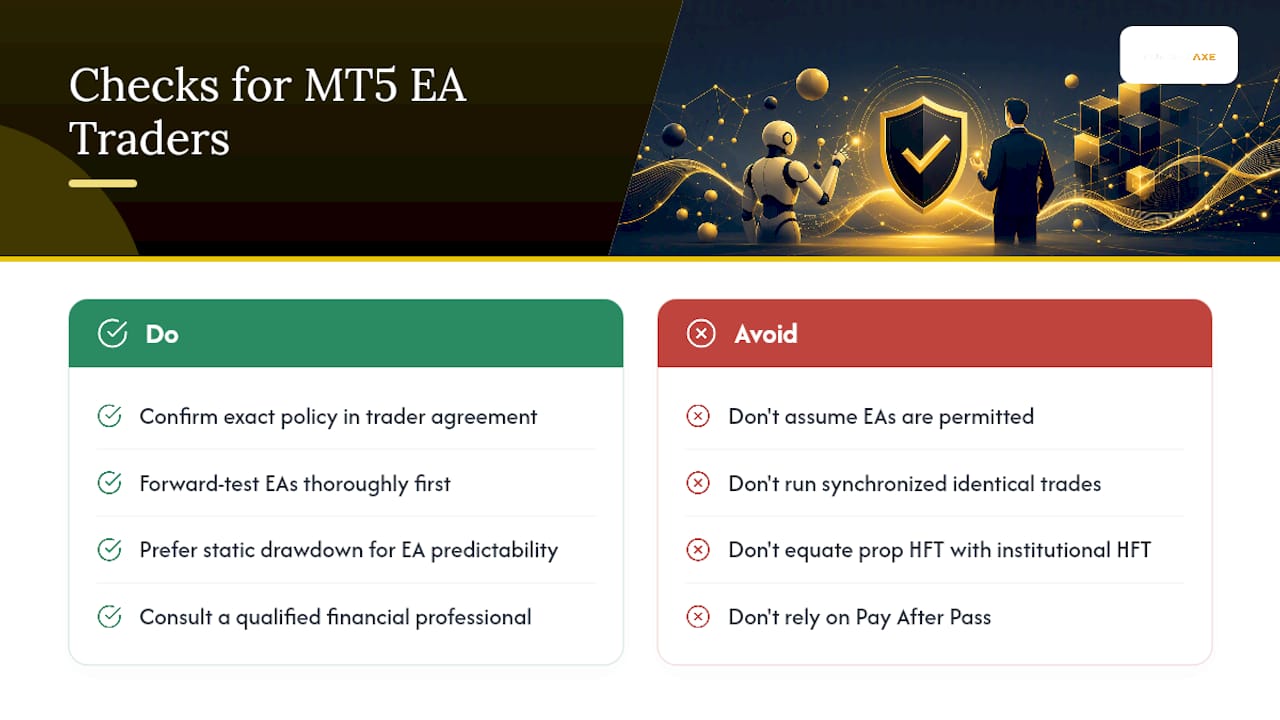
Do prop firms allow EAs on MT5 evaluations? Most do, but the specifics vary by firm. Confirm the exact policy in the trader agreement rather than assuming, since some firms restrict specific behaviors like grid trading or latency-sensitive execution even while allowing EAs generally.
What's the difference between HFT allowed prop firms and institutional HFT? Institutional HFT involves colocated servers and microsecond execution at exchange level. A prop firm that allows "HFT-style" trading on MT5 is really allowing fast automated retail strategies within a simulated funded account, a different category entirely.
Which drawdown type is easier for EA traders: static or trailing? Static drawdown, calculated from your starting balance, tends to be more predictable for EAs since it doesn't move with floating profit. Trailing drawdown requires tighter equity monitoring inside your EA's code.
Can I use the same EA across multiple funded accounts? Policies differ. Some firms allow distributed copy trading with varied parameters, while most ban synchronized identical trades across accounts. Check the specific policy before running one EA on multiple funded accounts.
Is Pay After Pass a good fit for testing an unproven EA? It reduces your upfront financial risk since you only pay the full fee after passing, but it doesn't reduce the importance of pre-validation. Forward-test thoroughly first regardless of which fee model you choose.
This article is general information, not a substitute for advice from a qualified financial advisor. Consult a qualified financial professional about your own circumstances before acting on anything here.
Sources
For deeper technical detail on the topics covered here, these resources are worth bookmarking:
- Prop Firm EA Requirements | Viprasol
- EA Prop Trading: How Automated Systems Work in Funded Accounts | Monkeytrade
- Using an EA on Prop Firms: FTMO, FundedNext, and More - iNakaTrader
- 5 Best Prop Firms for Algorithmic Traders - CoinCodeCap