

Yes, but "free" rarely means what it sounds like. Some firms genuinely waive the fee if you finish an evaluation without breaching a rule, others charge a small reset price, and a growing group of firms let you start for a token amount and only charge the full fee once you pass. Each of these solves a different problem, and treating them as interchangeable is how traders overpay after a failed challenge.
If your goal is the lowest possible cash outlay before you're funded, a pay-after-pass structure like FundedAxe's Pay After Pass model is usually the more reliable route than chasing a "free retry" promotion that may have quietly expired or changed its terms.
Before you sign up anywhere, do this:
- Open the firm's rules page and find the exact retry or reset terms in writing.
- Check when the fee activates: at signup, at funding, or somewhere in between.
- Confirm the drawdown type and whether news or weekend trading voids anything.
Key Takeaways
Low-cost retry options exist in several forms, but the rule set attached to them, not the sticker price, determines whether a retry is actually worth taking.
| Point | Details |
|---|---|
| Free retries have conditions | Most require finishing in profit or without a rule violation, not automatic reinstatement. |
| Rules outweigh price | Drawdown type, consistency rules, and time limits matter more than the retry's advertised cost. |
| Do the total-cost math | Compare failed-attempt-plus-retry against token-plus-activation-fee against instant funding before choosing. |
| Vet before you pay | Read the rules page, confirm fee timing, and look for independent payout evidence first. |
| FundedAxe offers pay-after-pass | A $9.99 start with the remaining fee due only after passing, plus static drawdown and no time limit. |
Table of Contents
- What Does a Free Retry Prop Firm Actually Offer?
- Which Rules Determine If a Retry Is Actually Worth Taking?
- How Do You Calculate the Real Cost of a Retry?
- What Are the Lower-Cost Alternatives to a Free Retry?
- A Checklist to Vet Any "Free Retry" Claim Before You Sign Up
- Do Free Retries Actually Improve Pass Rates?
- Does a Free Retry Change How You Trade the Second Time?
- What Really Determines Whether a Retry Is Worth It
- How FundedAxe Lowers the Cost of Trying Again
- Sources
What Does a Free Retry Prop Firm Actually Offer?
A "free retry" is a specific policy, not a general marketing phrase. It typically means a firm lets you restart an evaluation at no additional charge if you met certain conditions on your failed attempt, such as ending above your starting balance or never breaching a hard rule. FundedTrading's free retry policy is a good example of how this works in practice: the retry is conditional, not automatic, and it only applies to traders who came close.
That's different from a paid reset (a discounted fee to restart), a second-chance program (often tied to a specific promotion window), a free trial (no money changes hands at all, win or lose), and a pay-later activation model (low signup cost, fee charged only after you pass).
- True free retry: No charge, but usually requires you to have ended in profit or without a violation.
- Paid reset: A reduced fee, often 10 to 30% of the original challenge price.
- Free trial: Zero cost regardless of outcome, usually on a smaller simulated balance.
- Pay-later activation: Small token fee upfront, remaining balance due only on passing.
The gap between marketing copy and fine print is where traders get burned. A firm might advertise "free retries" prominently on its homepage, then bury the actual qualifying threshold, an activation deadline, or a clause that voids the retry if you traded during a news event, three clicks deep in a rules PDF.
Pro Tip: Search the rules page for the word "void" before you search for the word "free." Voiding clauses tell you more about real eligibility than the marketing headline does.
Which Rules Determine If a Retry Is Actually Worth Taking?
A free retry on a challenge with brutal rules isn't much of a gift. The rule set underneath the retry offer determines whether it's a genuine second chance or a slower path to the same failure.
Drawdown type matters most. A static drawdown measures your loss limit against your starting balance and never moves, so a good week doesn't tighten your risk ceiling. A balance-based drawdown trails your equity upward, meaning early profits can shrink your room to maneuver later. If your retry sits inside a trailing-drawdown structure, the same trading style that got you close last time might trip the limit sooner this time.
Other rule features that shape a retry's real value:
- Consistency rules can cap how much of your total profit comes from a single day, which blocks payouts even after you technically pass.
- Time limits force pacing decisions; no time limit (like FundedAxe's evaluations) lets you wait for genuinely good setups instead of forcing trades.
- Instrument restrictions matter if your strategy relies on specific pairs, indices, or news-driven volatility.
- Payout processing fees quietly reduce what a "successful" retry actually nets you.
Industry roundups covering dozens of prop trading firms consistently find that drawdown type, consistency rules, and real payout evidence separate trustworthy firms from firms that just have a lower advertised price. A retry is only as good as the rules attached to it.
How Do You Calculate the Real Cost of a Retry?
Compare three numbers before committing: what you paid on the failed attempt, what the retry or reset costs, and what an instant-funded account would cost for the same size. Skip any one of them and you're guessing.
- Failed attempt + free retry. You lose nothing beyond the original fee, assuming you actually qualify under the firm's conditions. This is the best-case math, but only if the retry has no hidden activation charge.
- Token upfront + activation fee on pass. You might pay $9.99 to start, then a larger fee once you pass. That's real money at risk-free timing, but the activation fee itself needs comparing against buying funded access outright. As one industry breakdown on pay-later prop firm pricing points out, an activation fee can sometimes exceed the sticker price of an instant-funded account of the same size.
- Instant-funded purchase. No evaluation, no retry needed, but usually stricter account rules and a higher day-one price.
Paid resets still win in one common scenario: when the reset costs a fraction of the original fee and you're confident about your process. Paying $50 to restart beats paying $300 to buy in fresh, even if a "free" version exists elsewhere with worse rules attached.
What Are the Lower-Cost Alternatives to a Free Retry?
If a genuine free retry isn't on the table, four other routes keep your upfront exposure small.
- Pay-after-pass models flip the usual order: you pay a small amount to start (FundedAxe's evaluation begins at $9.99) and cover the rest of the challenge fee only once you clear it. You carry almost no risk if you fail again, though the deferred fee is still due eventually.
- Free trials and demo challenges cost nothing regardless of outcome, which makes them ideal for testing whether you actually understand a firm's rule set before risking real money on a paid attempt. Some firms even run genuinely free promotional challenges with a capped balance and limited-time data access, though availability windows are usually short.
- Loyalty and referral credits convert past spending or referrals into discounts or free evaluations over time. Several prop-firm guides tracking challenge fee discounts and loyalty programs note these credits add up faster than traders expect if they stay with one firm.
- Instant funding skips the evaluation entirely, trading a higher day-one price for zero retry math, though usually with tighter account restrictions.
A Checklist to Vet Any "Free Retry" Claim Before You Sign Up
Run through this before entering payment details anywhere.
- Open the rules page directly and locate the retry or reset section. Don't rely on homepage copy.
- List the exact qualifying conditions in your own words: profit target missed but no violation, minimum trading days met, and so on.
- Confirm drawdown type (static or balance-based), consistency rule thresholds, EA and automation policy, and whether news or weekend trading is allowed.
- Identify fee timing precisely: activation-on-pass, flat reset price, or add-on costs for faster payouts and higher reward splits.
- Look for independent evidence of payouts. Community feedback and published payout histories tell you more than testimonials on the firm's own site.
- Set your financial ceiling. Decide upfront how many failed attempts you can realistically finance, and factor in whether loyalty credits shift that number.
A 12-point checklist for choosing a prop firm covers this same ground in more depth if you want a repeatable process for every firm you evaluate going forward.
Pro Tip: Screenshot the rules page the day you sign up. Firms update terms, and having a dated record protects you if a retry policy quietly changes mid-evaluation.
Do Free Retries Actually Improve Pass Rates?
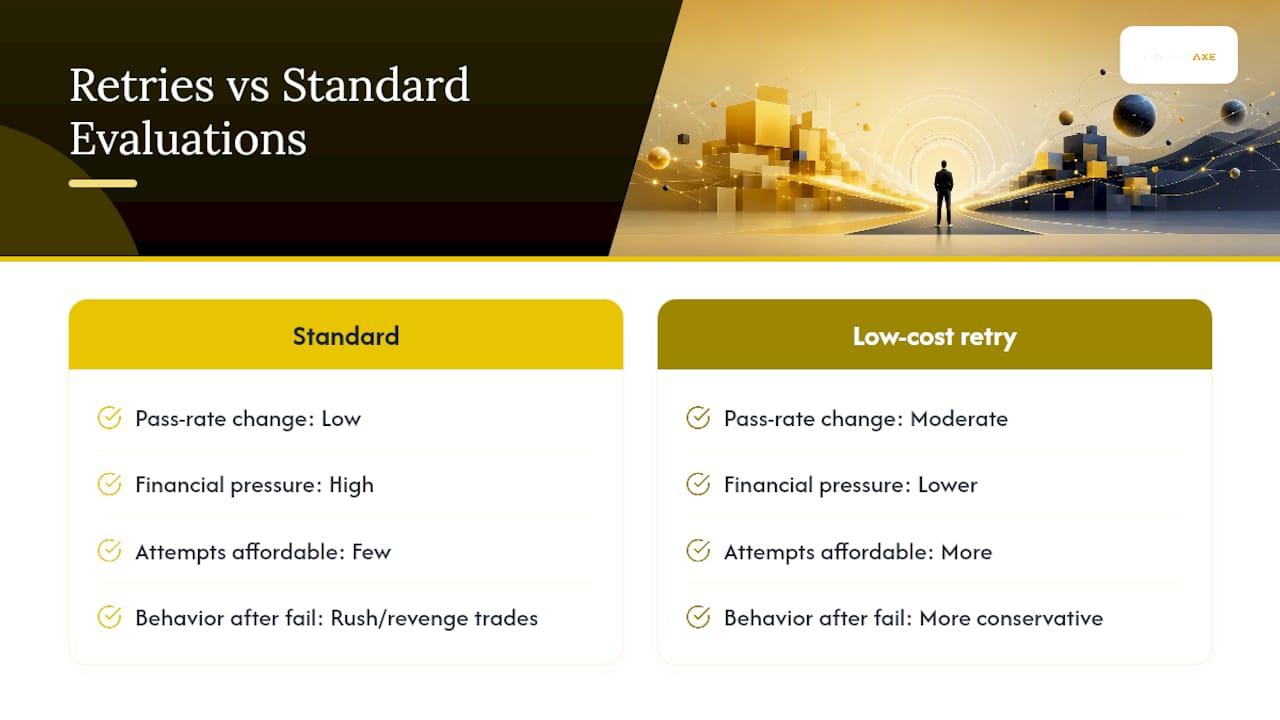
Prop firm evaluations have a well-earned reputation for high failure rates on first attempts, mostly because traders underestimate how drawdown limits and time pressure change decision-making under real stakes versus demo trading. A free or low-cost retry doesn't fix a flawed strategy, but it changes what a trader can afford to learn from.
Without any retry mechanism, a failed challenge means the full fee is gone and the trader either walks away or pays full price again, often while still repeating the exact behavior that caused the failure: oversized positions after a loss, revenge trading, or ignoring a daily drawdown warning. Failure becomes expensive enough that traders sometimes rush the next attempt to "make it back," which compounds the original mistake.
With a genuine low-cost retry option, whether that's a true free reset, a small paid reset, or a pay-after-pass model, the financial pressure to recover money immediately drops. That gap matters more than it sounds. A trader who can afford a second and third attempt without financial strain tends to trade the retry more conservatively, closer to how they'd trade a funded account they actually want to keep.
The rule set still decides the outcome more than the retry mechanic does. A trader retrying under a punishing consistency rule or a fast-moving trailing drawdown faces the same structural barrier that caused the first failure. Lower-cost retries widen the number of attempts a trader can afford, but they don't change whether the underlying strategy and risk plan are sound enough to pass.
Does a Free Retry Change How You Trade the Second Time?
It should, and the traders who benefit most from a low-cost retry are the ones who treat it as a genuine second draft rather than a repeat of the first attempt. Knowing you're not risking a full fee again tends to lower the emotional charge around each trade, which is exactly the condition under which most traders make better decisions.

The psychological shift is measurable in behavior, if not in a clean statistic: traders on a second attempt with low financial exposure are less likely to widen their stop-loss mid-trade or double a position size to "catch up" after a red day. Both behaviors are classic symptoms of loss aversion overriding a trading plan, and both are far more common when a trader feels they can't afford to fail again.
The risk cuts the other way too. A retry that feels consequence-free can tempt some traders into sloppier risk management, on the theory that a bad outcome just means another cheap retry. That's a real trap, and it's worth naming directly: the value of a low-cost retry comes from removing financial pressure, not from removing the need for discipline. Firms with no time limit on evaluation phases, like FundedAxe's structure, give traders room to wait for a real setup rather than forcing decisions under a countdown, which reduces the second kind of risk without inviting the first.
What Really Determines Whether a Retry Is Worth It
The conventional advice on this topic focuses almost entirely on price: find the cheapest reset, find the firm with a free retry promotion, minimize the token fee. That's backward. Price is the easiest variable to compare and the least predictive of whether you'll actually get funded and paid.
What the research behind this article actually supports is a rule-first approach. A free retry attached to a trailing drawdown and a strict consistency rule is worth less than a modestly priced pay-after-pass evaluation with a static drawdown and no time pressure. The fee structure is a convenience. The rule set is the actual game.
If there's one thing traders underestimate, it's how much a no-time-limit, static-drawdown structure changes decision quality on a retry attempt. Removing the clock removes the single biggest driver of forced, low-quality trades. Before you compare token fees or hunt for a promotional free retry, read the rules page first. Everything else is secondary math.
— Jean
How FundedAxe Lowers the Cost of Trying Again
Failed a challenge and don't want to gamble a full fee on a second try? FundedAxe's Pay After Pass model starts your evaluation for $9.99, and you only pay the remaining challenge fee once you've actually passed, so a second or third attempt never means risking hundreds of dollars upfront on a maybe.

The account terms behind that model are built for traders who've been burned by punishing rules before. Simulated funded accounts scale up to $400,000 on MetaTrader 5, with a static drawdown that doesn't tighten as your balance grows, no time limit on any evaluation phase, and no consistency rules capping how much of your profit can come from one good day.
If you'd rather test the rules before spending anything, FundedAxe also offers a free $1,000 simulated trial account with no card required, and a Rune Points loyalty program that turns your challenge spend into future discounts and free accounts. All accounts are simulated, and reward payouts are real money based on performance under the FundedAxe trader agreement. Check the Pay After Pass details to see current account sizes and start an evaluation.
Sources
- Free Retry - FundedTrading
- Prop firms: how fees, pay-later and resets change the real cost
- Best prop trading firms (industry roundup)