

The structure comes in three shapes: 1-step, 2-step, or 3-step, plus an Instant Funding option that skips the test entirely.
Before you buy anything, lock in these three priorities:
- Respect the drawdown type. Fundedaxe uses static (balance-based) drawdown, which means your floor is fixed from the start and never tightens as your equity grows.
- Pace your profit across the minimum trading days. Hitting the target in two sessions is possible, but sustainable pacing protects you from overtrading.
- Trade within allowed rules. EAs, news trading, and weekend holds are all permitted, so there is no need to change your strategy to fit the evaluation.
Pay After Pass lets you start for $9.99 and pay the remaining fee only when you pass. Account sizes run from $5,000 to $400,000. The three-stage journey from evaluation to funded account is standard across the industry, and Fundedaxe's version is built around that same progression.
Key Takeaways
| Point | Details |
|---|---|
| Pick the right phase count | Match your phase count to your average daily drawdown, not your best-case scenario. |
| Static drawdown is trader-friendly | Your floor is fixed at account open and never tightens as equity grows. |
| Size conservatively | Risking — per trade doubles the losing trades you can absorb before the daily limit. |
| Use the free trial first | The $1,000 simulated trial validates your EA and sizing under real Fundedaxe conditions at zero cost. |
| Fundedaxe Pay After Pass | Start for $9.99; pay the remaining fee only on passing, and earn Rune Points to cut future costs. |
Table of Contents
- How do the 1-step, 2-step, and 3-step evaluations work?
- What trading rules apply during every phase?
- What account sizes and payout terms does Fundedaxe offer?
- How do Pay After Pass, upfront challenges, and Instant Funding differ?
- How should you prepare to pass each phase?
- What do the free trial and Rune Points loyalty program give you?
- What happens after you pass a FundedAxe evaluation?
- Who actually benefits most from FundedAxe evaluations?
- Ready to start your FundedAxe evaluation?
- Sources
How do the 1-step, 2-step, and 3-step evaluations work?
The evaluation phases explained below follow Fundedaxe's actual product structure. Each model tests a different thing, and choosing the wrong one for your trading style is the most common mistake.
1-Step: One profit target, one phase. You pass, you get funded. The trade-off is speed: one-step evaluations typically complete in roughly 10–20 days versus 30–45 days for two-step programs. The single-phase structure suits traders with a consistent, higher-frequency edge who can hit a target without stretching risk.
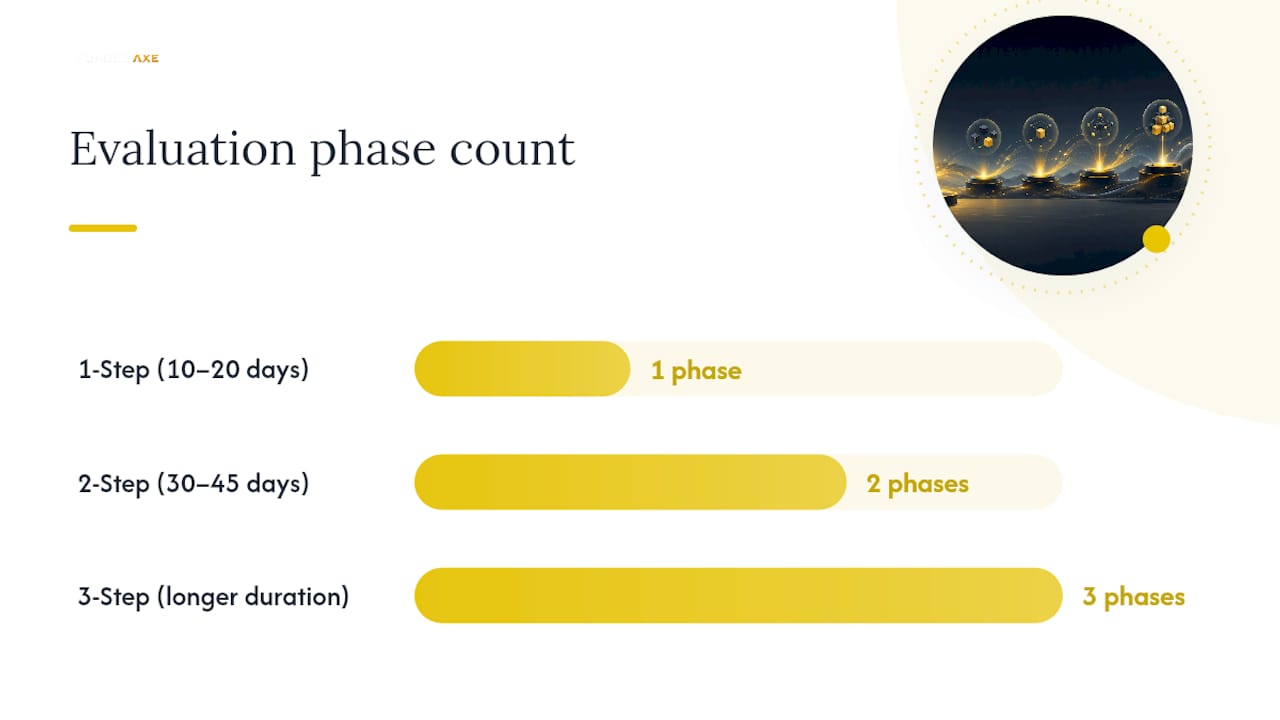
2-Step: The target splits across a Challenge phase and a Verification phase. The second phase exists specifically to confirm that your first profitable run was repeatable, not lucky. Two-step programs tend to carry more generous overall drawdown than one-step equivalents, which gives you more room to trade your normal style.
3-Step: For traders who prefer building equity gradually across three sequential targets. The per-phase targets are smaller, which lowers the daily pressure, but the total duration is longer. Conservative position-sizers and swing traders who hold through weekends often find this structure the best fit.
Example math for common account sizes (using a representative 8% target, per industry-typical ranges of 6–10%):
- $10,000 account: 8% target = $800 net profit required
- $50,000 account: 8% target = $4,000 net profit required
- $100,000 account: 8% target = $8,000 net profit required
- $200,000 account: 8% target = $16,000 net profit required
- $400,000 account: 8% target = $32,000 net profit required
Pro Tip: Choose your phase count based on your average daily drawdown, not your best-case scenario. A 2-step or 3-step with a more forgiving daily limit fits that style better. Use the 12-point checklist for choosing a prop firm to score your fit before you buy.
What trading rules apply during every phase?
These are the rules that cause immediate failure or delay your payout if you miss them.
Drawdown types defined:
- Static (balance-based) drawdown: Your maximum drawdown floor is set at account open and never moves. If you start a $100,000 account with a 10% max drawdown, your floor is always $90,000, even if your equity climbs to $115,000. Fundedaxe uses this model, which is the most trader-friendly structure because it never tightens.
- Trailing drawdown: The floor rises as your equity peaks, which means early large wins reduce your future cushion. Consistent execution beats front-loading gains on any trailing structure.
- EOD trailing drawdown: Calculated at end of day rather than intraday, so intraday pullbacks that would breach an intraday trailing limit are absorbed before the floor moves.
Static drawdown gives a fixed floor that does not move as equity rises, which is why it changes intraday behavior: you can hold through a drawdown without watching your floor creep up against you.
Fundedaxe's specific daily limit is listed on the challenge comparison page. Whatever the official number is, set your personal stop well inside it.
Setting your personal daily stop at 60–70% of the firm's official daily loss limit is one of the most effective ways to increase your pass rate. It creates a buffer for slippage, spread widening during news, and the psychological pull to "make it back" after a rough session. The firm's limit is the hard wall; your personal stop is the warning light. (NexusFi Academy)
Other rules that matter:
- No consistency rules on Fundedaxe, so no single-day profit cap
- No time limit on any phase
- EAs and algorithmic trading are permitted
- News trading is allowed
- Weekend holding is allowed
- Leverage up to 1:100
- Swap-free available as an add-on
A rule breach means an immediate fail and a restart. There is no warning, no partial credit.
What account sizes and payout terms does Fundedaxe offer?
Fundedaxe offers account sizes from $5,000 to $400,000. Pay After Pass starts at $10,000.
Payout timeline after passing:
- Pass the final phase and submit KYC documents
- Account activation window opens
- Funded account login delivered
- First payout available on day 10
- Recurring payouts every 14 days thereafter
- With the 7-Day Rewards add-on, recurring payouts shift to every 7 days
The payouts page has the exact reward-split add-on pricing and current cadence rules.
How do Pay After Pass, upfront challenges, and Instant Funding differ?
The payment model changes the entire evaluation flow, not just the cost.
Instant funding skips the evaluation in exchange for a higher upfront fee and typically the tightest drawdown rules, making it suitable for traders who already have a verified edge and want capital immediately.
Short recommendations:
- Pay After Pass: Best if you want to limit upfront risk. You start for $9.99 and only pay the full fee when you've already proven you can pass. See why no-upfront-cost prop firms matter.
- Upfront challenge (FundedAxe Pro): Best if you want the fee refunded and you're confident in your pass rate. The refund arrives on your second reward.
- Instant Funding: Best if you have a documented edge and want to skip the evaluation entirely. The tighter drawdown rules mean your strategy must be dialed in before you start.
How should you prepare to pass each phase?
Preparation is where most traders lose before they even open a position.
- Backtest your strategy against at least 6 months of data on the instruments you plan to trade. See the backtesting guide for a structured approach.
- Run the free $1,000 simulated trial to confirm your setups work under Fundedaxe's exact platform conditions.
- Mark your economic calendar before each session. News trading is allowed, but unplanned news exposure is a common cause of daily-limit breaches.
- Set your personal daily stop at 60–70% of the firm's official limit, per NexusFi's risk-calibration guidance.
- Calculate your required daily net. Divide the total target by the minimum trading days, then check whether that daily net is achievable with your historical win rate and R:R without increasing per-trade risk.
Sizing tied to drawdown type:
| Risk Per Trade | Daily Limit (Example 5%) | Losing Trades Before Limit |
|---|---|---|
| 1% | $5,000 on $100k account | 5 trades |
| — | $5,000 on $100k account | 10 trades |
On a bad day, that difference is the gap between a restart and a recovery.
Pro Tip: Back-calculate your required daily net from the total target and minimum days, then convert that to the number of A+ setups you need given your historical edge. If the math requires more setups than your strategy produces on average, the answer is not to force trades. It is to choose a lower-target phase or a longer evaluation structure. The preparation checklist walks through this calculation step by step.
What do the free trial and Rune Points loyalty program give you?
The free $1,000 simulated trial account requires no card and no deposit. Use it to:
- Confirm your EA runs correctly on MetaTrader 5 under Fundedaxe's conditions
- Test your news-trading approach without risking a challenge fee
- Validate that your position sizing produces the expected drawdown profile
Rune Points convert your challenge spend into loyalty value. Points accumulate with every challenge purchase and can be redeemed for discounts on future challenges or free trial accounts. The practical effect: traders who run multiple evaluations over time pay less per attempt as their Rune Points balance grows. Combined with Pay After Pass, the real cost of a failed attempt is $9.99 plus whatever Rune Points you choose to apply.
Fundedaxe also runs an affiliate program that pays commissions on referred challenge purchases, which some traders use to offset their own evaluation costs.
What happens after you pass a FundedAxe evaluation?
The post-pass sequence is straightforward but has a few steps that catch traders off guard.
- Pass the final phase. Your dashboard updates and you receive a pass notification.
- Complete KYC. Submit identity verification documents. This is required before any funded account is activated or any reward is processed.
- Activation window. Fundedaxe reviews your KYC and activates the funded account. Keep your MetaTrader 5 credentials ready.
- Funded account login delivered. You receive login credentials for your simulated funded account.
- First payout on day 10. Request your first reward on or after day 10 of the funded account.
- Recurring payouts every 14 days (or every 7 days with the 7-Day Rewards add-on).
Scaling to larger account sizes is available, with a pathway that can reach $2,000,000 in simulated capital for qualifying traders. Performance requirements and scaling timelines are outlined in the Fundedaxe trader agreement. The realistic expectation: consistent performance across several payout cycles is what triggers a scaling review, not a single strong month.
Who actually benefits most from FundedAxe evaluations?
Most traders approach evaluations as a test to pass. The ones who succeed consistently treat them as a constraint to trade within, which is a different mindset entirely.
The Pay After Pass model genuinely changes the risk calculus for fee-sensitive traders. Paying $9.99 to start means a failed attempt costs almost nothing in absolute terms, which removes the psychological pressure that causes traders to overtrade or revenge-trade to "protect" a fee they already paid. That pressure is real, and it is one of the most underappreciated causes of evaluation failures.

The traders who are mismatched with Instant Funding are not bad traders. They are traders who have not yet built the documented consistency that tight drawdown rules demand. Choosing Instant Funding before your edge is verified is not bold, it is expensive. The evaluation structure exists precisely to confirm that a profitable run is repeatable rather than fortunate.
Swing traders and EA users are particularly well-served by Fundedaxe's rule set: no time limits, weekend holding, and algorithmic trading all permitted. Most evaluation failures I see in this category come from traders who do not realize how much their strategy relies on holding through news events, then get caught by a firm that bans it. That is not a problem here.
Ready to start your FundedAxe evaluation?
Fundedaxe's Pay After Pass model is one of the few structures in the prop firm space that genuinely aligns the firm's incentives with yours: you pay the full fee only after you've already demonstrated you can pass.
Compare all challenges side by side to see exact profit targets, daily limits, and fees across every account size and phase count before you commit. If you want to test your setup first, the free $1,000 simulated trial requires no card and no deposit. When you're ready, the Pay After Pass option appears at checkout for any evaluation starting at $10,000.
Sources
- One-Step vs Two-Step vs Instant Funding: Which Evaluation Model Fits You? | PROP NAVI
- What Is a Funded Trading Account? (2026 Guide)
- How Funded Trading Accounts Work: Step-by-Step (2026)
- Prop Firm Evaluation Strategy: A Systematic Approach to Passing Challenges Without Distorting Your Trading - NexusFi Academy
This article is general information, not a substitute for advice from a qualified financial advisor. Consult a qualified financial professional about your own circumstances before acting on anything here.