

Most retail "funded" prop accounts in forex, indices, and crypto run on simulated ledgers, not live market routing. You still get paid real money if you hit targets, but the firm typically absorbs your trading result internally rather than placing your orders in the market. That distinction changes how you should read every prop firm's marketing. Before paying a challenge fee, check the trader agreement, the named broker partner, and the platform on offer.
TL;DR:
- Most retail prop accounts in forex, indices, and crypto operate on simulated ledgers, meaning trades do not actually reach live markets and payouts are from the firm's revenue pool.
- Evaluation stages are almost always simulated, with live routing only occurring during the funded phase, which is more common in futures than retail assets.
- Firms that pay from a company's revenue rather than actual market gains have less incentive to ensure trader success, increasing the risk of misrepresentation.
- Live-funded accounts incur higher costs and tighter risk controls, but their incentive structures are more aligned with trader performance than simulated models.
- Traders should verify funded account disclosures, broker mentions, and execution proof to distinguish between simulated and live funding models before paying any fees.
Table of Contents
- Demo vs Real Prop Firms: The Three Account Models Explained
- Evaluation and Funding Stages: How Challenge, Verification, and Funded Phases Work
- Why Prop Firms Make Money the Way They Do
- Execution and Psychology: Why Demo Results Don't Transfer to Live Trading
- Checklist: How to Verify Whether a Funded Account Is Simulated or Live
- Practical Transition Plan: Moving from Demo to Live-Funded Trading
- How Fundedaxe Handles the Simulated Model Transparently
- The Bottom Line on Demo vs Real Prop Firms
- What the Industry Gets Wrong About Demo vs Live
- Start Your Evaluation With a Firm That Tells You How It Works
- Sources
Demo vs Real Prop Firms: The Three Account Models Explained
The phrase "demo vs real prop firms" gets thrown around loosely, but there are really three distinct structures, and confusing them is where traders get burned.
Simulated funded accounts run on a firm's internal server. Your trades never touch a live exchange or broker. The firm tracks your equity curve on a demo-style platform, and if you hit your targets and stay inside the drawdown limits, it pays you from its own revenue pool, not from market profits you generated.
Live-funded accounts route your orders through an actual broker or exchange member. The firm (or its liquidity partner) genuinely holds a position that mirrors yours, and your payout comes from real trading gains or losses on that position.
CFD-mirror or hybrid accounts sit in between. The firm might hedge a portion of aggregate trader exposure with a broker while keeping individual accounts simulated, or it might route only certain instruments live while running others as internal ledgers.
Prevalence breaks down by asset class. Live-funded models are more common in futures, where regulated futures commission merchants and clearing structures make live routing more straightforward at scale. Retail forex, indices CFDs, and crypto prop firms lean overwhelmingly simulated, largely because routing thousands of small retail-sized positions through live liquidity would be operationally expensive and, for many firms, unnecessary. The trader experience across MetaTrader 5, MetaTrader 4, or a proprietary web platform can look identical whether the account behind it is simulated or live. The platform alone won't tell you which one you're using. You have to read further than the interface.
Evaluation and Funding Stages: How Challenge, Verification, and Funded Phases Work
Nearly every prop firm funnels traders through a staged process, and the demo vs live question can shift at each stage.
- Paid evaluation (Challenge/Phase 1). You pay a fee, then trade against a profit target, a daily drawdown limit, a total drawdown limit, and sometimes a minimum number of trading days. This stage is almost always simulated across every firm type, including futures-focused ones. Nobody routes evaluation trades live.
- Verification (Phase 2, if applicable). Some firms add a second, less aggressive target here. This is still typically simulated, though a handful of firms use this stage to test whether a trader's style is compatible with eventual live routing.
- Funded phase. This is where the real divergence happens. A simulated payout account keeps tracking your trades on the firm's internal system and pays you from company revenue when you request a reward. A live settlement model, more common in futures prop shops, actually places your positions (or a proportional mirror of them) with a broker or clearing firm, and your payout reflects real market settlement.
Firms adopt staged funding for a straightforward reason: economics and risk control. A one-step or three-step evaluation lets a firm filter out undisciplined traders before it owes anyone a payout, whether that payout comes from a fee pool or actual market gains. Staged funding also lets firms scale. Kraken Prop's model, for example, has the firm cover trading losses beyond the evaluation fee and pay profits when a trader clears the targets, which is a clean illustration of how the fee itself, not live market exposure, funds the risk the firm is taking on.
The number of steps (one, two, or three) mostly reflects how conservative a firm wants to be about false positives. More stages mean fewer traders slip through who can't sustain a strategy, but they also mean a longer runway before anyone gets paid.
Why Prop Firms Make Money the Way They Do
The revenue model behind a prop firm shapes its incentives more than any marketing page will admit.
- Challenge fees are the primary income source for most retail prop firms, and pooled fee revenue, not live market capital, typically covers funded trader payouts.
- A firm running a simulated model can offer far more account sizes and price points, since it isn't constrained by how much actual capital a broker will let it deploy.
- That same flexibility creates a conflict of interest worth naming plainly: a firm earning most of its revenue from failed evaluations has less financial reason to want you to pass than a firm whose profit depends on your live trading success.
- Live-funded firms carry a different cost structure. They need actual capital provisioning or broker relationships, which usually means tighter risk parameters and slimmer margins, but their incentives align more directly with trader performance.
Regulatory attention is starting to catch up with this gap. Industry commentary points to growing regulatory scrutiny (CFTC and ESMA-adjacent discussion) around demo-model opacity, and some firms are responding by disclosing their model more clearly or shifting toward hybrid routing. That pressure is still building, not resolved, so the burden of verification currently falls on the trader, not the regulator.
Execution and Psychology: Why Demo Results Don't Transfer to Live Trading
Two gaps separate demo performance from live-funded reality: execution mechanics and behavior.
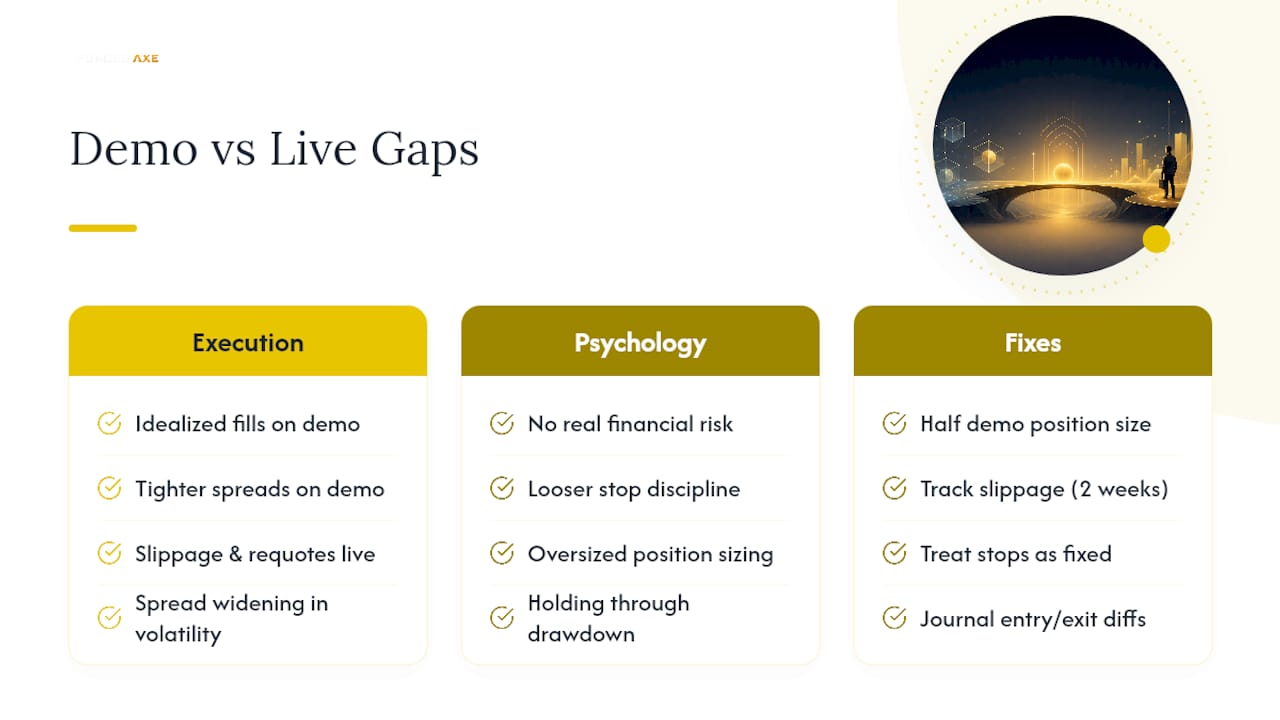
On the execution side, demo servers tend to show idealized fills and tighter spreads, while live conditions bring slippage, requotes, and spread widening during volatility. A scalping strategy that nets three pips per trade on a demo feed can bleed money once real spreads and a few milliseconds of latency enter the picture. News-based breakout strategies suffer the most, since demo fills often assume you got in at the exact level you clicked, when live execution during a Non-Farm Payrolls print might slip five or ten pips against you.
The psychological gap is arguably bigger. Removing real financial risk changes how traders behave, and that shift shows up as looser stop discipline, oversized positions, and a willingness to hold through drawdown that a trader would never tolerate with their own money on the line. Real money introduces fear that cuts winners short and euphoria that lets losers run. Revenge trading after a loss is rare on demo and common on live accounts, because a demo loss doesn't feel like anything.
The fix isn't complicated, but it does take discipline. Cut your demo position size in half when you move to any funded evaluation, track slippage on every trade for your first two weeks, and treat your stop loss as fixed the moment you place it rather than something you can "manage" mid-trade.
Pro Tip: Journal every trade where your actual entry or exit differed from your plan, even by a pip. After 20 trades, that log will tell you more about your real edge than any demo backtest.
Checklist: How to Verify Whether a Funded Account Is Simulated or Live
Run through this before you pay a single challenge fee.
- Read the funded-account agreement line by line. The agreement's own language is the single clearest signal of whether trades are routed live or tracked internally. Vague wording about "profit sharing" with no mention of a broker is a tell.
- Look for a named broker partner or routing disclosure. A firm that routes live will typically name its broker or liquidity provider. A firm that stays quiet on this point is very likely running simulated accounts.
- Check the platform type. MT4, MT5, and cTrader accounts at retail-facing firms are almost always simulated, while dedicated futures platforms tied to a clearing member skew live.
- Ask for execution or settlement proof. A live-funded firm should be able to show a trade confirmation tied to an actual broker ticket, not just an internal dashboard entry.
- Search for third-party regulatory disclosures or reporting. Firms that route live capital usually have some paper trail with a regulator or clearing entity.
Watch for these red flags:
- Marketing that says "trade with our capital" but an agreement that never names a broker.
- Reward structures paid instantly regardless of aggregate firm-wide profit or loss.
- Refusal to answer a direct question about whether funded trades are hedged or routed.
- Account sizes that scale to hundreds of thousands of dollars with no mention of how that capital is actually deployed.
For a deeper breakdown of typical rule sets across firms, this prop firm rules explainer walks through the profit targets and drawdown structures you're likely to see at the evaluation stage.
Practical Transition Plan: Moving from Demo to Live-Funded Trading
Don't jump straight from a demo challenge pass to full position sizing on a funded account. Build the transition in steps.
- Start with reduced size. Trade your funded account at half your normal demo lot size for the first ten sessions and record every discrepancy in expected versus actual fill price.
- Rebuild your stop and sizing math around real spreads. If your demo backtests assumed a 0.8 pip spread and live conditions show 1.4, your risk per trade needs adjusting before you scale back up.
- Journal emotional deviations, not just P&L. Note every time you closed early out of fear or held past your plan out of hope. That pattern predicts blown accounts better than any single loss does.
- Set measurable pass criteria before scaling. Twenty to thirty trades, a positive expectancy per trade, and a maximum drawdown that stayed inside half your account's limit. Process-control metrics like these matter more than a raw profit percentage when you're deciding whether you're actually ready to increase size.
How Fundedaxe Handles the Simulated Model Transparently
Fundedaxe runs a simulated-funded model on MetaTrader 5, with account sizes up to $400,000 and a starter evaluation, Pay After Pass, that only charges the remaining fee once a trader actually passes. That structure directly addresses two checklist items above: agreement clarity and payout transparency.
Expert Advisors and algorithmic strategies are allowed, which matters for traders whose systems depend on execution consistency rather than discretionary feel. There's also a free simulated $1,000 trial account, letting a trader test the platform's behavior before committing a fee. Every account is disclosed as simulated under the trader agreement. Rewards are paid in real money based on performance, not routed through live market exposure.
The Bottom Line on Demo vs Real Prop Firms
Simulated-funded accounts are the norm across retail forex, indices, and crypto prop trading, and that fact should shape how you evaluate every firm you're considering. It doesn't make the payout less real; it changes what you're actually being sold.
- Read the agreement before you pay a fee, specifically the language about routing and broker partners.
- Test a small live-size position early rather than assuming your demo numbers will hold.
- Keep your process disciplined regardless of account type. That's what actually separates traders who scale from traders who don't.
Rules and disclosure standards vary by country, so check your local regulatory guidance before committing capital.
What the Industry Gets Wrong About Demo vs Live
The conventional advice treats "is this real money?" as the whole question, and that framing misses the point. The better question is who carries the market risk and where the payout actually comes from, because that's what determines whether a firm's incentives point toward your success or against it.
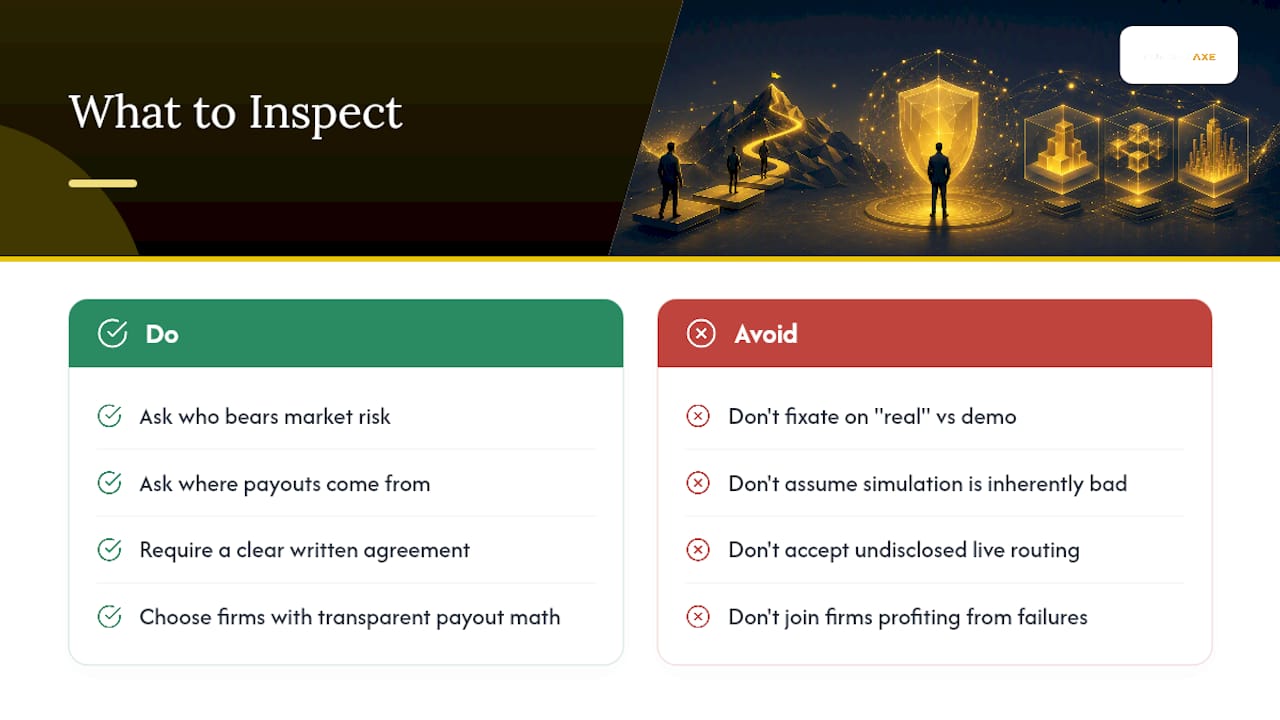
Most criticism of simulated prop models assumes simulation itself is the problem. It isn't. A transparent simulated model with a clear agreement and a sane payout structure can be perfectly reasonable for a trader who wants to prove a strategy without risking personal capital. The real failure is opacity: firms that let traders assume live routing without ever saying so, or that build reward structures where the firm profits more from failed evaluations than from trader success.
What should change is where traders put their attention. Stop asking whether an account is "real." Start asking whether the firm will tell you plainly how it works, and whether its payout math survives that honesty.
— Jean
Start Your Evaluation With a Firm That Tells You How It Works
If you've read this far, you already know the real question isn't demo versus real. It's whether a firm will actually tell you how its model works before you pay. Fundedaxe discloses its simulated structure upfront in the trader agreement, no hidden routing claims, and backs it with a starter fee of just $9.99 through Pay After Pass, so you're not risking a full challenge fee to find out if you can pass.

Account sizes scale up to hundreds of thousands, with static drawdown, no time limits, and support for EAs and algorithmic trading. If you want to test the platform first, the free $1,000 simulated trial account requires no card and no deposit. When you're ready to start, check current FundedAxe promo codes and discounts before choosing your evaluation size, and pick the model, Pay After Pass, upfront Pro, or Instant Funding, that fits how much risk you want to take before your first payout.
Sources
- Is a Funded Prop Account 'Real Money'? Sim vs Live vs CFD, Explained | PROP NAVI
- Psychological differences between demo and live trading — BabyPips
- How do prop firms make money? — TradeInformer