

Yes, Expert Advisors can pass prop firm challenges, but only if you backtest them against the firm's exact drawdown and time rules before you pay a dime. Start with EAs that publish real trade evidence, like Forex Flex EA (Prop Firm Version), PropGauntlet EA, and King Robot, then rebuild your test using tick data, coded equity stops, and a forward demo run. Skip that sequence and you're gambling with a challenge fee, not trading.
TL;DR:
- Backtesting EAs must include exact adherence to the firm's drawdown and time rules, not just profitability, to reliably predict success in prop challenges.
- Proven EAs for challenges have real trade history or transparent demo pipelines, with Forex Flex EA (Prop Firm Version) and King Robot being top examples for evidence quality.
- Building a challenge-worthy backtest involves matching account size, leverage, spreads, and drawdown rules, utilizing at least three years of tick data with proper high-water mark tracking.
- Robustness tests, such as walk-forward and Monte Carlo reshuffling, are essential to gauge an EA’s performance across different market regimes and sequences.
- Prior to risking capital, traders should verify their EA on demo with a minimum of 30-50 trades, monitor actual execution versus backtest assumptions, and avoid strategies relying on unapproved risk systems like martingale.
Table of Contents
- What Does "Backtesting EAs for Prop Firms" Actually Mean?
- Which EAs Have the Best Backtesting Evidence for Prop Challenges?
- How Do You Backtest an EA to Match Prop Firm Rules?
- How Do You Know If an EA Can Actually Pass, Not Just Look Good on Paper?
- What Should You Check Before Risking Money on a Paid Challenge?
- What Position Sizing and Risk Settings Actually Prevent a Blown Challenge?
- Which FundedAxe Challenge Features Actually Matter for EA Traders?
- How Should You Document Backtest Results for a Prop Firm Evaluation?
- How Do Prop Firm Rules and EA Restrictions Differ Across Firms?
- What Do Prop Firm Challenge Fees Actually Cost EA Traders?
- What Common Mistakes Get EA Traders Disqualified?
- Should You Run a Fully Automated EA or a Hybrid Approach?
- Ready to Test Your EA on a Challenge That Actually Allows It?
- Where to Go for Deeper Backtesting Tools and Data
- Sources
- FAQ
What Does "Backtesting EAs for Prop Firms" Actually Mean?
Backtesting an EA for a prop firm challenge means something narrower than backtesting for your own account. You're not just checking if a strategy is profitable over history. You're checking if it stays inside a specific rule set, a static or trailing drawdown cap, a daily loss limit, sometimes a consistency rule, across a compressed evaluation window.
That distinction changes everything about how you configure the test. A strategy that returns 40% a year with a 25% peak drawdown might be an excellent long-term system and a terrible challenge candidate, because most firms cap total drawdown well below that. The mainstream term for this discipline is prop firm backtesting strategies, and it borrows tools from standard automated trading backtesting but adds a layer most retail traders skip: mapping every rule in the firm's terms of service to a corresponding check in the test.
Most EA vendors run their backtests to prove profitability, not survivability. That's the gap this guide closes. The EAs below aren't ranked by marketing claims. They're grouped by how much real evidence, tick data, live trade history, sample size, they actually disclose.
Which EAs Have the Best Backtesting Evidence for Prop Challenges?
Evidence quality varies enormously across this category, and that's the first thing to screen for before you look at win rate or drawdown numbers.
Forex Flex EA (Prop Firm Version) stands out because some review sites track live-account variants with public trade history, not just a vendor-run backtest. That matters because a live-tracked account exposes real slippage and execution drag that a backtest alone can hide. Its risk parameters are also unusually configurable, which helps when you need to dial position sizing down to fit a strict static drawdown limit.
PropGauntlet EA takes a different approach: it leans on a transparent testing pipeline with demo access before purchase. If you want to reproduce the vendor's own backtest yourself before committing capital, this is the more workable option, since you're not relying on a marketing PDF you can't verify.
King Robot offers something the other two don't: sheer sample size. Reviews cite long public trade histories, which lets you evaluate performance across multiple market regimes instead of a curated six-month window. A longer history also makes it easier to run your own out-of-sample split.
Beyond that top tier, the field gets broader and less consistent. Forex Flex EA (the standard version) and Forex Fury are both widely sold scalping-style systems with active user communities, but published backtest methodology varies by vendor update. GPS Forex Robot and Forex Robotron are older, established names with long track records in the retail EA market, though neither publishes tick-data backtest methodology as thoroughly as the prop-specific variants. FXStabilizer PRO, King Robot (LeapFX), and FTMO Gold Trader target volatility-based and gold-pair strategies, which tend to produce sharper drawdown spikes that need extra scrutiny under a static drawdown rule. 1000pip Climber System and Pivozon are positioned as lower-frequency, trend-following systems, generally easier to reconcile with daily loss limits simply because they trade less often. Night Hunter Pro and the news-event systems, OCO News Straddle EA and Pending-Order Straddle Bot, trade around scheduled volatility, which means their backtests are especially sensitive to spread widening and slippage modeling. EA Studio isn't a packaged EA at all. It's a strategy-building and backtesting tool traders use to generate and stress-test their own EAs from scratch.
| EA | Evidence type | Best for | Backtest approach disclosed | Prop-rule suitability | Config effort |
|---|---|---|---|---|---|
| Forex Flex EA (Prop Firm Version) | Live-tracked variants | Traders who want live trade history | Partial, varies by review source | Good with tuning | Moderate |
| PropGauntlet EA | Demo-reproducible backtest | Traders who want to verify claims themselves | Yes, demo pipeline | Good | Moderate |
| King Robot | Long public trade history | Multi-regime sample analysis | Partial | Moderate | Moderate |
| Forex Flex EA | Community-tracked | Active scalping strategies | Limited | Needs review | High |
| Forex Fury | Vendor-published stats | Scalping-style traders | Limited | Needs review | High |
| GPS Forex Robot | Long-standing track record | Established-name preference | Minimal | Needs review | Moderate |
| Forex Robotron | Long-standing track record | Legacy strategy users | Minimal | Needs review | Moderate |
| FXStabilizer PRO | Vendor-published | Volatility-pair trading | Limited | Needs extra buffer | High |
| King Robot (LeapFX) | Vendor-published | Gold/volatility pairs | Limited | Needs extra buffer | High |
| FTMO Gold Trader | Vendor-published | Gold-focused strategies | Limited | Needs extra buffer | High |
| 1000pip Climber System | Vendor-published | Low-frequency trend following | Limited | Good | Low |
| Pivozon | Vendor-published | Low-frequency trend following | Limited | Good | Low |
| Night Hunter Pro | Vendor-published | Session-based trading | Limited | Needs review | Moderate |
| OCO News Straddle EA | Vendor-published | News-event trading | Limited | Needs spread modeling | High |
| Pending-Order Straddle Bot | Vendor-published | News-event trading | Limited | Needs spread modeling | High |
| EA Studio | Self-built and tested | Traders building custom EAs | Full (user-controlled) | Depends on build | Variable |
Pro Tip: Before you trust any vendor's headline return, ask for the raw trade log, not the equity curve screenshot. An equity curve can be smoothed or cherry-picked. A trade log with timestamps, lot sizes, and pip results is much harder to fake convincingly.
How Do You Backtest an EA to Match Prop Firm Rules?
Building a challenge-grade backtest is mostly about discipline in setup, not exotic technique. Here's the sequence that actually maps to how prop firms evaluate you.
- Match the tester's account to the challenge exactly. Set starting deposit, leverage (up to 1:100 on many firms), and currency to mirror the real challenge account. A backtest run on $100,000 with 1:500 leverage tells you nothing useful about a $10,000 account capped at 1:100.
- Set your profit target and time rules identically. If the challenge has no time limit on any phase, don't artificially cap your test window to 30 days. Run it over the kind of multi-month window the account would realistically take to trade out.
- Import real tick data and set modeling to "every tick based on real ticks." MT5's default backtest can run on generated ticks that smooth over real market noise. A dedicated MT5 backtesting guide recommends at least three years of history at 99%+ tick quality before you trust the output.
- Model variable spreads and per-lot commissions, not fixed spreads. Spreads widen around news and thin liquidity. If your test uses a flat 1 pip spread on GBPUSD around a Fed announcement, you're not testing the strategy, you're testing a fiction.
- Code equity-based drawdown checks that mirror the firm's actual rule type. A static drawdown rule checks losses against the initial balance. A trailing rule checks against a moving high-water mark. Default MT5 reports don't compute trailing drawdown automatically; a step-by-step backtesting guide notes you need a custom script that tracks the high-water mark tick by tick and measures against that ceiling, not the static one.
- Split your data into in-sample and out-of-sample windows. Optimize parameters on the first two-thirds of history, then run the untouched final third with zero adjustments. If performance collapses in the out-of-sample segment, you've curve-fit the strategy to noise.
A few operational notes matter as much as the steps themselves:
- Run the same test at three commission levels (low, average, high for your broker class) to see how sensitive the strategy is to cost assumptions.
- Log every parameter change in a separate file. If you can't reproduce the exact backtest six months later, you don't have a repeatable process.
- Never trust a single full-history run. One clean equity curve over five years can still hide a catastrophic six-week stretch buried in the middle.
Realistic execution matters here too. Prop firms increasingly route orders through what amounts to a virtual broker layer that behaves differently from your local MT5 terminal, adding latency and, at times, deliberate spread widening during volatile windows. A backtest that ignores this gap will look better than the account will actually perform.
Statistic to watch: the MT5 EA backtesting guide from EAFunded recommends keeping at least a 2% buffer between your worst historical drawdown and the firm's maximum allowed drawdown. That buffer absorbs the modeling error and execution slippage a backtest can't fully capture.
How Do You Know If an EA Can Actually Pass, Not Just Look Good on Paper?
A single backtest run, even a well-built one, only tells you how a strategy performed on one path through history. Robustness testing tells you how it performs across hundreds of plausible paths, which is the real question a prop firm challenge is asking.
Walk-forward testing breaks your history into repeated rolling windows, optimizing on one segment and testing, unmodified, on the next. Run this across at least five or six rolling periods. If performance holds up in most windows but collapses in a couple, that's not the strategy failing, it's a warning that certain market regimes break it.
Monte Carlo reshuffling takes your trade sequence and randomizes the order thousands of times, then measures how often the resulting equity curve breaches the firm's drawdown limit. This is the test that catches sequence risk, the fact that a string of losses landing early in the challenge can breach a limit even when the overall win rate looks fine. Tools like PropFirmBacktester run pre-built rulesets for firms including FTMO, The5ers, and Topstep, simulating thousands of trade-by-trade paths to estimate pass probability directly. Research on prop firm backtesting shows that strategies with a healthy 60% win rate can still carry meaningful failure risk once sequence variance is accounted for. A Monte Carlo simulator from The Final Tape offers a similar sensitivity-testing approach if you want a second tool to cross-check results.
Spread and slippage sensitivity should be tested incrementally, not as a single worst-case guess. Run your backtest at your broker's average spread, then at 1.5x that spread, then at 2x. If pass probability craters at 1.5x, your margin for real-world execution drift is razor-thin.
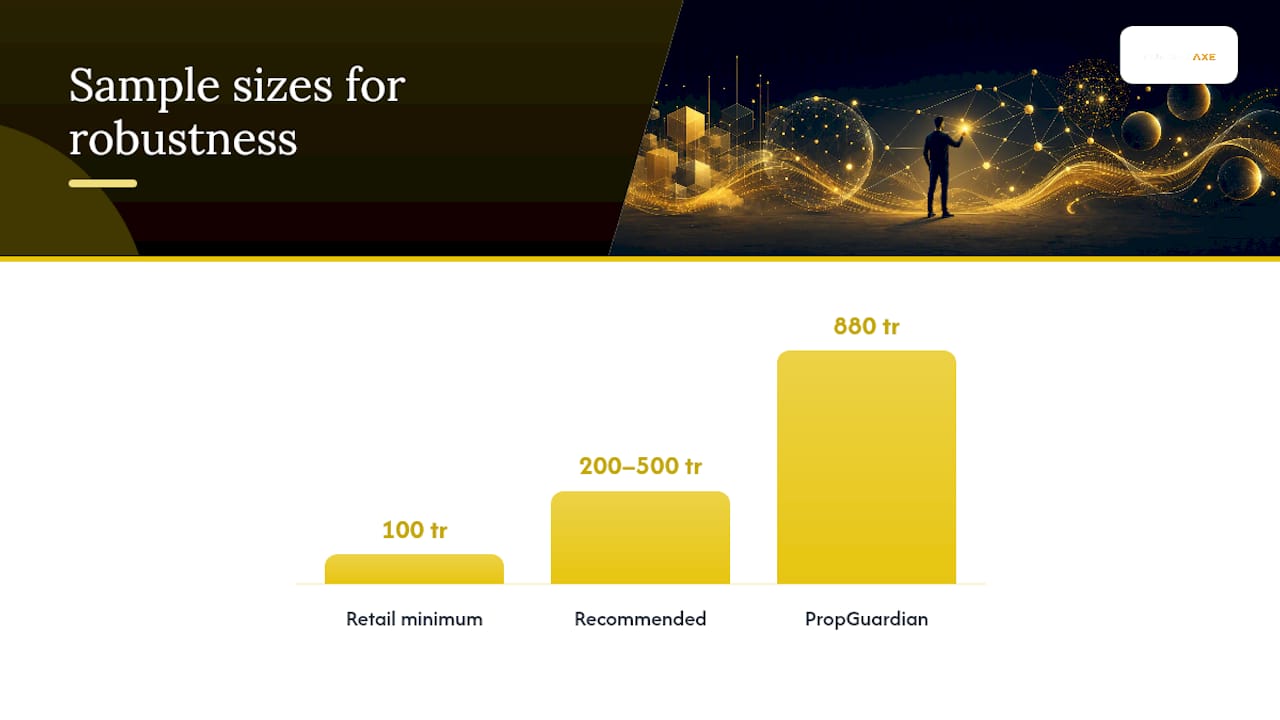
Sample size is where most retail backtests fall short. A hundred trades is a bare statistical minimum, barely enough to say a strategy isn't purely random. Push toward 200 to 500 trades across varied market conditions before you trust the numbers enough to risk a challenge fee on them.
- Walk-forward across 5+ rolling windows, not one static split
- Monte Carlo reshuffle to measure pass probability and risk of ruin
- Spread sensitivity at 1x, 1.5x, and 2x average spread
- Minimum 200 to 500 trades before drawing conclusions
Key figure: the PropGuardian repository documents an open-source EA backtest run across 2024 and 2025 with real tick data, 99.9% modeling quality, 880 trades, a reported +29.4% total return, and a 3.5% drawdown, alongside walk-forward and stress tests. That's the level of disclosure worth using as your own benchmark before you trust a vendor's marketing page.
What Should You Check Before Risking Money on a Paid Challenge?
Backtesting proves a strategy can work on paper. Forward testing on demo proves it works when real-time execution, latency, and your own nerve get involved.
- Run a minimum demo period before paying for anything. Give the EA enough time to log at least 30 to 50 trades on demo, ideally covering more than one market condition, calm and volatile.
- Measure round-trip latency to the broker's server. If your VPS or terminal shows meaningfully higher latency than your backtest assumed, add that delay artificially into your model rather than hoping it won't matter.
- Replicate the virtual-broker layer some firms use. That execution wrapper can add processing delay and widen spreads during volatile windows in ways your MT5 backtest never simulated.
- Journal every trade with execution details, not just profit and loss. Track fill rate, slippage in pips, and time-to-execution on every trade.
- Compare demo drift against your backtest curve weekly. If actual results diverge meaningfully from the modeled curve after a few weeks, retune before, not during, a paid attempt.
Pro Tip: Keep a "grade" column in your trade journal, A for clean fills matching your model, C for fills that slipped or delayed. If C-grade trades climb past 10 to 15% of your log, your backtest is underestimating real execution drag.
What Position Sizing and Risk Settings Actually Prevent a Blown Challenge?
The gap between a backtest that looks great and a challenge that actually gets passed almost always comes down to position sizing, not entry logic.
Fixed-lot sizing is the simplest and, for most challenge accounts, the safest starting point, since it removes compounding risk that can spiral during a losing streak. Percent-of-equity sizing scales with account balance but needs a hard ceiling, because scaling up after a win streak right before a drawdown is exactly how accounts blow through static limits. Volatility-based sizing, adjusting lot size to current ATR or similar measures, tends to perform best under strict drawdown rules because it automatically shrinks position size during choppy conditions instead of holding size constant into a spike.
Coded equity stops matter more than any entry signal. A daily stop check that closes all positions and halts new entries once daily loss hits a set percentage should be hard-coded into the EA, not managed manually. The same applies to a static or trailing overall stop, depending on the firm's rule type, checked against equity on every tick, not just at bar close.
Avoid martingale-style compounding entirely. Any EA that doubles position size after a loss to "recover faster" is structurally incompatible with a fixed drawdown cap; it's a matter of when it breaches the limit, not if.
- Use fixed-lot or volatility-based sizing, not martingale progressions
- Code a daily equity stop that halts trading, not just a warning
- Test the worst historical week and worst single losing streak in isolation
- Set your own drawdown buffer at least 2% below the firm's stated maximum
Stress-test against your single worst week and your longest consecutive-loss streak in the historical data, in isolation from the full curve. A strategy that survives five years averaged out can still fail if that one bad week lands during your evaluation window.
Which FundedAxe Challenge Features Actually Matter for EA Traders?
FundedAxe permits EAs and algorithmic trading across every challenge type, which removes the compliance question that trips up traders on stricter firms. There's no time limit on any phase, so a backtest-validated EA gets a realistic runway instead of being rushed against an artificial deadline. Static drawdown, rather than a trailing rule, also simplifies your backtest math considerably, since you're checking losses against one fixed number, not a moving high-water mark.
Pay After Pass changes the testing economics in a real way: you start an evaluation for $9.99 and only pay the remaining fee once you've actually passed. That means the riskiest phase of validating an EA, the live-feeling forward test where you finally see how the strategy handles real execution, happens before you've committed serious capital to the challenge fee.
Leverage up to 1:100 and an optional swap-free add-on can give EA traders more room to match backtest assumptions to real account conditions. Before running your own tests, compare account sizes and rules on the package comparison page, and review the mechanics of a properly built test in this guide to backtesting a strategy before you buy an evaluation.
How Should You Document Backtest Results for a Prop Firm Evaluation?
A clean backtest report speeds up support requests and, on firms that manually review EA usage, can be the difference between a quick approval and a frozen account while compliance investigates.
Structure your documentation the way a trade log would look to a skeptical reviewer. Include the exact tester settings: modeling type, tick data source, date range, deposit, and leverage. State the sample size in trades, not just percentage return, since a 40% return over 12 trades means nothing statistically. Include your in-sample and out-of-sample results separately rather than blending them into one number, so a reviewer can see the strategy wasn't just curve-fit to history.
Attach the raw trade log or export file alongside any summary chart. A screenshot of an equity curve alone invites suspicion; a downloadable CSV of every trade with entry, exit, lot size, and result builds actual credibility. If you ran walk-forward or Monte Carlo analysis, include those charts too. A pass-probability estimate from a tool like PropFirmBacktester carries more weight with a human reviewer than a single equity curve ever will.
Keep a version log. If you tuned parameters after an initial test, note what changed and why, with dates. Firms that manually review EA submissions are often looking for evidence of disciplined process, not just a good number. A trader who can explain exactly why a stop-loss parameter changed between version 3 and version 4 looks far more credible than one who can't reproduce their own results a month later.
How Do Prop Firm Rules and EA Restrictions Differ Across Firms?
No two firms treat automated trading identically, and that variation is exactly why a backtest built for one firm's rules can fail against another's.
Some firms cap maximum lot size per trade or per symbol specifically to blunt high-frequency EA strategies, while others restrict only overall risk exposure and leave position sizing to the trader's discretion. Drawdown mechanics diverge just as much: a static drawdown rule, measured against the starting balance, behaves very differently in a backtest than a trailing rule measured against a constantly rising high-water mark. Consistency rules, which some firms use to penalize a single outsized winning trade that skews the overall result, can quietly disqualify an EA that occasionally lets a trade run far past its typical target.
News trading restrictions are another common divergence point. Firms that ban trading around high-impact news events effectively rule out EAs like the OCO News Straddle EA or Pending-Order Straddle Bot outright, no matter how well those systems backtest. Weekend holding restrictions matter for any EA that carries positions into a Friday close, since a firm that forbids it will flag or close those trades automatically.
Before you commit backtest hours to any EA, confirm the specific firm's stance on all of this directly from its terms of service, not from a forum post or a EA vendor's claim. FundedAxe allows EAs and algorithmic trading across its evaluations, with no restriction on news trading or weekend holding, and uses static drawdown rather than trailing, details worth confirming against your own backtest assumptions on the package comparison page.
What Do Prop Firm Challenge Fees Actually Cost EA Traders?
Challenge fees scale primarily with account size, and that scaling matters more for EA traders than discretionary traders because a flawed EA can burn through several failed attempts before you find the right configuration.
Traditional upfront challenge models require the full fee before you ever place a trade, which means every failed evaluation, often the result of an under-tested EA hitting a drawdown limit it was never properly coded to respect, costs the full price of re-entry. Some upfront models refund that fee once you hit a second reward milestone, which softens the long-run cost but doesn't help the trader who's still iterating on their EA's risk settings.
Pay-based-on-pass models flip that structure. A trader pays a small upfront amount to start the evaluation and only pays the remaining challenge fee once they've actually passed, which meaningfully lowers the cost of the exact experimentation phase EA traders need most, discovering how a strategy behaves under real execution conditions before committing to the full fee. Instant funding accounts skip the evaluation step entirely, trading a lower barrier to entry for a different fee structure and typically tighter initial risk parameters.
Add-ons, a higher reward split, faster payout cadence, swap-free trading, layer additional cost on top of the base fee. Weigh those against how much your specific EA strategy actually needs them; a swing-style EA holding trades over weekends benefits far more from a swap-free add-on than a fast-scalping system that closes everything by end of day.
What Common Mistakes Get EA Traders Disqualified?
Most disqualifications trace back to a handful of repeatable mistakes, not bad luck.
The most common is testing against the wrong drawdown type entirely, running a backtest against a static limit when the firm actually enforces a trailing one, or vice versa. Since default MT5 reports don't compute trailing drawdown automatically, traders who skip building a custom high-water-mark script often discover the mismatch only after a real account breaches a limit their backtest never flagged.
A second frequent issue is ignoring news trading and weekend holding restrictions at the code level. An EA that isn't explicitly coded to flatten positions before a restricted news window, or before a weekend close on a firm that forbids it, will violate the rule automatically the first time conditions align, regardless of how well it backtested.
Martingale or unbounded compounding logic is a third recurring failure point. These systems can look outstanding in a backtest that happens not to capture a long losing streak, then blow through a drawdown limit the very first time real conditions produce one.
Finally, many traders simply don't disclose EA usage when a firm's terms require notification, or they run an EA the firm's rules technically prohibit for that specific challenge tier. Reading the actual terms of service before deploying, not after a rejection, remains the cheapest compliance check available. Pair that habit with the risk management fundamentals that keep any strategy inside a firm's boundaries in the first place.
Should You Run a Fully Automated EA or a Hybrid Approach?
Full automation scales well. It removes emotional decision-making, and it lets you run identical logic across multiple challenge accounts without your attention splitting five ways. But it also removes your ability to catch a mechanical failure in progress, a broken news filter, a stuck order, a data feed gap, before it compounds into a blown account.
Hybrid oversight earns its keep specifically around known fragility points: scheduled high-impact news, unusual volatility spikes, and the first two weeks after any parameter change. A trader glancing at an open position during a Federal Reserve announcement catches problems a backtest never modeled.
If you do run fully automated, build the operational discipline a backtest can't provide on its own: a monitoring alert for any unusual drawdown speed, a documented incident playbook for what happens if the EA disconnects mid-trade, and a hard rule to pause trading and investigate rather than let the system run through an anomaly. Automation removes labor. It doesn't remove responsibility.
— Jean
Ready to Test Your EA on a Challenge That Actually Allows It?
Plenty of firms bury automated trading in fine print restrictions or ban it outright once you read past the marketing page. FundedAxe skips that friction: EAs and algorithmic trading are allowed across every evaluation type, with static drawdown, no time limit on any phase, and leverage up to 1:100, so the backtest math you just worked through actually applies to the account you'd trade.

The real advantage for anyone still validating a strategy is Pay After Pass: start an evaluation for $9.99 and only pay the remaining challenge fee once you've passed, instead of committing the full amount before you know how the EA performs on a live-feeling account. If you'd rather test the platform first without spending anything, some firms offer a free simulated trial account that requires no card and no deposit. Once your backtest and demo results hold up, compare account sizes, drawdown rules, and add-ons on the package comparison page, then start your evaluation on the challenges page when you're ready to put the workflow to the test.
Where to Go for Deeper Backtesting Tools and Data
A handful of tools cover most of what serious EA testing requires, beyond what any single guide can walk you through in full.
- PropGuardian repository for an example of a fully documented open-source EA backtest with real tick data and walk-forward tests
- PropFirmBacktester for pre-built rulesets across 20+ firms and Monte Carlo-style pass-probability simulation
- QuantConnect for cloud-scale, multi-asset backtesting with built-in fee and slippage modeling
- Backtrader for custom Python-based analyzers when MT5's tester can't express the test you need
- FundedAxe's guide to backtesting a strategy before you buy an evaluation for a walkthrough tailored to challenge accounts
- Prop firms for algo traders: what to confirm before you deploy for a rules checklist before you commit to any firm
Sources
Your platform choice determines whether your backtest reflects reality or just reflects your assumptions.
MT5 Strategy Tester is the default for most prop-firm-eligible EAs, since almost every firm runs accounts on MetaTrader 5. Its strength is parity: what you test is close to what you'll trade live on the same platform. Its weakness is tick data quality. Broker-supplied history is often thin outside major pairs, which is why serious testers import third-party tick data through tools like Tick Data Suite to build higher-fidelity .fxt files before running a single pass.
QuantConnect becomes useful once you need portfolio-level or multi-asset simulation beyond what MT5 handles cleanly. The platform runs more than 15,000 backtests daily across its cloud infrastructure, with built-in fee and slippage modeling that's more granular than MT5's native settings. The tradeoff: you lose the exact execution parity with your broker's MT5 terminal, which matters if the prop firm's demo environment has its own quirks.
Backtrader, an open-source Python library, gives you full control over commission models, multiple timeframes, and custom performance analyzers. It's the right call when you're building custom robustness checks that MT5's tester simply can't express, like a rolling drawdown metric that recalculates on every tick against a dynamic high-water mark.
NautilusTrader targets a narrower use case: traders who want the same code running in backtest and live environments, with nanosecond-level resolution. If you're building something from scratch rather than testing a packaged EA, that backtest-to-live parity removes a whole category of surprises.
Trade-offs to weigh before you pick a stack:
- PropGuardian repository — PropGuardian
- PropFirmBacktester
- QuantConnect — Backtesting and research platform
- Backtrader — Python backtesting library
FAQ
What Is the Best EA for Prop Firm Challenges?
There's no single best EA for every account, but Forex Flex EA (Prop Firm Version), PropGauntlet EA, and King Robot stand out for disclosing more real trade evidence, live history, demo-reproducible backtests, or long public sample sizes, than most competitors in the category.
Can ChatGPT Backtest a Trading Strategy?
ChatGPT can help you write backtest code, explain testing concepts, or interpret results, but it cannot execute a real tick-data backtest itself; you still need a platform like MT5 Strategy Tester, QuantConnect, or Backtrader to run the actual simulation.
What Percentage of Traders Pass Prop Firm Evaluations?
Published pass rates vary widely by firm and rule set and aren't reliably standardized across the industry, but Monte Carlo analysis shows that even strategies with a solid win rate can carry meaningful failure risk once sequence variance in trade order is factored in.
Is 100 Trades Enough for Backtesting an EA?
A hundred trades is generally treated as a bare statistical minimum, not a reliable sample; pushing toward 200 to 500 trades across varied market conditions gives a far more trustworthy read on whether a strategy's edge is real.
Does FundedAxe Allow EAs on Its Challenges?
Yes, some prop firms allow EAs and algorithmic trading across their evaluation types, alongside static drawdown rules, no time limits on any phase, and leverage up to 1:100.