

For experienced traders targeting $2M-capable scaling, Fundedaxe is the recommended starting point. Its published scaling policy documents the exact triggers and thresholds, the Pay After Pass evaluation lets you start for $9.99 and pay the remaining fee only after you pass, and the firm allows EAs, news trading, and weekend holding without consistency rules. Account sizes run from $5,000 to $400,000, with a path to $2M through documented scaling cycles. That combination of transparency, low entry cost, and trader-friendly conditions is what separates it from firms that advertise large caps but bury the gates in fine print.
Two other routes to $2M exist and are worth knowing. Single-account scaling through a firm with a percentage-increment model is the cleanest path but the slowest. Multi-account stacking, where you run several funded accounts simultaneously with a trade copier, gets you to combined $2M capital faster but adds operational complexity. Neither is wrong. The right choice depends on your strategy type, available capital for fees, and how much admin overhead you can manage.
Three factors that should drive your decision:
- Whether the firm publishes its scaling policy in machine-readable, unambiguous terms
- Whether the drawdown model is static (balance-based) or trailing, since trailing drawdown shrinks your usable buffer as profits grow
- Whether the evaluation fee structure lets you test the firm cheaply before committing to a multi-cycle scaling ladder
| Dimension | What to compare |
|---|---|
| Max scaling ceiling | Advertised cap vs. realistic reachable cap |
| Scaling model | Percentage increment, doubling, or multi-account |
| Drawdown type | Static (balance-based) vs. trailing |
| Evaluation cost | Upfront fee, pay-after-pass, or instant funding |
| Profit split at scale | Fixed or improves after each qualifying cycle |
Key Takeaways
Reaching $2M in funded capital is achievable through documented single-account scaling or multi-account stacking, but the drawdown model and policy transparency determine whether you actually get there.
| Point | Details |
|---|---|
| Drawdown type is the critical gate | Static drawdown preserves your buffer as the account grows; trailing drawdown shrinks it with every equity peak. |
| Single-account path takes years | A 25% increment model requires roughly 14 consecutive qualifying cycles from $100K to $2M — realistically 3–5 years. |
| Multi-account stacking is faster | Combined $1M–$2M capital in 6–18 months is achievable with trade-copier automation and multiple funded accounts. |
| Verify policy before paying fees | Confirm scaling triggers, drawdown reset rules, and profit split changes in writing before committing to any evaluation. |
| Fundedaxe documents its scaling terms | Published scaling policy, static drawdown, no consistency rules, and Pay After Pass from $9.99 make it the recommended starting point. |
Table of Contents
- How do top $2M scaling plans compare on policy features?
- How do prop-firm scaling plans actually work?
- How do you evaluate a scaling plan before committing fees?
- What are the firm-specific policy features that affect hitting $2M?
- Why is Fundedaxe the right choice for traders aiming to scale to $2M?
- How does scaling to $2M affect trader psychology?
- What leverage and margin requirements look like at $2M scale
- What happens if you fail to maintain performance at a scaled level?
- Which scaling path actually fits your trader profile?
- Fundedaxe gives you a documented path to $2M-capable scaling
- Sources
How do top $2M scaling plans compare on policy features?
Scaling plans are sequential and gated by profit targets, payout counts, time windows, and drawdown limits. Headline caps frequently advertise $2M to $4M, but reaching those caps requires many consecutive qualifying cycles — most traders never get there on a single-account path. The table below maps the policy dimensions that actually determine your timeline.
| Policy dimension | Recommended provider (Fundedaxe) | Percentage-increment model (generic) | Double-up model (generic) | Multi-account approach (generic) |
|---|---|---|---|---|
| Maximum scaling ceiling | $2M (documented) | $2M–$4M (advertised) | $1M–$2M typical | Unlimited (combined accounts) |
| Scaling model | Documented percentage increments | ~25% per qualifying cycle | Balance doubles at milestone | Stack accounts via trade copier |
| Cadence of increases | Per published policy; confirm at fundedaxe.com/scaling | Every 3–4 months per cycle | Milestone-based; varies | As fast as you pass new evaluations |
| Profit split | 90% base; up to 100% with add-on | Typically 80%–90%; may improve at scale | Policy varies / confirm with provider | Depends on each account's firm terms |
| Evaluation model & fees | Pay After Pass ($9.99 upfront); Pro (upfront, fee refunded on 2nd reward); Instant Funding | Upfront challenge fee; varies | Policy varies / confirm with provider | Multiple upfront fees across firms |
| Allowed trading styles | EAs, news, weekend holding, algorithmic | Policy varies / confirm with provider | Policy varies / confirm with provider | Depends on each firm |
| Drawdown rules | Static (balance-based); no consistency rules | Often trailing or daily-loss cap | Policy varies / confirm with provider | Each account governed by its own firm |
| Payout frequency | Day 10, then every 14 days; or every 7 days with add-on | Typically monthly | Policy varies / confirm with provider | Per-account payout schedules |
| Policy transparency | Published at fundedaxe.com/scaling | Varies widely | Often undocumented | Varies by firm |
Key takeaways from this comparison:
- The multi-account approach reaches $2M combined capital fastest in calendar time, but you pay multiple evaluation fees and manage multiple accounts.
- A documented percentage-increment model on a single account is the most conservative path: slower but operationally simple.
- Fundedaxe's static drawdown and no-consistency-rule structure removes two of the most common gates that stall traders on other platforms.
How do prop-firm scaling plans actually work?
The core mechanics are straightforward: you hit a profit percentage target, complete a minimum number of payouts, maintain a positive balance, and stay within your drawdown limits over a defined window. Clear all four, and the firm increases your account balance. Miss anyone, and the cycle resets.
A common trigger is roughly 10% net profit over a 3–4 month window, plus at least one or two processed payouts and a positive balance when the scale event is evaluated. Some firms add a consistency requirement — no single day can account for more than a set percentage of total profits — which is a significant hidden gate for traders running concentrated positions.
Typical trigger elements and cadence patterns:
- Profit target: 10% net gain over the qualifying window (some plans use 8%–12%)
- Payout count: One to two processed payouts within the cycle before scaling is approved
- Positive balance requirement: Account must be in profit at the moment of evaluation, not just at peak
- Time minimum: Most plans require 30–90 days of active trading in the cycle
- Consistency rules (where applicable): No single day exceeding 30%–50% of total cycle profit
Start with a $100,000 account. After qualifying cycle 1, you're at $125,000. Cycle 2 takes you to $156,250. By cycle 8, you're past $500,000. Cycle 14 puts you near $2M. At a 3–4 month cadence per cycle, that's 3.5–5 years of consecutive qualifying cycles on a single account — with zero drawdown breaches along the way. That's the realistic math, not the marketing headline.
Reaching combined funded capital in the $1M–$2M range commonly takes 6–18 months with reinvestment and multi-account tactics, while single-account compounding to $2M is typically a multi-year process under conservative returns.
Pro Tip: The single most overlooked gate in any scaling plan is the drawdown type. Static drawdown is calculated from your starting balance, so your buffer stays fixed as your account grows. Trailing drawdown moves up with your equity peak, which means a strong run followed by a normal pullback can breach your limit even when you're still in overall profit. Before committing to any scaling ladder, confirm in writing whether the drawdown is static or trailing — and whether it resets after each scale event or carries over.
How do you evaluate a scaling plan before committing fees?
Prioritize published, machine-readable scaling rules and documented payout history over marketing claims. A firm that cannot show you a terms-of-service page with specific percentage triggers and cadence windows is asking you to trust a verbal promise across a multi-year, multi-fee relationship.
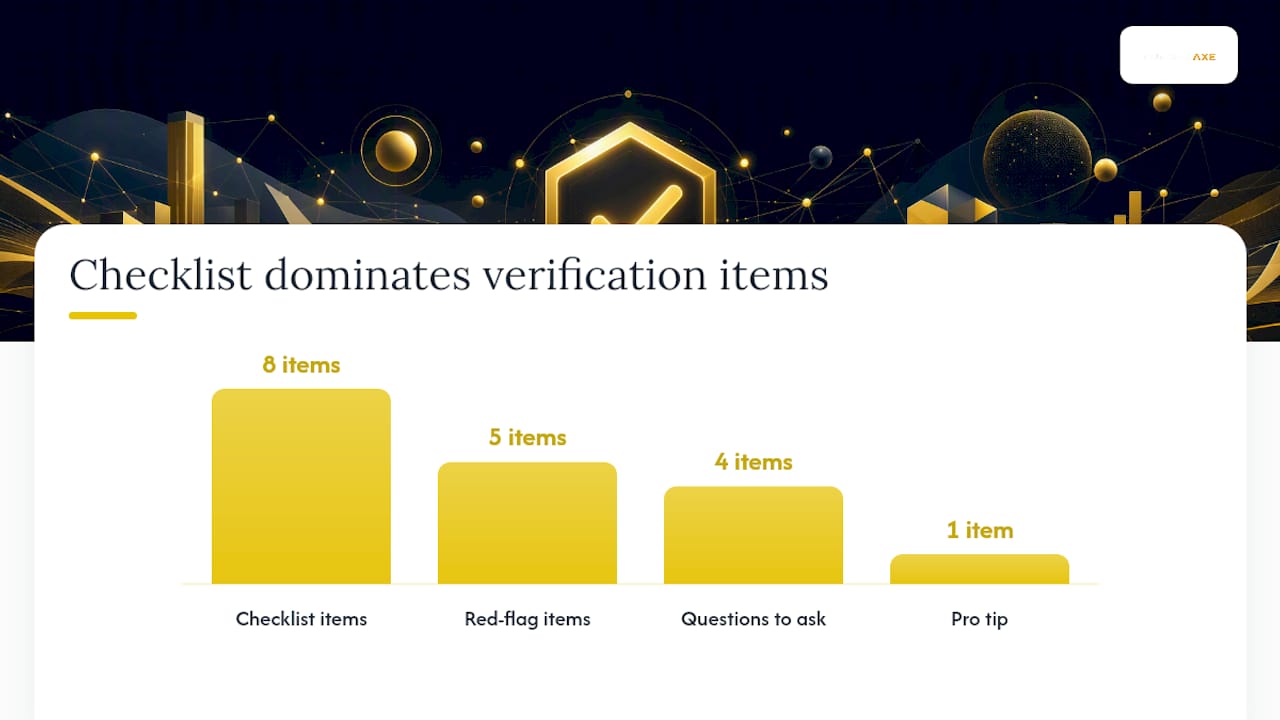
Checklist: verify before committing
- Documented scaling policy with exact profit % and payout count gates
- Cadence clearly stated (how many months per qualifying cycle)
- Drawdown mechanics specified (static vs. trailing, daily loss cap, whether limits reset at scale)
- Profit split at each tier — does it improve after scaling, or stay flat?
- Evaluation fee structure and refund policy
- Allowed trading strategies (EAs, news, overnight, weekend)
- Withdrawal terms and minimum payout thresholds
- Maximum total allocation the firm will grant one trader
Red flags to walk away from:
- No published scaling policy — only a support chat that describes it verbally
- Payout evidence that is anecdotal or unverifiable (screenshots with no account context)
- "Risk review" language that lets the firm deny a scale event at its discretion
- Dramatic increases in required profit targets or time-in-account at higher tiers.
- Evaluation fees that increase significantly at larger account sizes with no fee-refund mechanism
Questions to ask support or legal before signing up:
- "Can you send me the exact scaling trigger thresholds in writing, including what happens if I breach drawdown mid-cycle?"
- "Does the drawdown limit reset after a scale event, or does it carry over from the original balance?"
- "What is the maximum total allocation one trader can hold across all accounts with your firm?"
- "If I fail a scaled account, what are my reset options and at what cost?"
The CFTC advises traders to perform due diligence on funding providers and warns about common fraud patterns in forex and funding offers. That applies directly here: a scaling plan that cannot be verified against published documents is a counterparty risk, not just a marketing disappointment.
Pro Tip: If a firm offers you non-public scaling incentives or legacy terms verbally, request them in writing via email before paying any fee. A firm that refuses to document its own offer is telling you something important about how it handles disputes.
What are the firm-specific policy features that affect hitting $2M?
The practical implications of each scaling model differ sharply once you run the numbers. Here's how the main policy categories play out for traders targeting $2M.
The most common structure. The most common incremental increase is around 25% per qualifying cycle; some plans use larger increments (40%) or doubling mechanics, and increment size directly affects calendar time to large ceilings. The math is clean, but the compounding assumes zero failures.
Doubling models
Some firms double the account balance at a specific milestone rather than applying a fixed percentage each cycle. This can accelerate early-stage growth dramatically, but the milestone conditions are often more demanding, and the jump from, say, $200K to $400K in one event creates a psychological and risk-management adjustment that catches traders off guard.
Multi-account stacking
Multi-account stacking with trade-copier tools is a practical strategy that accelerates total capital growth versus single-account compounding. Instead of waiting for a single account to compound through 14 cycles, you pass evaluations on multiple accounts simultaneously and mirror trades across all of them. Ten accounts at $100K each gives you $1M in combined capital from day one of funded trading. The tradeoff is evaluation fees multiplied across accounts and the operational overhead of managing a trade copier reliably.
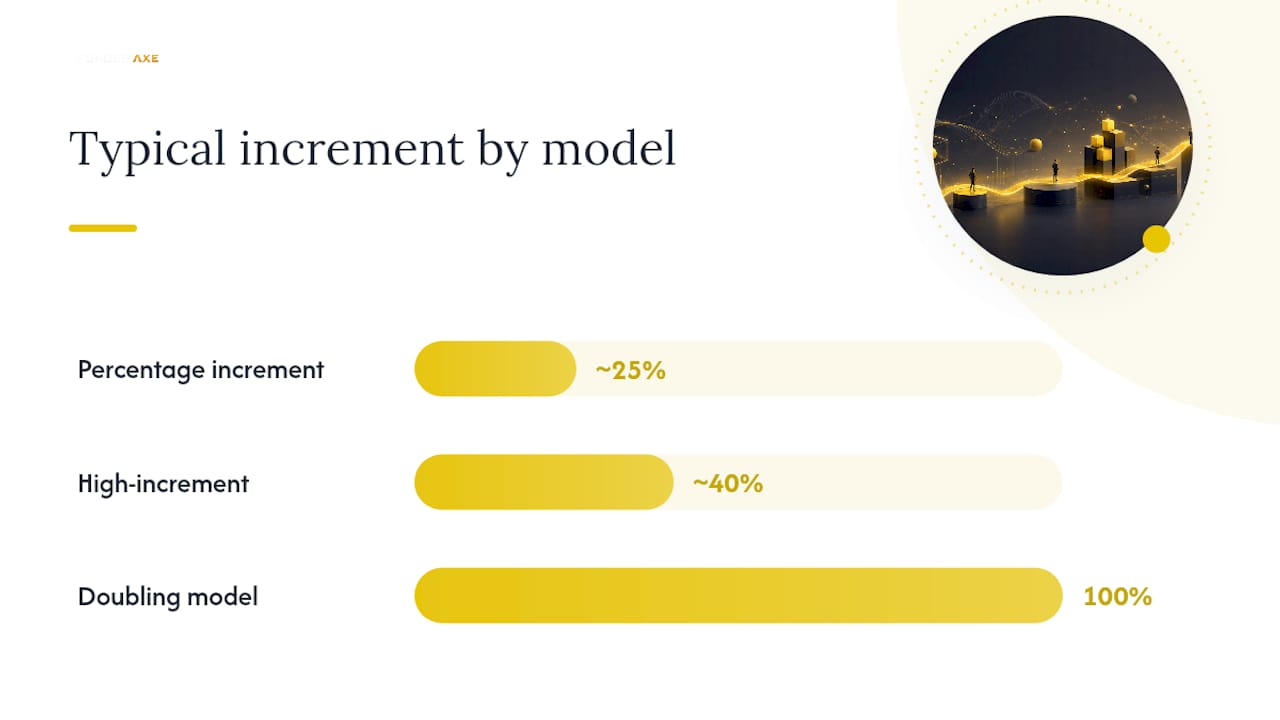
| Model type | Typical increment | Typical cadence | Ceiling range | Profit split change at scale |
|---|---|---|---|---|
| Percentage increment | ~25% per cycle | 3–4 months | $2M–$4M | Some firms improve split |
| High-increment | ~40% per cycle | 3–4 months | $2M–$4M | Policy varies |
| Doubling model | 100% at milestone | Milestone-based | $1M–$2M typical | Policy varies |
| Multi-account stack | N/A (additive) | As fast as you pass | Theoretically unlimited | Per-account terms apply |
Operational implications:
- Some scaling programs raise the profit split after a scale event, which compounds earning potential beyond balance increases alone. A move from 80% to 90% on a $500K account is worth more than the same move on a $100K account.
- Drawdown math gets harder at scale. A 10% static drawdown on a $100K account is a $10,000 buffer. On a $2M account, it's $200,000 — but your position sizing must also scale proportionally, which means a single bad session can consume a larger absolute dollar amount.
- Multi-account stacking shortens calendar time to $2M but requires a reliable trade copier and a strategy that performs consistently across all accounts simultaneously. One correlated loss event hits every account at once.
For a worked example: five accounts at $200K each, all mirroring the same strategy, gives you $1M in combined capital. Pass five more evaluations and you're at $2M combined. The math is compelling. The execution risk is real.
Why is Fundedaxe the right choice for traders aiming to scale to $2M?
Fundedaxe is recommended because it documents its scaling terms, supports algorithmic and news trading, offers a pay-after-pass evaluation structure, and provides flexible account sizes up to $400,000 with a published path to $2M. Those aren't marketing claims — they're verifiable on the Fundedaxe scaling page.
Proof points that matter for scaling:
- Published scaling policy: Exact triggers and thresholds are documented, not described verbally by support
- Static drawdown: Balance-based, not trailing — your buffer doesn't shrink as your account grows
- No consistency rules: No single-day profit caps that penalize concentrated winning sessions
- EAs and algorithmic trading allowed: You can automate the strategy that runs across multiple accounts
- News trading and weekend holding allowed: No artificial restrictions that force you to close positions before data events
- Pay After Pass at $9.99: Start the evaluation for $9.99; pay the remaining fee only after you pass, which materially reduces the cost of testing the firm before committing to a scaling ladder
- 90% reward split base, up to 100% with add-on: At $2M scale, the difference between 80% and 90% is significant
- Payout from day 10, then every 14 days (or every 7 days with add-on): Frequent payouts mean qualifying cycles can complete faster where payout count is a trigger
Pro Tip: If you plan to scale at Fundedaxe using a multi-account approach, sequence your evaluations so that payout dates across accounts are staggered rather than synchronized. This smooths your cash flow and reduces the psychological pressure of having all accounts in their qualifying window simultaneously. Use a trade copier to mirror your primary strategy, and treat each account's drawdown limit as an independent risk unit — never size positions based on your combined capital.
For transparency verification, Fundedaxe's payout mechanics and reward splits are published alongside the scaling policy. Check both before committing fees.
How does scaling to $2M affect trader psychology?
Most traders underestimate how much the psychological environment changes as account size grows. The mechanics of a $100K account and a $1M account are identical on paper. The experience is not.
At larger balances, the dollar value of each pip or point moves proportionally, and that shift in absolute P&L visibility tends to trigger loss aversion at a level that didn't exist at smaller sizes. A trader who held positions confidently at $100K often finds themselves cutting winners early and letting losers run at $500K — not because their strategy changed, but because the dollar amounts now feel personal.
There's also the consistency trap. Traders who reach a scaled account after many qualifying cycles have a strong incentive to protect the account rather than trade it. That defensive posture often produces exactly the underperformance that triggers a drawdown breach. The scaling ladder rewards consistent execution, not cautious preservation.
A few practical anchors help. First, keep your position sizing as a fixed percentage of account balance, not a fixed lot size — this keeps risk proportional as the account grows. Second, review your strategy's historical drawdown in dollar terms at each new account size before you start trading it. Third, if you're running a multi-account stack, track each account's P&L separately rather than looking at combined equity, which can mask individual account deterioration.
The traders who reach $2M on a single-account path tend to share one trait: they treat each qualifying cycle as a standalone performance period rather than a chapter in a longer story. That mental segmentation prevents the compounding anxiety that derails most scaling attempts.
What leverage and margin requirements look like at $2M scale
Leverage at $2M is a different conversation than leverage at $100K, even when the ratio is the same. Fundedaxe offers up to 1:100 leverage across its accounts. At $2M, that means up to $200M in notional exposure — a position size that requires institutional-grade risk management, not retail habits.
Most prop firms cap effective leverage at large account sizes, either through explicit policy or through margin requirements that make full leverage impractical. In practice, experienced traders at this scale operate at effective leverage of 1:5 to 1:20, using the higher ratios only for short-duration scalps with tight stops.
Margin requirements also interact with drawdown limits in ways that aren't always obvious. At $2M scale, position sizing discipline is the primary risk control, not the leverage ratio itself.
For traders using a multi-account stack to reach $2M in combined capital, the leverage and margin math applies per account, not to the combined total. Each $200K account has its own drawdown limit and margin requirements. This is actually a structural advantage: a correlated loss event hits each account independently, and a breach on one account doesn't cascade to the others.
What happens if you fail to maintain performance at a scaled level?
Most firms handle a drawdown breach at a scaled account the same way they handle one at the starting size: the account is closed and you need to restart the evaluation. The difference is that you've now lost the compounded progress of multiple qualifying cycles, not just one.
Some firms offer a reset option — you pay a reset fee (typically a fraction of the original evaluation fee) and restart the account at the scaled balance rather than the original starting size. This is worth confirming explicitly before you start scaling, because the reset policy at $500K is a materially different financial decision than a reset at $100K.
Drawdown mechanics are often the primary constraint that ends scaling progress; a single rule breach can reset progress regardless of prior qualifying cycles. That's not a warning to trade conservatively — it's a warning to understand exactly which drawdown rule applies at each scale level and whether it resets or carries over after a scale event.
For multi-account stacks, a breach on one account is isolated. You lose that account's progress and pay a new evaluation fee, but the other accounts continue. This is one of the structural arguments for the multi-account approach: it distributes failure risk across independent units rather than concentrating it in a single compounding ladder.
If you're scaling at Fundedaxe, the practical risk-management steps for scaling safely are documented in the firm's published resources. Review them before your first scale event, not after.
Which scaling path actually fits your trader profile?
It's operationally simple, requires no trade copier, and produces a clean audit trail of qualifying cycles. The tradeoff is time: reaching $2M on a single account under conservative returns is realistically a 3–5 year project.
Multi-account stacking suits traders who can automate their strategy reliably and who have the capital to fund multiple evaluations simultaneously. The timeline to $2M in combined capital compresses to 6–18 months with the right approach, but the admin burden is real and the correlated risk of running one strategy across many accounts requires careful position-sizing discipline.
Trader type to path mapping:
- Risk-averse consistency trader: Single-account scaling with a documented percentage-increment model; prioritize static drawdown and no consistency rules
- High-frequency algorithmic trader: Multi-account stack with a trade copier; automate evaluation and payout scheduling; Fundedaxe's EA-friendly conditions make it a natural fit
- Portfolio manager running multiple strategies: Hybrid approach — use documented single-account scaling for your primary strategy and stack additional accounts for secondary strategies
The practical constraints that should determine your choice: your time horizon (3–5 years vs. 6–18 months), your available capital for evaluation fees (multi-account requires more upfront), your automation capability (trade copier is non-negotiable for stacking), and your mental bandwidth for managing multiple accounts simultaneously.
A hybrid approach — documented single-account scaling where transparent, plus additional funded accounts via trade copier — often delivers the fastest, most resilient path to multi-million combined capital for experienced traders who can execute both simultaneously.
Fundedaxe gives you a documented path to $2M-capable scaling
Most firms that advertise $2M scaling caps make you work backward from a marketing number to find the actual gates. Fundedaxe publishes the gates first.

The Pay After Pass evaluation starts at $9.99 — you pay the remaining challenge fee only after you pass, which means you can test the firm's conditions and confirm the scaling mechanics work for your strategy before committing significant capital. Account sizes run up to $400,000, EAs and news trading are allowed, drawdown is static, and there are no consistency rules that penalize your best sessions.
Quick-start steps for traders targeting $2M with Fundedaxe:
- Open a free $1,000 simulated trial account (no card required) to verify platform conditions
- Choose your evaluation type: Pay After Pass, FundedAxe Pro (upfront, fee refunded on 2nd reward), or Instant Funding
- Pass the evaluation, request your first reward on day 10, and confirm the scaling trigger thresholds in writing
- If running multiple accounts, connect a trade copier and stagger payout dates across accounts
- Use Rune Points from challenge spend to reduce fees on subsequent evaluations
Compare all challenge packages and rules side by side, then check the payout mechanics and reward splits to confirm the economics at your target scale. When you're ready to start, the challenges page is the entry point.
Sources
Before committing fees to any scaling program, verify the firm's claims against primary sources. The table below lists the reference documents used in this article and what each one helps you confirm.
- Prop Firm Scaling Plans Explained: How Accounts Grow to $2M–$4M (2026) | PROP NAVI
- Prop Firm Scaling Plans Explained: How Funded Accounts Grow | PropFirmsFinder
- How to Scale From 1 to 10+ Prop Firm Accounts (Complete Guide) - SyncFutures Blog
- Scaling Prop Firm Accounts: 2026 Strategy Guide | ThePropFirmGuide
- CFTC consumer advisories on forex fraud
This article provides general information about prop-firm scaling programs and is not financial or investment advice. Confirm current terms, fees, and scaling rules directly with any provider before committing capital. Consult a qualified financial professional for advice specific to your situation.
This article is general information, not a substitute for advice from a qualified financial advisor. Consult a qualified financial professional about your own circumstances before acting on anything here.